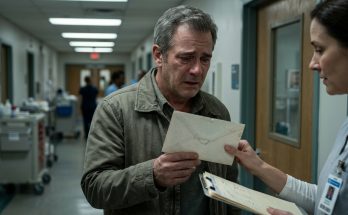
I cheated on him only once, and my husband punished me for eighteen years without touching me, as if my body disgusted him. But on the day of his retired exam, the doctor opened the medical record and said a sentence that broke me more than my sin. 💔
My name is Helena Nogueira, and for eighteen years I slept next to a man who treated me as if I were already dead.
He didn’t kiss me.
He didn’t hug me.
He didn’t even touch my fingers when I passed the salt.
And the worst thing is that I accepted that punishment as if I deserved it.
Because yes.
I made a mistake.
Only once.
On a rainy afternoon, in the Vila Mariana neighborhood, while the water hit the pastel stalls and traffic drowned on Avenida Paulista, I did what I never imagined I would do.
I cheated on my husband.
His name was Vitor.
I was a supplier to the company where I worked.
He was not more handsome than Antônio.
He was no longer kind.
He didn’t even promise me anything.
He only looked at me like it had been years since anyone had looked at me.
As a woman.
Like living flesh.
Like someone who still breathed under his apron, the bills at the market and his ironed shirts.
Antônio and I had not spoken to each other affectionately for years.
He would arrive, take off his shoes, turn on the television and ask what he had for dinner.
I served.
He ate.
Then he slept with the controller in his hand.
And when I tried to get closer, he said:
“I’m tired, Helena.
He was always tired.
Tired of me.
Tired of my voice.
Tired even of my shadow in the kitchen.
Vitor didn’t do much.
That was the danger.
A message.
A coffee.
A laugh that caught me off guard.
A hand on my back as I crossed the street.
And then a small lie.
Then another.
Until, one afternoon, in a cheap motel near Avenida do Estado, I took off my ring and left it on the nightstand.
To this day it burns me inside.
Not because of Vitor.
Because of me.
Because, while the rain was beating on the window and the sheet smelled of cheap chlorine, I knew that I had walked through a door that could no longer be closed without blood.
I came home soaking wet.
With her hair smelling of rain.
With a dry mouth.
With guilt stuck around his neck like a chain.
Antônio was sitting in the kitchen.
He didn’t scream.
He didn’t cry.
He didn’t ask where I had been.
He just looked up and looked at my hand.
My ring was on my finger again.
But crooked.
As if even gold gave me away.
“Go take a shower,” he said.
That was all.
One word.
Cold.
Clean.
Final.
That night, he didn’t touch me.
Not in the next one either.
A week passed.
Then a month.
Then a year.
I tried to ask for forgiveness so many times that the word rotted in my mouth.
– Antônio, let me explain.
“There’s nothing to explain.”
“I made a mistake.
“No. You slept with another man.
He said this without raising his voice.
That was the worst part.
He never hit me.
He never kicked me out.
He never insulted me in front of anyone.
He just let me live next to him as one leaves an old piece of furniture inside the house: because it bothers me, but it makes me lazy to throw it away.
At family gatherings, he smiled.
At Mass, he sat with me.
At Christmas, he passed the cod dish to me.
And at night, when we closed the bedroom door, I would lie on the edge of the bed, with my back to me, as if my breath soiled the air.
I cried without making a sound.
Because a guilty woman learns to cry softly.
After two years, I stopped insisting.
After five, I stopped grooming myself.
After ten, no one called me “pretty lady” at the fair anymore.
After fifteen, I started sleeping in my socks even in the heat, because the cold didn’t come from my feet.
It came from my life.
My sister Rosana told me:
“Helena, get out of this house.”
But I lowered my head.
“I can’t. I hurt him first.
My mother, before dying, shook my hand and said:
– My daughter, the forgiveness that is demanded every day is no longer forgiveness. It’s revenge.
I didn’t understand.
Or he didn’t want to understand.
Because Antônio also knew how to make me feel grateful.
I paid the electricity bill.
I bought medicine.
He took me to the doctor when my blood pressure rose.
If someone asked, he would say:
“Helena is my wife. She is still here.
To be continued here.
As if continuing was living.
Thus eighteen years passed.
Eighteen birthdays without a kiss.
Eighteen wedding dates with flowers bought at the supermarket, left on the table without a card.
Eighteen nights of my body fading next to his.
Until the day of his retired exam.
Antônio had just retired from the factory where he had worked almost his entire life.
They gave him a golden watch, a glass plate and a basic basket with cans of sardines.
He was proud.
Me too.
In spite of everything, I still knew how to rejoice for him.
We went to a SUS clinic in Vila Mariana on a Wednesday morning.
The room smelled of hand sanitizer, coffee machine and tired people.
Antonio wore a well-pressed blue shirt, carried his papers in a brown briefcase and had that serious expression of someone who seemed to be judging the whole world.
“Don’t talk too much,” he said before we entered.
Like I was a child.
As if I could embarrass him just by breathing.
The doctor was young, wore glasses and had a gentle voice.
He measured the pressure.
Sugar.
Cholesterol.
He asked if Antônio smoked.
If you drank.
If he slept well.
Antônio replied dryly.
I was sitting in a plastic chair, with my bag over my legs, staring at the computer screen without understanding anything.
Until the doctor opened the old medical record.
Not the new summary.
The old one.
One that seemed to have been pulled from another life.
The doctor’s face changed.
First, he frowned.
Then he looked at Antônio.
Then he looked at me.
Then he turned his eyes to the screen.
“Mr. Antonio,” he said slowly, “here is a note from eighteen years ago.
I felt something tighten up my throat.
Eighteen years old.
The same number.
The same wound.
Antonio straightened up in his chair.
“It doesn’t matter now.
The doctor did not obey.
He continued reading.
“It is signed by urology.
Antonio clenched his jaw.
I knew him.
That gesture was not anger.
It was fear.
– Doctor, I came to do my exam, not to talk about old things.
“Yes, but that’s relevant to your record.
“It’s not.
The doctor looked up.
– Mrs. Helena, did you know about this diagnosis?
I was cold.
— What diagnosis?
Antonio stood up suddenly.
The chair scraped on the floor.
“Let’s go.”
“Sit down,” I said.
It was the first time in eighteen years that my voice sounded stronger than my guilt.
Antonio turned to me as if he didn’t recognize me.
The doctor swallowed.
– Mrs. Helena, I need to confirm something before continuing.
My heart started beating against my ribs.
— Confirmed.
Antônio reached for the briefcase.
“Helena, don’t do that.
He didn’t call me “love.”
I didn’t say “please”.
I said my name as one speaks to someone who is about to open a grave.
So I got it.
For eighteen years, I had carried guilt.
But Antônio was carrying something else.
The doctor turned the screen a little for me.
I saw my last name.
There to date.
I saw the word “confidential.”
And I saw a line underlined in red.
I couldn’t read everything.
Because Antônio turned off the monitor with a slap.
The office was silent.
The doctor stood up.
– Mr. Antônio, this is not done.
I didn’t look at the doctor.
I looked at him.
To my husband.
For the man who punished me for almost half my life for a betrayal.
And that now trembled as if the greatest betrayal had been his.
“Turn on the screen,” I said.
— Helena…
— Flirt.
The doctor took a deep breath, turned the monitor back on, and opened the medical record again.
Antonio closed his eyes.
I felt the ground disappear from beneath my feet.
And then the doctor read aloud the first sentence of the report:
— “Male patient attends accompanied by his extramarital partner…”
The word fell in the office like a stone in a well.
Extramarital companion.
I kept looking at the doctor’s mouth, waiting for him to correct it, to say that he had read it wrong, that that medical record belonged to another Antônio, another Nogueira, another life.
But Antônio’s silence confirmed everything before any explanation came.
The man who had spent eighteen years treating me like garbage for a single betrayal had gone to the doctor at the same time, accompanied by another woman.
My hand squeezed the handle of the bag.
“Go on, doctor,” I asked.
Antonio opened his eyes.
– Helena, enough.
But for the first time I didn’t obey.
The doctor looked at me with sad embarrassment, as if he also understood that he was holding a knife, but it was too late to hide it.
“The report says that the patient sought care for suspected sexually transmitted infection. Here it is also stated that Mr. Antônio asked for absolute secrecy so that his wife would not be informed.
I felt my stomach turn.
It wasn’t jealousy.
It wasn’t anger.
It was something deeper.
It was the feeling of realizing that I had spent eighteen years kneeling before a false altar.
I stood up slowly.
Antônio stood still, white as a hospital wall.
“You knew it,” I said.
My voice came out low, but whole.
“You knew you had betrayed me too.
He did not answer.
“You saw me arrive wet that night, you saw my crooked ring and you decided to bury me alive. But you already had another woman.
Antônio ran his hand over his face.
“It’s not the same.
I laughed.
It wasn’t a pretty laugh.
It was a broken, bitter laugh of a woman who finally sees the cage and discovers that the door was never locked.
– Of course it’s not the same thing, Antônio. I messed up once and carried my guilt every day. You made mistakes too, hid, lied, punished me and still felt holy.
The doctor lowered his eyes.
– Dona Helena, I’m sorry.
I looked at that young man in the white coat, and for the first time in many years, I felt shameless pity for myself.
Sorry for Helena who slept in her socks in the heat.
Sorry for Helena who stopped dyeing her hair.
Sorry for Helena who thought that surviving next to a cold man was a way to pay off debt.
I grabbed my bag.
Antonio held my arm.
“Where are you going?”
I looked at his hand on my skin.
For eighteen years, I waited for that ring.
Now, it seemed too late to me.
“I’m leaving.”
“Helena, don’t make a fuss.”
“Scandal was my silent life by your side.
I pulled my arm.
I left the office without looking back.
In the corridor of the clinic, the noise of people seemed to come from far away. Children cried, gentlemen coughed, an old television announced an afternoon soap opera. But inside me there was a different silence.
It was not the silence of humiliation.
It was the silence before a door opened.
I took a taxi at the door of the clinic and went straight home.
Antônio arrived almost an hour later.
He entered slowly, as if the house was no longer his.
I was in the room, with an open suitcase on the bed.
For the first time in eighteen years, I didn’t cry in secret.
I folded my clothes calmly.
My simple blouses.
My forgotten dresses.
An old photograph of my mother.
The rosary she left me.
Antônio stopped at the door.
“You have nowhere to go.
“Yes, I do.”
“To Rosana’s house?”
“First over there.” Then, wherever I want.
He took a deep breath.
– Helena, we are old.
That crossed me.
Old.
As if age were a sentence.
As if I had to accept crumbs because my face already had wrinkles.
I closed the suitcase.
– Antônio, I’m not too old to be respected.
He lowered his head.
“I was angry.
“No. You were comfortable. The anger passes. What you did lasted eighteen years.
Antonio approached, but stopped before touching me.
“I suffered too.
I looked at him.
“Did you suffer because I betrayed you or because you lost the right to play the victim alone?”
He did not know how to answer.
Then I understood that I didn’t need anything else.
No confession.
No request for forgiveness.
No scene.
The medical record had already said what was missing.
That afternoon, I left the house with a suitcase, a purse, and my heart trembling inside my chest.
Rosana opened the door before I even rang the doorbell.
When he saw me, he didn’t ask anything.
He only opened his arms.
And I, who had gone almost two decades without a real hug, collapsed in my sister’s lap like a tired child.
“I’ve taken too long, Rosa,” I whispered.
Rosana kissed my hair.
“But it has arrived, Helena. That’s what matters.
For the first few days, I woke up scared, as if I had committed another sin by sleeping peacefully.
At Rosana’s house, no one told me to shut up.
No one told me not to talk too much.
No one turned their backs on the bed because I was breathing.
My sister made coffee early and placed two cups on the table.
“Sugar?”
“A little bit.
– Same before?
I smiled.
Before.
There was one before.
There was a Helena before Antônio turned me into a shadow.
Little by little, I began to remember her.
In the first week, Rosana took me to the salon.
“Just cut off the ends,” I said.
The hairdresser, Mrs. Cida, looked at me in the mirror.
– Dona Helena, sometimes we don’t just cut hair. Sometimes it cuts the past.
I left there with shorter strands, a lighter face and a strange desire to look at the sky.
In the second week, I bought a blue dress in a small store on Rua Augusta.
I stayed fifteen minutes inside the dressing room, looking at myself.
Not because I was beautiful as a girl.
But because I was alive as a woman.
In the third week, I looked for a lawyer.
Dr. Patrícia Albuquerque listened to me without interrupting.
I told him everything.
Betrayal.
The punishment.
The medical record.
The eighteen years of abandonment within marriage.
When I finished, she closed the pen and said:
– Mrs. Helena, you don’t need to prove that you suffered to have the right to start over. You have the right simply because you are a person.
Those words accompanied me for days.
One person.
Not a culprit.
Not a tolerated wife.
Not an old piece of furniture.
One person.
The divorce was not pretty.
Antônio tried to call me ungrateful.
I told the family that I was exaggerating.
That I had destroyed the marriage.
That he had only been “cold” because he was injured.
But the truth has its own way of coming out through the cracks.
Rosana told my niece.
My niece told her husband.
Her husband knew a cousin who worked in the same factory as Antônio.
And before long, the story of that extramarital companion from eighteen years ago began to appear in pieces.
Her name was Márcia.
She had been an outsourced employee of the factory.
Antônio not only accompanied her to the doctor.
Antônio maintained that relationship for almost three years.
While I was cooking.
While I washed his shirts.
While I cried softly asking for forgiveness.
When I heard about this, I thought I was going to die of pain.
But I didn’t die.
That was the most powerful discovery.
We think that certain truths will kill.
In reality, they kill only the part of us that still accepted lies.
Months later, the divorce came out.
I kept half of the apartment, part of the retirement accumulated during the marriage and, most important of all, I stayed with myself.
Antônio grew old suddenly.
I learned from acquaintances that he began to go to the market alone, that he burned rice, that he forgot clothes in the machine, that he sat on the same bench in the square every afternoon.
One day, he called me.
I stared at the name on the screen for a long time before answering.
— Helena?
“Yes.
On the other side, his voice sounded smaller.
“I wanted to ask you for forgiveness.
I closed my eyes.
For eighteen years, I dreamed of that phrase.
I imagined that if one day Antônio asked for forgiveness, I would run back.
But that is not what happened.
The word came late.
And yet I received it without hatred.
“I hear your request, Antonio.
He cried.
I had never heard Antônio cry.
“I destroyed your life.
I looked out the window of Rosana’s house. There was a tree on the sidewalk, full of new leaves after the rain.
“It didn’t destroy everything,” I said. “There was enough left for me to rebuild.
“Can you forgive me?”
I took a deep breath.
My mother came back to my memory, shaking my hand on her deathbed.
“The forgiveness that is demanded every day is no longer forgiveness. It’s revenge.”
At that moment, I understood the other half of the sentence that she never said:
True forgiveness also does not force anyone to return.
“One day, maybe I’ll be able to forgive completely,” I replied. “But that doesn’t mean I’ll come back.”
Antônio was silent.
“I don’t want to sleep next to someone who buried me awake anymore.
After that, I hung up.
Not out of cruelty.
For peace.
Time passed.
With the money from the division, I rented a small house in Campinas, near my niece Marina’s house.
The house had a narrow porch, basil pots, and a kitchen lit in the morning.
On the first Sunday living alone, I made coffee, sat at the table and waited for the sadness to arrive.
She came.
But it came tamely.
He sat next to me like an old visitor.
And for the first time, I didn’t try to kick her out.
I also didn’t let her boss me around.
After breakfast, I put on music.
An old song by Roberto Carlos that my mother liked.
And I danced alone in the kitchen.
At first, embarrassed.
Then, laughing.
Laughing at me.
Laughing at life.
Laughing because my feet still knew how to dance.
I started working some afternoons in a neighborhood flower shop.
The owner was called Lúcia.
She was a widow, cheerful, talkative and had the hands of someone who knew how to take care of both roses and wounds.
“Flowers don’t bloom because someone tells them to,” she said. “It blooms when it finds light.
I learned the names of the plants.
Orchid.
Azalea.
Peace lily.
Jasmine.
I also learned that some flowers look dead for months, but they are not dead.
They are gathering strength from within.
I was one of those.
At the flower shop, I met Mr. Augusto.
He was sixty-seven, a retired teacher, and bought sunflowers every Friday to take to his wife’s grave.
At first, he just greeted.
Then he started talking.
He talked about books.
Of recipes.
From the time when he taught in a public school.
One day, when he saw me carrying a heavy vase, he ran to help.
– Be careful, Mrs. Helena. You can get hurt.
I almost replied that I was used to it.
But I stopped.
He no longer wanted to make pain a habit.
– Thank you, Mr. Augusto.
He smiled.
“Helena. Can I just call Helena?
My face warmed up as if I were twenty.
“Yes.
There was no hurry.
That was the beautiful thing.
Mr. Augusto did not try to save me.
He didn’t try to touch me before I wanted to.
He didn’t look at me like a broken thing.
She looked like someone who sees a whole woman, even with scars.
After a few months, he invited me to have coffee in the square.
I accepted.
I went with a yellow dress that I bought without asking anyone’s opinion.
In the square, Mr. Augusto arrived with two cups of coffee and a cheese bread wrapped in a napkin.
“I didn’t know if you liked it.
“I like it.
“Thankfully.” Because I brought two.
We laughed.
It was simple.
So simple that it made me want to cry.
Because I spent years thinking that love was debt, punishment, penance.
And here was a man offering me cheese bread without charging my soul in return.
A year after the divorce, I returned to São Paulo to settle the last papers of the old apartment.
I met Antônio at the entrance.
He was thinner.
Her hair, almost all white.
For an instant, I saw not the judge who had sentenced me for eighteen years, but only a man who had also wasted his own life trying to punish someone else.
“Are you okay?” He asked.
I thought before answering.
Not by any doubt.
But because the answer was too big to fit into a small sentence.
“I’m staying.
He nodded.
“You’re different.
I smiled.
“No. I’m coming back.
Antonio lowered his eyes.
“I’m sorry, Helena.
This time, the sentence didn’t break me.
It didn’t arrest me.
It didn’t pull me back.
It just passed me by like wind.
– I feel it too, Antônio. By the two of us.
I signed the documents, handed over the keys and left without looking at the window of the apartment where I had cried so many nights.
On the sidewalk, the sun was beating down hard.
My cell phone vibrated.
It was Augusto’s message.
“I made cornmeal cake. I went over the point at the coffee, but I think I can save it. Are you coming?”
I laughed to myself.
I replied:
“I’m going. But I make coffee.”
That night, sitting on the porch of my house in Campinas, with a hot cup in my hands, I realized that the happy ending was not to find another man.
It was also not seeing Antônio repenting.
The happy ending was to wake up without fear.
It was choosing clothes in the morning without hearing criticism.
It was eating slowly.
It was sleeping in the middle of the bed.
It was laughing out loud.
It was looking at my body in the mirror and not apologizing for it existing.
Augusto held my hand on that balcony, light, unhurried.
It could seem little to anyone.
For me, it was immense.
Because after eighteen years of being treated as untouchable out of disgust, I finally felt a touch without charge.
No punishment.
No past holding my neck.
I looked up at the sky and thought of my mother.
“Your forgiveness has come, Mom,” I whispered.
Not forgiveness for Antônio.
This one might come in one piece one day, maybe not.
But the most important forgiveness was already there.
Helena’s forgiveness for Helena.
And when Augusto asked why I was smiling, I just shook his hand and replied:
“Because I spent eighteen years thinking my life was over… and only now did I find out that she was waiting for me.