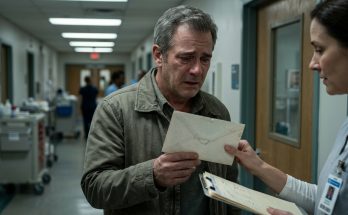
Sophie drove us to her final scheduled pediatric oncology appointment.
I sat in the passenger seat.
Eight years earlier, I had held her hand while doctors tried to understand why a ten-year-old child had beta-hCG in her blood.
Now she checked her mirror, changed lanes, and complained about a slow driver in front of us.
The ordinary irritation steadied me.
This was not her final medical appointment.
It was her transition out of pediatric oncology.
That distinction mattered.
She would still see adult endocrinology.
She would maintain appropriate survivorship follow-up.
Her thyroid medication would continue.
Primary care was established.
But this was the last scheduled visit with the doctor who had treated her as a child.
Eric asked whether he should come.
Sophie said no.
“I’ll call you after.”
He accepted.
Daniel sent a message.
Good luck. Proud of you.
He did not appear unexpectedly with coffee.
Everyone had learned something about invitation.
The clinic looked smaller than I remembered.
Maybe the building had been renovated.
Maybe Sophie was taller.
Maybe fear had once enlarged every corridor.
We checked in.
Sophie gave her own insurance information.
Answered her own questions.
Signed where she needed to sign.
I followed.
For years, I had led her through this place.
Now I was the guest.
Dr. Reyes entered carrying the survivorship summary.
She sat across from Sophie.
“MRI remains stable.”
Sophie nodded.
“No evidence of active tumor.”
Another nod.
“Markers normal.”
Sophie smiled.
“Adult endocrinology?”
“Scheduled.”
“Thyroid medication?”
“Every morning.”
“Primary care?”
“Near campus.”
Dr. Reyes looked at me.
“She doesn’t need you.”
“I’m aware.”
Sophie laughed.
“I need her for some things.”
“I’ll take it.”
The medical history that once overwhelmed all of us now belonged mostly to Sophie.
She knew the name and location of the tumor.
She understood the hydrocephalus that had required urgent intervention.
She knew she had received chemotherapy and radiation.
She knew endocrine follow-up mattered.
She knew beta-hCG had been the marker that first revealed something was wrong.
Most importantly, she understood what the test had never been able to tell us.
Why the hormone was there.
A positive hCG result identified hCG.
It did not automatically identify pregnancy.
It did not identify abuse.
It did not identify a perpetrator.
Those conclusions required context and evidence.
Dr. Reyes asked what Sophie planned to study.
She had been accepted to a university two states away.
“Maybe public health.”
“That makes sense.”
“Or biology.”
“Also makes sense.”
“Or art history.”
Dr. Reyes smiled.
“Excellent. Do something that lets you sleep occasionally.”
“No promises.”
I loved that she had not chosen a major because of the tumor.
She might work in medicine someday.
She might never work anywhere near it.
Survival did not create a vocational obligation.
The appointment became emotional despite Sophie’s resistance.
One of the nurses who had cared for her during chemotherapy stopped by.
Sophie recognized her.
The nurse recognized Sophie only after looking twice.
“You have so much hair.”
Sophie touched it.
“Apparently.”
Dr. Shah had left a short note through the chart.
Child life gave Sophie a small card containing a photograph of artwork from the treatment-era wall.
Nobody suggested ringing a bell.
Sophie still hated bells.
Dr. Reyes asked before hugging her.
Sophie said yes.
Then Dr. Reyes hugged me.
“Thank you,” I whispered.
“For doing my job?”
“Yes.”
That was precisely what I meant.
People doing their jobs carefully had saved us from two disasters.
The first was physical.
Pressure building inside Sophie’s skull.
A tumor obstructing cerebrospinal fluid.
A medical emergency requiring surgery.
Cancer requiring treatment.
The second disaster could have happened inside our family.
One positive test.
One terrified father.
One accused stepfather.
One child standing in the middle.
Dr. Ortiz had not looked at a positive pregnancy test and declared that Daniel must have harmed Sophie.
She had continued examining the evidence.
Ultrasound.
Symptoms.
Imaging.
Hormones.
She had asked why.
Maya had not dismissed Eric as irrational and walked away.
She had followed safeguarding procedure.
Protected Sophie.
Documented.
Allowed trained people to interview her.
Then narrowed the concern as facts emerged.
Rina had not forced Sophie to repeat herself until adults received an answer they expected.
Dr. Reyes had not promised a cure when treatment began.
She had given us what medicine could honestly give.
Current evidence.
Current choices.
Current uncertainty.
Again and again.
Outside the hospital, Sophie and I sat in the car without starting it.
She looked back at the building.
“Do you remember everything about the first day?”
“Too much.”
“I don’t.”
“Maybe that’s good.”
She smiled.
“I remember Dad yelling ‘arrest him.’”
I looked at her.
“Does it still bother you?”
“Sometimes.”
“Want to talk about it?”
“Not today.”
“Okay.”
Choice.
Then Sophie said something I never expected.
“I’m glad the pregnancy test was positive.”
I turned fully toward her.
“What?”
“Not glad about the situation.”
“Good clarification.”
“But if it hadn’t detected the hormone, would they have found the tumor that day?”
I considered the question.
Maybe the headaches and neurologic symptoms would still have led to imaging soon.
Maybe another clinician would have connected the signs.
Maybe diagnosis would have taken longer.
We could not know.
“It helped show the doctors that something unusual was happening.”
“So the worst test of my life was useful.”
“Yes.”
“That’s annoying.”
“Extremely.”
She started the car.
That evening, Eric joined us for dinner.
Daniel grilled outside.
Sophie explained her adult follow-up plan.
Eric asked one unnecessary question about whether she had written down the endocrinologist’s number.
Sophie looked at him.
“I know what I’m doing.”
Eric opened his mouth.
Then closed it.
“Okay.”
Eight years of growth in one word.
Daniel asked, “Do you need help moving?”
“Yes.”
His face brightened.
“Finally. A medical problem I can solve with a truck.”
“That’s not medical.”
“Even better.”
We laughed.
Nobody mentioned the first hospital day until Sophie did.
She looked at Eric.
“You know that day could’ve wrecked everything.”
Eric’s expression changed.
“Yes.”
“Why didn’t it?”
He looked toward Daniel.
Daniel looked toward me.
I answered first.
“Because the doctors kept checking what was actually true.”
Daniel added, “And you told the truth.”
Sophie shook her head slightly.
“I was ten.”
“I know. I’m not saying it was your responsibility. I’m saying what you said mattered.”
She looked at Eric.
He took his time.
“Because I eventually learned that being terrified doesn’t give me permission to decide the answer before the facts do.”
Sophie nodded.
No speech followed.
Good enough.
The first line of her story had always invited the wrong conclusion.
Ten-year-old girl.
Positive pregnancy test.
Stepfather.
Biological father demanding an arrest.
Anyone hearing only those details could build the scandal in seconds.
The truth required patience.
There had been no pregnancy.
No hidden assault.
No forgotten event Sophie needed adults to uncover.
There had been a hormone-producing central nervous system germ cell tumor.
There had been obstructed fluid inside her brain.
There had been surgery.
Chemotherapy.
Radiation.
Endocrine consequences.
Neurocognitive effects.
Years of surveillance.
The medical truth was stranger than the accusation.
And longer.
But even that was not the whole story.
There was Eric learning that protection without evidence could become harm.
Daniel learning that being falsely accused did not require him to disappear from Sophie’s life.
Me learning that vigilance and control were not the same thing.
Professionals learning nothing—they had already known what we needed years to understand.
Check.
Ask.
Document.
Interpret.
Revise when facts change.
And Sophie learning that information about her body belonged to her.
College move-in arrived before I was ready.
Sophie packed her survivorship summary inside a document folder.
Not on top.
Between vaccination records and insurance information.
Exactly where it belonged.
Important.
Accessible.
Not the first thing anyone saw.
Daniel carried boxes up the stairs.
Eric tried to assemble a lamp and somehow installed part of it backward.
I began making Sophie’s bed.
She stopped me halfway through.
“Mom.”
“I’m helping.”
“You’re hovering.”
“I am putting on a fitted sheet.”
“You’ve adjusted it four times.”
“It has corners.”
“Leave the bed.”
I stepped away.
Her desk filled quickly.
Art supplies.
Photographs.
A laptop.
Pens.
A small plant I expected to die within a month.
Medication went beside her toothbrush.
Her health information went into a secure digital folder.
Then ordinary life covered every remaining surface.
Daniel found a place for the last box.
Eric finally fixed the lamp.
I stood in the middle of the room searching for another task.
Sophie saw me.
“I love you.”
My throat tightened.
“Love you too.”
“Now leave.”
Eric laughed.
“You heard her.”
“You too.”
She pushed all three of us toward the door.
In the parking lot, we stopped beside our cars.
Eric looked at Daniel.
“Long way from that hospital hallway.”
Daniel nodded.
“Yeah.”
No hug.
No final declaration of forgiveness.
Nothing needed staging.
We drove home separately.
Sophie stayed.
That was the ending I wanted.
Not a perfect family.
Not a promise that her health would never require attention again.
Not a scan powerful enough to erase history.
Not Daniel pretending the accusation had never hurt.
Not Eric being punished forever for the worst decision he made in fear.
And certainly not Sophie remaining the ten-year-old girl adults once discussed as if her body were evidence belonging to everyone else.
A young woman remained.
Accurate records.
Appropriate follow-up.
Medication she understood.
People she could call.
A future larger than the crisis.
Before leaving pediatric oncology, Sophie had asked Dr. Reyes one final technical question.
“If I get a positive pregnancy test someday, how do I know whether it’s actually pregnancy or something related to the old tumor?”
Dr. Reyes had not laughed.
“If pregnancy is possible, that gets evaluated. Your prior hCG-producing tumor also belongs in the clinical context. Your doctors would interpret the result alongside your history and whatever else is happening.”
Sophie nodded.
“So basically, still don’t decide the whole story from one test.”
“Exactly.”
That sentence carried eight years inside it.
The first test had been accurate about a molecule.
Adults nearly made it disastrous by treating the molecule as an explanation.
The test had said hCG.
Fear had said pregnancy.
Fear had said abuse.
Fear had said Daniel.
Evidence eventually said tumor.
Eight years later, Sophie knew enough to ask the next question herself.
A few weeks after college began, she called me.
“I’m sick.”
Every old alarm woke at once.
“What kind of sick?”
“Cold. Maybe mild fever.”
“Any headache?”
“Mom.”
“Right.”
The chemotherapy emergency rules had expired years earlier.
She was no longer neutropenic.
There was no reason to treat every fever as an oncology emergency.
Sophie contacted her current doctor, followed ordinary guidance, rested, drank fluids, and recovered.
No emergency department.
No cancer center.
No frantic portal refresh.
For years, I had wanted ordinary life so badly that I failed to understand what ordinary actually meant.
Ordinary did not mean nothing frightening ever happened.
It meant frightening things could be evaluated for what they were instead of automatically becoming the old catastrophe.
A cold could be a cold.
A bad grade could be a bad grade.
A driving mistake could be a driving mistake.
A relationship could begin and end without becoming a lesson about cancer.
And a laboratory test could be allowed to say exactly what it measured without being forced to tell a story it had never been capable of telling.
The tumor remained part of Sophie’s history.
So did the accusation.
Neither became the title of her life.
That belonged to Sophie.
The End
Read more original stories on Feel Every Story.
A Positive Test Turned One Hospital Hallway Against Daniel Until the Ultrasound Revealed a Different and More Dangerous Question
Part 16 of 16