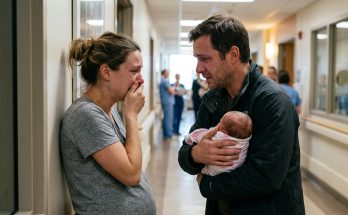
“What happened?”
The question came out before I was fully awake.
Ethan was breathing too quickly.
“He called me from the emergency room. Severe abdominal pain. They think it’s his appendix.”
I turned on the bedside lamp.
“Where?”
“Northbridge University Hospital.”
“Is he alone?”
“His roommate is there.”
“Have you spoken to the doctor?”
“No. They’re running imaging.”
I was already dressing.
Daniel woke beside me.
One look at my face and he got out of bed.
“Eli?”
I nodded.
By the time we reached the car, Ethan had called again.
Appendicitis.
Surgery likely.
Routine, the doctor had said.
Routine is a word medical professionals use correctly and parents hear incorrectly.
Nothing involving your child under anesthesia feels routine.
Nathan learned twenty minutes later.
Ethan told him.
That mattered.
I did not.
Nathan called Eli directly but did not keep calling when Eli failed to answer.
Then he sent one message.
I heard what’s happening. I’m available. Tell me what you need.
He drove toward Northbridge anyway.
That might have violated the old rules.
By then, the rules had changed.
Not disappeared.
Changed.
Eli was twenty.
Nathan could travel wherever he wanted.
What he could not do was assume that arriving entitled him to the room.
I reached the hospital shortly before dawn.
Ethan had driven in from his university and arrived ten minutes before me.
We found Eli pale, irritated, and attached to an IV.
“You all look terrible,” he said.
I kissed his forehead.
“You’re having surgery.”
“I’ve been informed.”
Ethan stood beside the bed.
“I told you not to eat that gas-station sushi.”
“This is not caused by sushi.”
“That is exactly what sushi wants you to believe.”
The surgeon came in.
The appendix had not ruptured.
The procedure should be straightforward.
Relief arrived in cautious increments.
Then Nathan appeared in the hallway.
He stopped several feet from the door.
He looked older than I remembered from the week before.
Fear does that quickly.
A nurse approached him.
“Are you family?”
Nathan glanced through the doorway toward Eli.
He did not answer immediately.
That pause told me how much he had learned.
The nurse followed his gaze.
“Dad?”
Nathan looked at Eli.
Eli met his eyes.
For several seconds, nobody moved.
Then Eli nodded.
“Yes,” he said. “He’s my dad.”
Nathan closed his eyes briefly.
It was one word.
Not forgiveness.
Not restoration.
Not proof that the thirteen missing years had vanished.
Still, I saw what it did to him.
The nurse checked the chart.
“All right. We’re limiting visitors before surgery.”
Nathan remained outside.
He did not use the word father as a key.
“Do you want me in there?” he asked Eli.
Eli thought about it.
“Not right now.”
Nathan nodded.
“Okay.”
He sat in the hallway.
That was where he stayed.
Daniel brought coffee.
Ethan paced.
I signed nothing because Eli was an adult now.
That fact felt strange.
When they took him toward surgery, I walked beside the bed until the staff stopped us.
Ethan squeezed Eli’s foot.
Nathan stood farther back.
“See you after,” he said.
Eli nodded.
The procedure lasted less than an hour.
It felt longer.
Nathan sat across from me in the waiting room.
He did not speak about regret.
Did not say he should have been there for childhood illnesses.
Did not transform a medical emergency into a lesson about himself.
He simply waited.
When the surgeon appeared, we all stood.
Everything had gone well.
No rupture.
No complications.
Eli would remain overnight.
My knees weakened slightly.
Daniel put a hand against my back.
Nathan exhaled so sharply I heard it across the room.
Then came another boundary.
Only one visitor could initially enter recovery.
The nurse looked at us.
I did not answer.
Eli had already made the decision.
“Mom.”
Nathan looked at me.
“Go.”
There was no disappointment in his voice that he expected anyone else to manage.
I followed the nurse.
Eli was groggy and annoyed by the blood-pressure cuff.
“You look terrible,” I told him.
“So I’ve heard.”
I sat beside him.
His hand was warm.
For twenty years, that hand had been part of my life.
Tiny fingers around mine.
Crayons.
Pencils.
Science kits.
Steering wheels.
Laptop keyboards.
Now an IV line ran across the back of it.
“You scared me.”
“Sorry.”
“Don’t apologize for appendicitis.”
“I’ll schedule better next time.”
“That would be considerate.”
He drifted in and out of sleep.
Eventually, Ethan was allowed in.
Then Nathan.
Nathan entered quietly.
He stopped beside the bed.
“How are you?”
Eli opened one eye.
“Apparently lighter by one appendix.”
Nathan smiled.
“I’m glad you’re okay.”
“Me too.”
A silence followed.
Nathan did not touch him until Eli lifted his hand.
Then Nathan took it.
Only for a moment.
Watching them, I thought about all the illnesses Nathan had missed.
Ear infections.
Flu.
A broken wrist.
Ethan’s stitches after falling from a bicycle.
Nathan could not retroactively sit beside those beds.
He had this one.
Only because Eli gave it to him.
The distinction mattered.
Nathan stayed twenty minutes.
Then he asked, “Do you want me to leave?”
Eli nodded.
“I’m tired.”
“Okay.”
Again that word.
Nathan left.
He did not ask whether I planned to stay overnight.
He assumed I would decide for myself.
The next morning, Eli was discharged.
Nathan offered to drive him back to campus.
Eli preferred to ride with me.
Nathan accepted it.
He carried Eli’s bag to my car.
Then he left.
A week later, Eli updated his medical emergency contacts.
He told me because he needed my current address for one form.
I was first.
Ethan second.
Nathan third.
Nathan learned because Eli told him directly.
“Just so you know, I added you as an emergency contact.”
Nathan was quiet.
“Third,” Eli clarified.
“I assumed your mother was first.”
“She is.”
“And Ethan?”
“Second.”
Nathan nodded.
“Thank you.”
That was all.
No joke about moving up the list.
No complaint that Celeste was absent.
No attempt to turn third place into a wound.
He understood what third meant.
Not rank.
Trust with limits.
Later, Eli told me why he had done it.
“If something happened and you and Ethan couldn’t be reached, he’d come.”
It was not phrased as a question.
“You believe that?”
“Yes.”
That certainty would have been impossible four years earlier.
Nathan had not earned it with one letter.
Or one awards night.
Or one hospital visit.
He had earned it through hundreds of small occasions in which nothing dramatic happened.
Calls returned.
Boundaries respected.
Promises kept.
No turned-up-uninvited surprises.
No guilt when a message went unanswered.
No public performance.
Consistency.
Ms. Alvarez had been right.
Preston came to see Eli the following weekend.
He brought a bag of junk food Eli was technically not supposed to eat yet.
Ethan confiscated half.
The three of them sprawled around my living room as if college had never separated them.
At one point, Preston asked, “Did they let Dad into recovery?”
Eli nodded.
“Eventually.”
Preston looked toward him.
“He told me you called him Dad.”
Eli’s expression changed.
“He told you?”
“Only because I asked why he looked like he’d been hit by a truck.”
Ethan grinned.
“You called him Dad?”
“Apparently.”
“Voluntarily?”
“I was medicated.”
“You were pre-op.”
“Stress impairs judgment.”
They laughed.
But later, after Preston left, Eli stood in the kitchen with me.
“It felt weird.”
“Saying Dad?”
“Yes.”
“You don’t have to do it again.”
“I know.”
He looked toward the dark window.
“I might.”
That was his choice.
Not mine.
Not Nathan’s.
The medical scare changed something else.
It reminded all three brothers how much of their lives had begun separately.
Preston remembered childhood emergencies with Nathan beside him.
Eli and Ethan remembered mine.
Nobody could merge those histories.
Nathan’s worst choice had taken more than his own relationship with the twins.
It had taken thirteen years in which three brothers could have known each other.
They could not recreate toddlerhood.
They could not manufacture shared elementary-school memories.
They could not become children together.
What they could build was adulthood.
That summer, all three took a short trip together.
No parents.
They rented a cabin near a lake.
Ethan sent me one message confirming they had arrived.
Nathan received the same message.
Neither of us was invited to interfere.
Two days later, I received a photograph.
Three young men on a dock.
Preston sunburned.
Ethan holding a fishing rod incorrectly.
Eli laughing.
Nathan texted me separately.
I did not know whether to answer.
Then another message appeared.
I keep thinking about how much time I cost them.
I stared at it.
Years earlier, I might have responded with anger.
Or comfort.
Instead I wrote:
They know that too.
Nathan answered:
I know.
Nothing else.
That was enough.
Because the consequence no longer required constant explanation.
It was visible.
Three brothers had found each other late.
They loved each other now.
That love did not erase the childhood Nathan’s absence had divided.
It simply refused to let his old decision keep stealing years.
When the boys returned, Ethan complained that Preston snored.
Preston accused Eli of creating a spreadsheet for grocery expenses.
Eli defended the spreadsheet.
I listened to them argue in my kitchen.
Nathan was not there.
Neither was Daniel.
For a few minutes, it was simply the three of them.
Then Eli’s phone rang.
Nathan.
Eli looked at the screen.
He answered.
“Hey, Dad.”
Ethan’s eyes moved toward him.
Preston smiled but said nothing.
I turned back toward the sink.
Some moments become important only if nobody grabs them too tightly.
Nathan had spent years trying to reclaim a title he believed biology should have preserved.
Now, when the word finally came naturally, he did the wisest thing he could.
He answered the call without making Eli explain why he had used it.
Click here to continue reading: PART 13: Evelyn’s Final Days Forced the Twins to Decide Whether Family Duty Could Exist Without Pretending Their Missing Years Had Never Happened
Thirteen Years After Nathan Walked Away, One Championship Scoreboard Forced Him to Look Closely at the Boys Beside Me
Part 12 of 16