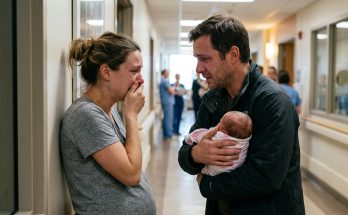
Nathan turned sixty on a clear Saturday in October.
Celeste asked what kind of party he wanted.
Years earlier, he would have chosen a private room somewhere expensive.
Good wine.
A photographer.
A guest list containing at least a few people he wanted to impress.
Instead he asked for dinner in the backyard.
Family only.
No photographer.
No speeches.
Celeste ignored the last instruction enough to buy a cake.
Otherwise, she listened.
I was invited.
So was Daniel.
There had been a time when the idea of attending Nathan’s birthday would have seemed not merely unpleasant but absurd.
Now I accepted without much thought.
Not because we had become close.
We had become something more useful.
People with a shared history who no longer needed to fight over ownership of it.
Daniel and I arrived late in the afternoon.
Sophie came running across the yard before we reached the patio.
“Grandma!”
I bent down.
She collided with me at full speed.
Behind her, Eli called, “We’re working on braking.”
“You’re failing.”
“Engineering has limits.”
Maya followed carrying a bowl of salad.
Ethan was at the grill arguing with Nathan.
“You’re burning it.”
“I’ve been grilling longer than you’ve been alive.”
“That proves duration, not competence.”
Preston stood nearby with his partner.
Fair the dog sat under the table waiting for someone’s standards to collapse.
Celeste came out of the house.
“Mara.”
She hugged me lightly.
That too had become possible.
Not sisterhood.
Not friendship built on forgetting.
Civility with enough years behind it to feel natural.
Nathan emerged from the patio doors carrying plates.
Sixty looked good on him.
Gray at the temples.
Less polished than the man who had entered the Grand Whitmore Convention Center years earlier expecting the world to arrange itself around his assumptions.
“Thanks for coming,” he said.
“Happy birthday.”
Daniel shook his hand.
Ethan shouted from the grill.
“Dad, your chicken is becoming a public-health issue.”
Daniel looked interested.
“Finally, something in my field.”
Nathan closed his eyes.
“I regret inviting all of you.”
“No, you don’t,” Preston said.
Nathan looked around the yard.
“No. I don’t.”
Inside the house, photographs covered the hallway.
Not curated perfection.
Life.
Preston at graduation.
Ethan receiving his master’s degree.
Eli and Maya on their wedding day.
Sophie covered in birthday cake.
Celeste with Preston.
Nathan holding a fish so small Ethan had apparently framed the photograph specifically to embarrass him.
There were also photographs of Eli and Ethan alone.
Some with Nathan.
Some without.
The championship picture remained in his study.
Not prominently.
Not hidden.
I saw it when I went inside to wash my hands.
Three sixteen-year-old boys.
Three medals.
Nathan in the background.
The day everything changed because a scoreboard displayed two names he should never have needed a scoreboard to recognize.
I stood there for several seconds.
Nathan appeared in the doorway.
“You found the museum of poor decisions.”
I looked at him.
“You kept it.”
“I almost threw it away about twenty times.”
“Why didn’t you?”
He came beside me.
“Because for a long time I wanted to remember the day I got them back.”
I glanced at him.
“And now?”
“Now I know that isn’t what happened.”
No defensiveness.
“What happened?”
“I found out who they had become without me.”
That answer was better.
He looked at the photograph.
“And they decided, very slowly, whether I could know them afterward.”
We returned outside.
Dinner was noisy.
Sophie refused vegetables.
Ethan told her this was evidence-based behavior.
Daniel objected on professional grounds.
Preston’s partner accused everyone in the family of turning ordinary meals into panel discussions.
Maya agreed.
Fair received a piece of chicken under suspicious circumstances.
Nathan pretended not to notice.
At some point, Celeste brought out the cake.
Sixty candles had been rejected as a fire hazard.
There were six.
“Each represents a decade,” Preston explained.
“That is mathematically lazy,” Eli said.
“You’re welcome to light fifty-four more.”
“I withdraw the objection.”
We sang.
Nathan looked embarrassed.
He blew out the candles.
Then Ethan stood with his glass.
Nathan pointed at him.
“I said no speeches.”
“This is a toast.”
“That sounds legally adjacent.”
“You raised three argumentative sons.”
Nathan looked at me.
“I raised one of them to be argumentative.”
Ethan nodded approvingly.
“Growth.”
He lifted his glass.
“To sixty years of making things harder than necessary.”
Everyone laughed.
Nathan raised his own glass.
“Accurate.”
Preston added, “And occasionally learning.”
“Occasionally?”
“We’re protecting against overstatement.”
Glasses touched.
No sentimental speech followed.
That was appropriate.
Later, as evening settled over the yard, people separated into smaller conversations.
Maya took Sophie inside for pajamas.
Daniel and Celeste argued pleasantly about a documentary.
Ethan and Preston were trying to convince Eli that his new car was boring.
Nathan sat beside me near the patio.
For a while, we watched our sons.
“They’re good men,” he said.
“Yes.”
“You did that.”
I shook my head.
“They did a lot of it themselves.”
He smiled.
“There’s Ms. Alvarez again.”
“She was usually right.”
Nathan leaned back.
“Do you ever think about that day?”
“The championship?”
“Yes.”
“Sometimes.”
“I think about it more than I should.”
“That sounds like your problem.”
He laughed softly.
Then became serious.
“I still remember looking at them and not knowing.”
I did too.
The expensive suit.
The irritated expression.
His contempt when he thought I did not belong.
The casual way his eyes moved past two boys carrying his face.
“You didn’t recognize them,” I said.
“No.”
“You should remember that.”
“I do.”
He looked toward Eli.
“But I also remember the second I knew.”
The scoreboard.
Ellis.
Two boys.
Sixteen.
Genetics finally defeating denial.
“I thought that was the worst moment of my life.”
“Was it?”
“No.”
I waited.
“The worst part came later.”
“When?”
“When I realized recognition didn’t give me anything.”
I turned toward him.
“I thought knowing they were my sons meant I had some right to act like their father. Then every boundary reminded me that biology had survived, but the relationship hadn’t.”
He watched Ethan laugh at something Preston said.
“I had to build something I once had for free.”
“You didn’t have it for free.”
He looked at me.
“You had it because you were there.”
Nathan nodded.
“Right.”
That correction still mattered after all these years.
Presence had never been free.
It required midnight fevers.
Groceries.
School pickups.
Patience.
Money.
Repetition.
Boredom.
Showing up when nobody applauded.
Nathan had once mistaken biological fact for permanent ownership.
The twins had taught him otherwise.
A little later, all three sons came over.
Preston sat on the patio step.
Ethan took the empty chair.
Eli remained standing.
Nathan looked at them.
“This feels ominous.”
“It should,” Ethan said.
“It’s his birthday,” Eli reminded him.
“I’m being gentle.”
Nathan smiled.
Then he looked around.
Celeste through the kitchen window.
Sophie’s toys scattered near the door.
His three sons.
Me.
Daniel.
The life that existed despite everything.
“Is this my legacy?” he asked.
Preston tilted his head.
“What?”
Nathan gestured vaguely.
“This.”
Ethan groaned.
“You’re becoming philosophical because you’re sixty.”
“It happens.”
Preston considered the question.
“Part of it.”
Nathan nodded.
“Part?”
“You don’t get one legacy.”
Nathan looked at him.
Preston continued.
“You left them.”
He indicated the twins.
“That’s part of it.”
Nathan’s face tightened, but he did not look away.
“You raised me.”
Preston touched his own chest.
“That’s part.”
Ethan added, “You came back.”
“Part,” Preston agreed.
Eli finally sat on the arm of Nathan’s chair.
“And you stayed after coming back.”
Nathan looked at him.
“Also part.”
No one offered him a cleaner answer.
He no longer needed one.
Thirteen years could not be repaid.
There was no mathematical operation that turned absence into presence retroactively.
Nathan had missed childhoods.
Birthdays.
Illnesses.
Science fairs.
Ordinary Tuesdays.
He had deprived three brothers of years together.
He had left me carrying decisions no one should have had to carry alone.
Those facts remained.
So did everything afterward.
The letter where he finally wrote I chose absence.
The first meeting.
The boundaries.
The back row at Ethan’s award ceremony.
Staying away from Eli’s presentation.
The diner apology.
Driving lessons.
College.
The hospital hallway.
Evelyn’s funeral.
Sophie.
A thousand small moments too ordinary to list.
That was the part Nathan once failed to understand.
A relationship was not rebuilt by one enormous act.
It was accumulated.
Like damage.
Like trust.
One choice after another.
Darkness settled over the yard.
Maya brought Sophie outside in pajamas because she refused to sleep while everyone else remained awake.
Sophie climbed directly onto Nathan’s lap.
“Grandpa.”
“Yes?”
“Cake.”
“You already had cake.”
“More.”
Nathan looked at Eli.
Eli shook his head.
Nathan returned his attention to Sophie.
“Your father has issued a policy decision.”
Ethan leaned over.
“You should teach her civil disobedience.”
“Do not,” Eli said.
Nathan whispered loudly to Sophie, “We respect parental authority.”
Everyone laughed.
I watched him hold his granddaughter.
For a moment, the image overlapped with an old photograph in my mind.
Nathan at twenty-nine.
Two toddlers.
A couch.
A bottle.
A man who loved his children before becoming a man capable of abandoning them.
For years, I had believed those versions of him contradicted each other.
They did not.
People can love and still fail.
They can regret and still owe consequences.
They can change without becoming innocent.
They can be forgiven by one person and not another.
They can become better without earning the right to rewrite who they were.
Nathan looked up and caught me watching.
He smiled.
Not the polished smile from the championship.
Just Nathan.
Older.
Quieter.
No longer asking me to confirm that he had changed.
I smiled back.
That was enough.
Later, when Daniel and I prepared to leave, Ethan hugged me.
Preston carried leftovers to our car.
Eli followed with Sophie asleep against his shoulder.
Nathan stood near the gate.
For a second, the scene reminded me of the parking garage after the championship.
That day, the twins had walked away from him.
He had stood behind them unable to stop them.
He had finally recognized his sons only to discover recognition was not relationship.
Tonight, nobody was walking away in anger.
They were simply going home.
Ethan called, “See you next week, Dad.”
Nathan raised a hand.
“Drive carefully.”
Preston said, “I’ll call tomorrow.”
Eli shifted Sophie higher against his shoulder.
“Sunday dinner still good?”
Nathan answered without making the question larger than it was.
“Sunday’s good.”
We drove away.
Through the window, I saw him return to the yard beside Celeste.
No victory pose.
No triumphant ending.
Just a sixty-year-old man cleaning up after his birthday while the people in his life went back to theirs.
That was the ending Nathan had finally earned.
Not the erasure of what he had done.
Not revenge.
Not a miraculous restoration of thirteen missing years.
Something quieter.
The past remained true.
So did the present.
Eli and Ethan would always be the sons Nathan abandoned.
They were also the sons who later chose, carefully and on their own terms, to let him become their father again.
Preston would always be the son Nathan stayed for.
He was also the son who learned that staying meant more than celebrating achievement.
The three brothers would always have a childhood they should have shared and did not.
They also had an adulthood they refused to surrender to that loss.
And I would always be the woman who raised two boys after their father walked away.
But I was no longer standing in the life he left.
I had work I loved.
Daniel.
My sons.
A granddaughter.
A kitchen that still filled with arguments whenever everyone came home.
Nathan’s absence had once shaped nearly every decision I made.
Now his presence required almost none.
That was freedom.
Years earlier, a scoreboard had forced Nathan to recognize two names.
Eli Ellis.
Ethan Ellis.
Names chosen partly because two ten-year-old boys were tired of carrying the surname of a father who did not carry them.
Nathan never asked them to change those names back.
He understood what Ellis represented.
Their mother.
Their childhood.
The household that stayed.
Their own decision.
He learned to love sons whose names publicly recorded the consequence of his absence.
Perhaps that was fitting.
Because love, in the end, did not require pretending the record was clean.
It required reading the whole record and staying anyway.
Nathan had spent thirteen years proving how completely a father could disappear.
The rest of his life became something less dramatic and far more difficult.
He showed up.
Again.
And again.
And again.
Not until the past vanished.
It never did.
He showed up until presence became true too.
The End
Read more original stories on Feel Every Story.
Thirteen Years After Nathan Walked Away, One Championship Scoreboard Forced Him to Look Closely at the Boys Beside Me
Part 16 of 16