I carried Leah's envelope into the hospital chapel because I needed a place where nobody would ask me what I intended to do. The room was nearly empty. A narrow stained-glass window cast muted blue light across the floor, and the air smelled faintly of furniture polish. I chose a seat near the back, where I could see the door. My hands were trembling when I opened the envelope. I had spent the walk imagining accusations, excuses, or some desperate appeal to my sympathy. I was not prepared for the first sentence.
Leah began by acknowledging that she had no claim on my kindness. She knew James was married when their relationship became inappropriate. She knew he had three children. She did not blame alcohol, loneliness, or confusion for what happened. Reading those admissions did not make me feel better. I had wanted her to understand the damage she had helped cause, but seeing it written plainly only confirmed that she had known exactly what she was doing.
She described discovering the pregnancy and the choices she considered afterward. For a time, she thought about raising the child without telling James. She also considered ending the pregnancy. Eventually, she decided he should know because the baby deserved accurate family medical information and the opportunity to have a relationship with her biological father. James had offered money when he learned the news. Leah accepted that he had responsibilities, but she did not want their daughter to become a permanent secret.
That last claim made me stop reading. If Leah believed the child should not be hidden, why had she allowed James to conceal the pregnancy from me? I could imagine her telling herself that our marriage was his responsibility. Perhaps that was partly true. But she had known I existed. She had met me. She knew our sons had a home with their father. The secrecy had not been an accident. It had continued because both adults found reasons to postpone an unbearable conversation.
The letter then turned to medical details. At twenty-eight weeks, Leah had developed complications involving placenta previa. She had been hospitalized more than once and warned that delivery could involve dangerous bleeding. As the pregnancy progressed, she began preparing for the possibility that she might be incapacitated. She consulted an attorney, arranged temporary care documents, and identified James as the child's father. She also arranged prenatal genetic testing through an accredited laboratory so that paternity would not become another source of uncertainty.
I stared at the page, disturbed by how carefully everything had been organized. James and Leah had discussed legal responsibilities, medical emergencies, and financial support. They had made arrangements that required appointments, documents, and deliberate decisions. Meanwhile, James had come home every evening and asked whether the boys had finished their homework. I thought of all the opportunities he had possessed to tell me the truth. Each passing week had required him to choose silence again.
Then I reached the paragraph about my pregnancies. Leah wrote that James had told her about the complications after Owen's birth. He had told her we once hoped for a daughter and that another pregnancy was too dangerous for me. I lowered the letter onto my lap. That history belonged to James and me. It included hospital rooms, difficult conversations, and the grief of accepting that our family would remain the size it was. He had shared those private memories with the woman carrying his child.
I was furious enough to consider tearing the pages apart. Instead, I folded my hands over them and waited until I could breathe normally. Destroying the letter would not undo what I had read. I reminded myself that I could leave at any moment. Nobody had the right to demand that I finish. But I wanted to understand why Leah had asked for me, particularly when she knew how deeply the request might hurt.
She explained that if she recovered, she intended to raise her daughter and arrange appropriate co-parenting with James. She was not asking me to replace her. If she died, however, she hoped the child could remain connected to her brothers through James. Leah wanted her daughter to grow up knowing she belonged somewhere, rather than feeling she had been hidden because adults were ashamed of the circumstances of her birth.
I read that passage several times. The request was painful because I understood it. I knew how James loved Eli, Noah, and Owen. I knew the sound of his voice when he soothed a frightened child. Leah had apparently seen enough of that part of him to believe he could be a good father to her daughter. What she had not fully understood, perhaps, was that the same man could be devoted to his children and still betray their mother.
Near the end, Leah wrote that she did not expect forgiveness. She understood if I wanted no contact with her or the baby. She asked only that I make my choices according to what I could live with years later, rather than what James wanted in the middle of a crisis. I did not find the words comforting. They were too close to the question I had already been asking myself. I wanted to make decisions that protected my dignity without allowing my anger to determine the life of an innocent child.
I remained in the chapel after finishing. Somewhere beyond the walls, nurses were changing shifts and families were receiving news. I could hear the distant hum of ventilation. I thought about Leah lying in intensive care, unaware of whether she would wake again. I wondered whether she had written the letter because she genuinely feared for her daughter or because she hoped my longing for a girl would make me more willing to help. Perhaps both things could be true.
When I returned to the maternity corridor, James was still waiting. He looked at the envelope in my hand but did not ask what I thought. I asked where the baby had gone. He explained that a nurse had taken her for feeding. Then I asked whether he had held her yet. He admitted he had not. He had wanted to wait until I arrived and understood the situation. His answer brought back my anger so quickly that I could feel my face grow hot.
I told him that his daughter did not need my permission to have a father. Whatever happened to our marriage, he had already become responsible for her. Waiting for me to approve that responsibility was another way of placing the burden on my shoulders. James looked toward the nursery and admitted I was right. I told him to stop agreeing with me as though agreement could substitute for action. If he intended to care for his daughter, he needed to begin.
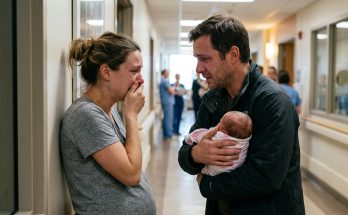
A nurse appeared moments later, pushing the bassinet. The baby was awake, her eyes moving without focus. She made a small sound as the nurse adjusted her blanket. James stepped closer, and I saw his expression change. I recognized it immediately. He had looked at each of our sons that way during the first hours of their lives, as though the world had narrowed to the child in front of him. The familiarity of that expression hurt more than I expected.
The nurse asked whether James wanted to hold his daughter. This time, he answered without looking to me for guidance. He sat down and accepted the baby carefully, supporting her head with the awkward concentration of a man who had done the same thing years before but feared getting it wrong. She settled against his chest. His eyes filled, and he bent his face toward her. I turned away because watching him love her felt too much like watching a private memory being repeated without me.
Mara approached and asked whether I wanted to leave. I told her I wasn't sure. She accepted that answer without trying to interpret it. Then I asked what would happen if Leah did not survive. Mara explained that James's parental rights and responsibilities would depend on the legal documentation and applicable state law. Leah's relatives could seek legal advice or raise concerns, but they would not automatically receive custody simply because they were related to her. The hospital's role was to protect the baby's immediate welfare and coordinate the appropriate process.
James explained that Leah had prepared a temporary care authorization naming him if she became incapacitated. I asked how long he had known about the possibility of a dangerous delivery. He admitted that Leah's doctors had warned her repeatedly. I could hardly believe he had allowed the situation to reach this point without telling me. He had known that a medical emergency might leave him responsible for a newborn while still living with me and our sons. Yet he had made no honest plan for how those two lives would meet.
By late afternoon, I knew I could not manage the situation alone. I called my sister Claire from a quiet area near the vending machines. She answered cheerfully, then fell silent when she heard my voice. I told her what had happened, beginning with James's call and ending with the baby in his arms. Claire listened without interrupting. When I finished, she asked whether I needed her to confront him. I almost laughed. I told her I needed something much more useful.
Claire agreed to collect the boys from our mother's house and stay with them until I returned. She also offered to spend the night if I wanted company. Her practical response steadied me. I had spent hours surrounded by people asking me to consider the needs of James, Leah, and Grace. Claire was the first person who asked what I needed. I told her I wanted James to stay somewhere else. She said she would support whatever decision I made, but she would not make it for me.
I found James alone in the consultation room. Leah remained critically ill, and the doctors planned to keep her sedated overnight. I told him I was going home. He nodded. Then I told him he would not be coming with me. I wanted space to think without seeing his face at our breakfast table or hearing him move around our bedroom. I also wanted our sons protected from arguments neither of us could yet control. James agreed to find somewhere else to stay.
I warned him that the boys would notice his absence. I would not invent a business trip or make them believe everything was normal. At the same time, I would not tell them details they were too young to understand. James said he would follow my lead. I told him that being honest with his children was his responsibility too. He had already allowed his fear to shape too many decisions. I would not help him hide from another difficult conversation.
Before leaving, I handed him Leah's letter. He hesitated because it had been written to me. I told him I had read it and did not want to carry it home. He accepted the envelope, holding it carefully by one corner. I was almost at the door when I realized there was one question I had not asked. I turned around and asked what Leah had named the baby.
James said her name was Grace. The room seemed to contract around me. I had chosen that name when I was nineteen, long before marriage or children. James knew what it meant to me. I stared at him, certain for one terrible moment that he had told Leah and allowed her to use it. He insisted he had never mentioned the name. I wanted to believe he was lying because deliberate cruelty would have been easier to understand than such an impossible coincidence.
Then I remembered a sentence near the bottom of Leah's letter. She had named the baby after her grandmother. The name had belonged to someone she loved long before James entered her life. I could not reasonably accuse him of choosing it. Yet knowing the explanation did nothing to soften the pain. Somewhere in the hospital was a newborn girl with the name I had imagined calling through our home. She was James's daughter, but she was not mine.
I left without saying goodbye. Outside, the evening air felt cooler than I expected. I sat in my car for several minutes, unable to start the engine. I thought of the baby resting against James's chest and the little clothes still stored in our garage. I thought of the letter, Leah's fear, and the sons waiting for me at home. By the time I finally drove away, I knew one thing with certainty: whatever became of my marriage, I would not allow anyone to use that child's existence as a reason to excuse the betrayal that brought us here.
Click here to continue reading: PART 3: I Tried to Protect Our Sons from the Truth, Until a Conversation with Leah Changed What I Believed I Could Control
A Desperate Call from the Maternity Ward Forced Me to Confront the Secret My Husband Had Hidden Behind Eleven Years of Marriage
Part 2 of 16