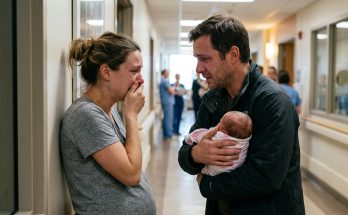
The call came during Leo’s junior year.
My phone rang at 6:42 on a Tuesday evening.
I did not recognize the number.
“Is this Helen Ellis?”
“Yes.”
“This is the emergency department at St. Joseph Medical Center. Leo Ellis listed you as an emergency contact.”
My knees weakened before the woman finished the sentence.
“What happened?”
“He collapsed while playing intramural basketball. He is awake and stable.”
Stable.
I heard everything else through that word.
“Is he conscious?”
“Yes.”
“Can I speak to him?”
“Soon. The physician is with him now.”
I called Evan before I found my shoes.
He answered immediately.
“What happened?”
“Leo’s in the emergency room.”
“I’m leaving.”
No interrogation.
No panic.
Just movement.
The five-hour drive felt longer than the ten years before Judith’s letter.
I kept imagining Sarah.
Hospitals had been where I lost her.
I knew that connection was irrational.
My body did not care.
Because Leo was twenty, the hospital could not automatically tell me everything.
That mattered.
He was an adult.
When I arrived, he had already authorized the staff to speak with both Evan and me.
He sat upright in the bed with an IV line in his arm.
He looked irritated.
That was reassuring.
“You drove all the way here?”
“What exactly did you think I would do?”
He looked behind me.
Evan entered.
“You came too?”
Evan raised both hands.
“I was summoned.”
“You were not summoned,” I said.
“You sounded extremely summoning.”
Leo laughed.
So did I.
The doctors believed he had become severely dehydrated while recovering from a viral infection.
During basketball, his heart had briefly gone into a rapid, irregular rhythm before he collapsed.
They wanted observation.
More tests.
Bloodwork.
An electrocardiogram.
An echocardiogram the following morning.
The absence of immediate catastrophe should have reassured me.
Instead, uncertainty made everything worse.
Then came the family-history questions.
For the first time, Evan’s presence beside that hospital bed mattered in a measurable medical way.
He could answer questions I never could.
Judith had high blood pressure.
Thomas had type 2 diabetes.
Evan’s maternal grandfather had developed colon cancer.
Then Judith, reached by phone, remembered something else.
Thomas had an older brother with atrial fibrillation.
The cardiologist wrote it down.
“Does that mean Leo inherited something?”
“Not necessarily.”
“But it could?”
“It’s one piece of information. We test before we conclude.”
I wanted certainty.
Medicine refused to provide it.
The echocardiogram showed no structural abnormality.
Additional monitoring did not reveal evidence of a dangerous inherited rhythm disorder.
The doctors concluded that the episode was most consistent with illness, dehydration, and strenuous exertion.
Leo would need rest.
Fluids.
Follow-up.
A gradual return to exercise only after medical clearance.
“So he’s fine?” I asked.
The doctor gave me the look physicians reserve for relatives demanding guarantees.
“He is doing well.”
“That isn’t what I asked.”
“It is the most accurate answer I can give you.”
Leo smirked from the bed.
“I like her.”
“You’re medicated.”
“I’m not.”
“Then stop enjoying this.”
When he was discharged, Leo announced that he was returning to his apartment.
I objected.
Evan objected.
Leo folded his arms.
“I am twenty years old.”
“You collapsed on a basketball court.”
“I have roommates.”
“One of those roommates once believed aspirin treated food poisoning.”
“That was Caleb.”
“Exactly.”
“He was seventeen when he said that.”
“His medical credentials remain revoked.”
Evan turned away to hide a smile.
We compromised.
Leo returned to his apartment.
I stayed in a nearby hotel for two nights.
Evan stayed one.
We stocked Leo’s refrigerator.
We reminded him to drink water so many times that he threatened to block our numbers.
We resisted the urge to check his pulse whenever he sat still.
On the second evening, Leo ordered both of us out.
“I’m fine.”
“We know.”
“Then leave.”
“We are leaving.”
“You’re standing in my kitchen.”
“We’re preparing to leave.”
He pointed toward the door.
Evan and I ended up sitting in the hotel lobby with terrible coffee.
For a while neither of us spoke.
Then Evan said, “He doesn’t need us the same way anymore.”
“No.”
“That’s harder than I thought.”
“Yes.”
He stared into the paper cup.
“I used to think the worst thing was missing his childhood.”
I looked at him.
“And now?”
“I missed learning how to let go slowly.”
That stopped me.
I had been given stages.
Preschool.
His first sleepover.
Summer camp.
The first time he crossed a busy street alone.
Driving.
College.
Each one had loosened my grip by another inch.
Evan had entered when Leo was ten.
Then time accelerated.
“He still calls you,” I said.
“I know.”
“He called when calculus went badly.”
“I know.”
“He listed you as his second emergency contact.”
Evan looked up.
“Second?”
I smiled.
“After me.”
He pressed one hand against his chest.
“I am devastated.”
“You’ll survive.”
“I’m not sure.”
The joke carried more truth than he admitted.
Evan had spent years trying not to take my place.
Now he had to accept that being Leo’s father did not guarantee first place in every category.
Nor should it.
A week later, Leo called.
“I updated my health-care proxy.”
I nearly dropped the phone.
“You had a health-care proxy?”
“Campus legal services did a clinic.”
He explained that he wanted clear written instructions in case he ever became unable to make his own medical decisions.
He named me first.
Evan was the alternate.
He also completed authorization allowing both of us access to information during an emergency while keeping routine medical matters private.
“That is very responsible.”
“You sound surprised.”
“I do not.”
“You sound a little surprised.”
“I am impressed.”
“That’s the polite version.”
I smiled.
Then the significance settled in.
When Leo was a child, adults had made enormous decisions about his life without his knowledge.
Thomas had decided Evan should lose Sarah.
Judith had decided Evan should believe his son was dead.
Sarah had decided silence would protect Evan.
Even I, with better intentions, had sometimes decided what Leo needed before asking him.
Now he was twenty.
Neither Evan nor I possessed automatic authority over him.
He chose.
He chose who could receive information.
He chose who could speak for him if he could not speak.
That distinction mattered.
Two days later Evan called me.
“He told me about the proxy.”
“Yes.”
“I’m alternate.”
“Try to endure.”
“I’ll seek counseling.”
Then his voice softened.
“Helen?”
“Yes?”
“Thank you.”
“For what?”
“For not treating me like I was trying to steal him.”
I thought of the first overnight visit.
The college bills.
The arguments over responsibility.
The years it had taken me to stop seeing shared parenting as subtraction.
“I did sometimes.”
“I know.”
“You were patient.”
“Sometimes.”
We both laughed.
The medical emergency frightened all of us.
But it also exposed something important.
The blank spaces in Leo’s medical history had shrunk.
The father who once did not know his son existed had stood beside his hospital bed answering questions about inherited conditions.
And the boy adults once deprived of choices had become a man carefully documenting his own.
Click here to continue reading: PART 12: On Sarah’s Thirtieth Birthday, We Returned to Her Grave Without Secrets and Finally Let Her Be More Than a Tragedy
On Sarah’s Birthday, a Stranger at Her Grave Handed Me the Secret My Daughter Had Trusted Her to Keep
Part 11 of 16