Leo was twenty-eight when he called on a Sunday morning and asked whether I was sitting down.
My hand tightened around the phone.
“What happened?”
“Nothing bad.”
“Then never begin a telephone call that way again.”
He laughed.
“Anna’s pregnant.”
For several seconds, I could not answer.
“Grandma?”
“I’m here.”
“Say something.”
I started crying.
“That works.”
“When?”
“About ten weeks.”
“Is she all right?”
“Yes.”
“She’s seen a doctor?”
“Yes.”
“Taking vitamins?”
“Yes.”
“Does Evan know?”
“No. You’re first.”
That made me cry harder.
For most of Leo’s childhood, I had been first because there was nobody else available.
This time he had chosen me first.
The difference was enormous.
He and Anna told Evan that afternoon.
Leo sent me a video afterward.
Evan stared at the ultrasound photograph for nearly ten seconds.
Then he sat down.
Rebecca laughed at him.
Nora, now in college, shouted that she was going to be an aunt.
Evan looked at Leo.
“You’re going to be a father.”
“Apparently.”
Something moved across Evan’s face.
I recognized it immediately.
Seventeen.
Sarah pregnant.
Thomas.
Ohio.
The child Evan had wanted and then believed dead.
Leo saw it too.
He put one hand on his father’s shoulder.
“Different story.”
Evan nodded.
“Very different.”
Pregnancy changed Leo’s questions about Sarah.
For years he had wanted to know who she was.
Now he wanted to know what happened inside her body.
“Did she have morning sickness?”
“Yes.”
“When did you know she was pregnant?”
“About eleven weeks.”
“Was she scared about labor?”
“Terrified.”
Then came a question that stopped me.
“Did doctors know she was high risk?”
Sarah’s death had always existed in our family as one broad sentence.
She died giving birth to Leo.
He wanted more.
I retrieved the medical records I had kept for nearly three decades.
The paper smelled faintly of the fireproof box.
The language was clinical enough to make tragedy sound procedural.
Sarah suffered a severe obstetric hemorrhage after delivery.
Doctors attempted emergency treatment.
Blood transfusions.
Surgery.
They could not stop the bleeding in time.
Leo sat at my kitchen table reading the summary.
“So nobody knew this was going to happen.”
“No.”
“Was I okay?”
“You were monitored, but yes. You were stable.”
His thumb rested against the page.
Then he said something I had never known.
“When I was little, I thought maybe I caused it.”
My chest tightened.
“Leo.”
“I knew it didn’t make sense.”
“How long did you think that?”
“I don’t know. Not all the time. Just sometimes. She died having me.”
I moved my chair closer.
“You did not cause your mother’s death.”
“I know.”
“Listen anyway.”
He looked at me.
“Pregnancy and childbirth sometimes have dangerous complications. Sarah’s hemorrhage was not caused by you existing. You were a newborn child. None of the responsibility belonged to you.”
He nodded.
This time, I believed he heard me.
Later that month, he asked to see Sarah’s original letter.
Not a photocopy.
I removed the pages from the fireproof box and gave them to him in their archival sleeve.
He sat alone for nearly an hour.
When he finished, he looked unsettled.
“She was so young.”
“She was eighteen.”
“I know. But I didn’t understand eighteen when I was ten.”
Neither had I, perhaps.
Not fully.
At ten, Leo had imagined eighteen as adulthood.
At twenty-eight, he could see Sarah for what she had been.
A frightened girl attempting to make decisions for herself, Evan, her mother, and an unborn child.
“She was trying to manage everyone.”
“Yes.”
“You.”
“Yes.”
“Dad.”
“Yes.”
“Me.”
“Yes.”
“That’s too much for an eighteen-year-old.”
“It was.”
He looked down at the pages.
“I used to be angry because she didn’t trust you.”
“I was angry too.”
“Still?”
“Sometimes.”
Leo smiled faintly.
“Good.”
“Why good?”
“Because I don’t want everyone pretending dying made her perfect.”
I laughed.
“Our family has never been particularly good at pretending anyone is perfect.”
By Anna’s third trimester, Leo’s anxiety became difficult to hide.
He checked every appointment result.
He read too many medical websites.
He questioned whether Anna should switch hospitals despite having no clinical reason.
Finally Anna called me.
“He’s scared because Sarah died.”
“Yes.”
“Will you talk to him?”
“I will.”
Then I reconsidered.
“He should probably talk to somebody who isn’t his grandmother too.”
Leo agreed.
He saw a therapist for several sessions.
There was no dramatic diagnosis.
He was a man approaching the birth of his first child knowing his own mother had died during his birth.
Fear was not evidence that something was wrong with him.
It needed somewhere useful to go.
He learned to distinguish Sarah’s history from Anna’s actual medical condition.
He attended appointments.
He asked reasonable questions.
He stopped searching for rare complications at two in the morning.
Evan understood the fear differently.
One evening, while Anna was inside my house, father and son sat on the porch.
Evan told Leo that when Sarah became pregnant, he had thought admitting fear would make him weak.
So he pretended to understand things he did not.
Leo asked, “Did you think she might die?”
“Never.”
“Do you still feel guilty that she did?”
“Yes.”
“Why?”
Evan looked toward the yard.
“Because I wasn’t there.”
“That doesn’t make it your fault.”
“I know.”
“You actually know?”
Evan smiled sadly.
“Most days.”
The symmetry struck me.
I had spent years telling Leo he did not cause Sarah’s death.
Now Leo was telling Evan.
They were finally learning to separate grief from responsibility.
Anna went into labor at thirty-nine weeks.
Leo called me at 3:11 in the morning.
“This is it.”
His voice shook.
“You’re at the hospital?”
“Yes.”
“Anna okay?”
“Yes.”
“Then stay with her.”
“I am.”
“You do not need to update the family every ten minutes.”
“Tell Dad.”
“I will.”
Evan was already awake.
Leo had called him first.
So much for my permanent priority.
We waited at home.
Anna had requested privacy.
We respected it.
No relatives occupied the hallway.
No one turned childbirth into a family performance.
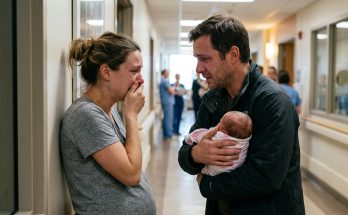
At 11:26 a photograph arrived.
A red-faced newborn was wrapped tightly in a white hospital blanket.
Sarah June Ellis Carter.
Sarah for Leo’s mother.
June for Anna’s grandmother.
I sat down on the kitchen floor and cried.
Evan called a minute later.
Neither of us could form a complete sentence.
Finally he managed, “They named her Sarah.”
“I know.”
“Did you know?”
“No.”
“Neither did I.”
Three days later, Leo placed my great-granddaughter in my arms.
“You okay?”
“No.”
He laughed softly.
“Good no?”
“The best kind.”
I looked at the tiny face.
For decades, Sarah had been a name attached to absence.
Now another Sarah breathed against my chest.
She was not a replacement.
She never would be.
She was a continuation.
The first months were considerably less poetic.
Baby Sarah slept according to a schedule designed by an enemy.
Anna developed mastitis and cried from pain and exhaustion.
Leo returned to work after parental leave and felt guilty in both places.
At work he worried about home.
At home he worried about work.
One evening he called.
“I think everyone lied about newborns.”
“What were you promised?”
“Magic.”
“It is magical.”
“She screamed for forty minutes because one sock came off.”
“Also magical.”
“I hate you.”
“You’re tired.”
The next morning I arrived with groceries.
Not advice.
Groceries.
Anna was asleep on the couch.
The baby slept on Leo’s chest.
He sat completely motionless.
“My arm is numb,” he whispered.
“Move it.”
“She’ll wake up.”
“She will eventually wake up regardless.”
“You are not helping.”
I took Sarah.
Leo stood and stretched.
Then he asked, “How did you do this alone?”
“I did not do it elegantly.”
“You always make it sound like you managed everything.”
“I managed whatever was directly in front of me. That is different.”
He looked toward Anna.
“Were you scared?”
“Frequently.”
“Did you ever resent me?”
The question surprised me.
“No.”
“Never?”
“I resented being exhausted. I resented the circumstances. I occasionally resented people who brought opinions instead of food.”
He smiled.
“But you?”
“No.”
He nodded slowly.
“I think I understand that now.”
Evan reacted to grandfatherhood by buying things.
Books.
Blankets.
Tiny socks.
Toys.
A wooden activity center requiring approximately four thousand screws.
Rebecca finally stopped him.
“You know purchasing the entire baby department won’t give you Leo’s infancy back.”
Evan froze.
Then sat down.
“You’re right.”
Leo, holding an Allen wrench, said, “I was hoping you’d realize that after buying the stroller.”
Evan threw the instruction sheet at him.
After that, Evan learned to ask.
More importantly, he learned that useful gifts were often hours.
He pushed the stroller while Leo and Anna slept.
He warmed bottles.
He changed diapers without behaving as if civilization should award him a medal.
One afternoon I found him asleep in a chair with baby Sarah on his chest.
Her hand rested against his shirt.
This was the man who had once spent years believing his own baby had died.
I quietly took a photograph.
Later, Evan kept a copy on his desk.
Fatherhood changed the scale of Leo’s old questions.
He now understood how completely newborns depend on adults for access, safety, and truth.
It made him angrier at Thomas.
Strangely, it also made him gentler toward Sarah.
“She was basically a kid trying to control a situation that was too big for her.”
“Yes.”
“She thought hiding things was protecting people.”
“Yes.”
“That was terrible logic.”
“She was eighteen.”
Leo looked down at his sleeping daughter.
“I hope this Sarah never has to make a decision that big when she’s eighteen.”
“So do I.”
“And if she does?”
I looked at him.
“Make sure she knows where the safe door is before she ever needs it.”
He was quiet.
Then he nodded.
“She’ll know she can come home.”
That was the promise our family had spent decades learning how to make.
Click here to continue reading: PART 15: Judith Held Leo’s Daughter and Finally Apologized Without Asking for Anything Back, While Thomas Learned That Remorse Could Not Restore His Place
On Sarah’s Birthday, a Stranger at Her Grave Handed Me the Secret My Daughter Had Trusted Her to Keep
Part 14 of 16