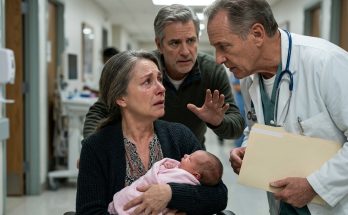
Claire slept through most of the afternoon while the hospital staff monitored her blood pressure. Dr. Patel had warned us that her condition remained serious enough to require quiet, medication, and careful observation. Grace, born three weeks early, stayed under nursery supervision after a temporary drop in blood sugar. The nurses checked her feeding times and recorded every small improvement. I found myself studying those numbers whenever my thoughts became unbearable. A baby could be measured in ounces and milliliters. The thirty-seven years I had lost with her mother had no such convenient measurement.
David waited with me in a family lounge on the second floor. A television mounted above the vending machines played a morning program nobody was watching. He sat beside me, leaving barely a foot between us, although the distance felt much greater. When he reached for my hand, I drew it into my lap. He did not try again. I wanted an account of what had happened, beginning with the first moment he learned Claire might exist.
He told me an email had arrived at his engineering firm in May. Claire had found his professional contact information while researching our family. She introduced herself cautiously, explaining that adoption records and genealogical matches suggested she might be related to me. She included her birth date and the name of St. Anne's Hospital. David initially suspected someone was trying to obtain private information or money.
“Did she ever ask you for anything financial?” I asked.
“Never. She wanted to know whether you'd had a child before we met.”
“And you knew the answer.”
“Yes. But I didn't tell her immediately.”
He explained that he had refused to discuss my personal history until Claire supplied additional documentation. She sent an adoption summary describing a sixteen-year-old birth mother from Millbrook County, with brown hair and gray eyes. The girl's father sold agricultural equipment, and her mother worked as a church secretary. Those details described my parents with disturbing accuracy. David realized that someone had preserved information I had been told would remain confidential.
He met Claire at a coffee shop in Northwood. He remembered how she held her cup with both hands and how carefully she asked questions. She wanted to know whether I was alive, whether I had children, and whether contacting me would cause harm. He told her what he could without revealing everything. Then he agreed to help investigate. Over the following months, they met six times, including meetings connected with genetic testing and the review of adoption records.
“Six meetings,” I repeated. “You sat across from my daughter six times while I didn't even know she existed.”
David rubbed his forehead. “I was trying to find out whether she was telling the truth.”
“You were allowed to investigate. I was allowed to remain ignorant.”
He did not answer. I watched an elderly man guide his wife toward the elevators and wondered whether every long marriage contained a moment when familiar gestures suddenly looked different. David had always considered himself responsible for preventing unnecessary worry. When Matthew broke his arm at twelve, David called me only after the doctor confirmed it wasn't serious. I had complained then, but I had also understood his intentions. This was not a broken arm. This was my daughter.
He said Claire had asked for confidentiality while she decided whether she wanted contact. She feared disturbing my family, disappointing her adoptive parents, and discovering that I had willingly surrendered her. David believed he was respecting her wishes while protecting me from another devastating loss if the investigation proved mistaken. I understood Claire's uncertainty. She had no obligation to welcome a stranger into her life. But David had known me for decades, and he had decided that my own history was something he could manage without me.
I reminded him of the pink blanket I had kept after Matthew's birth. I reminded him of the Novembers when I became quiet without explaining why. He remembered those years. He remembered the nights when I woke from dreams about a hospital corridor and a child crying beyond a closed door. His eyes filled when I described what it meant to discover that the child had been alive during every one of those nights.
“I thought I was sparing you pain,” he said.
“You took away the chance to decide what I could bear.”
He looked down. This time he did not apologize immediately. He seemed to be considering the distinction rather than searching for the fastest way to end the argument. That was the first useful thing he had done since I arrived.
A nurse came to tell us Claire was awake and wanted to see me. I went upstairs alone. David remained in the lounge, where I left him with his unfinished explanations. Claire's room smelled of disinfectant and warm linen. A blood pressure cuff surrounded her arm, and a plastic pitcher of water stood beside the bed. She looked pale but more alert. Without the confusion of our first meeting, I could see small similarities between us. Her eyes were unmistakable. So was the way she worried at the edge of her blanket with her thumbnail.
She asked what she should call me. I told her Linda would be fine. She seemed relieved, and I was glad I had not made the moment difficult. Claire had spent thirty-seven years calling another woman Mom. I did not want our first conversations to become negotiations over a title. We had enough to learn about each other without pretending the missing decades could be restored by a word.
Claire knew more about my life than I expected. She knew Matthew was thirty-one, Jonah twenty-five, and Noah seventeen. She knew I taught fourth grade at Lincoln Elementary and had received a district teaching award in 2018. She had found photographs from school events and an old article about a reading program I helped organize. When I asked how she had learned so much, she admitted that researching strangers was easier than deciding whether to meet them.
I asked about her childhood. Her parents were Mary and Thomas Bennett. Mary worked as a pharmacist, and Thomas had repaired elevators before retiring. Claire described their yellow house, the maple tree outside her bedroom, and the bicycle accident that left her with a broken wrist at nine. She remembered piano lessons she hated, an unsuccessful attempt to learn clarinet, and family holidays spent arguing about board games. These details comforted me more than she probably realized. They described a childhood full of ordinary experiences rather than the emptiness I had imagined.
Claire had married Aaron Bennett at twenty-eight. Despite their shared surname, Aaron was unrelated to her adoptive family, a coincidence that had amused their wedding guests. Their marriage eventually deteriorated, and they separated two years earlier. The divorce became final six months before Grace's birth. Aaron was Grace's father. He knew about the induction but had been working in Denver when complications developed. Claire hoped he would return soon and remain involved in their daughter's life.
I wanted to ask whether Aaron had treated her well, whether she had support, and whether she was frightened about raising a baby after a divorce. Instead, I asked what she needed that afternoon. She requested water and help adjusting her pillow. I gave her both. It was a small beginning, but I could perform those tasks without claiming authority over her decisions.
Eventually our conversation returned to David. Claire explained that she had initially suspected he might be her biological father because she did not know when we met. He volunteered a sample, and the result excluded paternity. That should have ended his involvement in genetic testing. Instead, he became determined to establish whether I was Claire's mother.
Claire hesitated before describing what happened next. David had taken a coffee cup I used at home and arranged for material from it to be examined through a private genealogical service. A laboratory counselor had refused to treat the sample as valid for an official report because I had not consented. David nevertheless proceeded with a separate comparison through the private service.
I felt my face grow hot. The secret meetings had already damaged my trust. This was something else. He had taken biological material from an object in our home and used it to investigate my genetic relationships without my knowledge. He had treated access to my kitchen as permission to make decisions about my body.
Claire said she learned about the sample only afterward and told him he should not have done it. She had wanted answers, but she had not wanted them obtained through deception. I believed her. The distinction mattered because I was determined not to transfer my anger toward David onto the daughter who had come searching for me.
I asked how Dr. Patel had obtained the report involving Grace. Claire explained that the hospital had not secretly collected a new sample from me. I had undergone hereditary cancer screening two years earlier after my sister developed breast cancer at forty-nine. Those clinical records existed in the hospital system, but the medical team had not been authorized to use them for Claire's family investigation. David had implied I would agree to the comparison, and Dr. Patel had stopped the proposed process and involved the hospital's privacy officer.
The figure presented to me came from the private testing and related accredited analysis Claire had supplied, not an unauthorized new hospital test. I was relieved that the hospital had recognized the consent problem. It did not make David's conduct acceptable. If anything, it clarified where responsibility belonged.
Claire reached toward a folder on her bedside table. She said she had brought copies of her adoption papers because she thought they might help. I pulled my chair closer as she spread the documents across the blanket. There were placement records, a social history, and a legal petition. One page bore my maiden name, Linda Marie Waters, in the careful lettering I had used as a teenager.
At the bottom was a signature. The first letter had a large loop, and the final letters pressed heavily into the line. I recognized the handwriting. I remembered signing papers in a room with green walls while my mother stood nearby. A woman I did not know had repeatedly told me that I was making a responsible decision. I remembered asking when I could see my baby. I did not remember anyone explaining that I was permanently surrendering her for adoption.
Claire watched me study the page. She asked whether I had truly believed she died. I told her about the hospital bed, my mother's announcement, and the years that followed. Claire began crying. She admitted she had grown up believing her birth mother had chosen adoption and never attempted to find her.
We sat with the painful difference between those stories. Claire had been told she was relinquished. I had been told she was dead. Neither of us had been given the opportunity to question the account while the other was still within reach.
I asked whether I could touch her arm. She nodded, and I rested my hand lightly against her skin. After a moment, she turned her palm upward and held my fingers. We remained that way until a nurse came to check her blood pressure. I did not want to make a grand promise. I wanted to be present long enough for Claire to decide whether my presence was welcome.
That evening I told David to return home. I stayed at the hospital and sent careful messages to Matthew and Jonah, explaining that an important family matter had arisen but everyone was safe. I told Noah I would return the following day. I could not explain the situation through a phone screen. My sons deserved to hear it from me, and Claire deserved some control over how her existence became known.
Late that night, Grace was resting in the nursery, and the lights in Claire's room had been dimmed. I sat in the reclining chair beside her bed, listening to the intermittent sounds of nurses moving through the corridor. Claire spoke softly from the darkness.
“Linda, did you ever give me a name?”
I had not expected the question. For a moment, I could not answer. Then I told her I had called my daughter Emily during the pregnancy. It was the name I whispered when nobody else was listening, the name I wrote once on a scrap of paper and kept hidden in a schoolbook.
Claire turned toward me. Her middle name was Emily.
Mary and Thomas had chosen it without knowing what I called her. Claire explained that her adoptive mother liked the sound of it and wanted her to have a name that felt gentle beside Claire. There was no secret message, no hidden arrangement, only a coincidence that brought tears to both our eyes.
I lay awake long after Claire fell asleep. I thought about the name she had carried without knowing its meaning to me, the signature on the adoption papers, and the coffee cup David had taken from our kitchen. I had discovered my daughter was alive, but the evidence now suggested that finding her was only the beginning. I needed to understand how she had been taken from my life, and whether my consent had ever truly existed.
Click here to continue reading: PART 3: When Our Three Sons Learned They Had an Older Sister, Their Questions Exposed Divisions Our Family Could No Longer Ignore
My Husband Called Me to the Maternity Ward Before Sunrise, Where a Newborn and Two DNA Reports Challenged Everything I Believed
Part 2 of 16