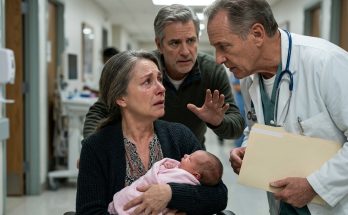
I nearly called my mother at midnight. The caseworker's note lay on the kitchen table, and I could imagine reading it aloud while Eleanor tried to explain why she had prevented me from seeing my baby. I wanted to hear her voice when she realized I knew. Instead, I placed the document inside a protective sleeve and wrote down the questions I needed answered. By morning, I had decided to speak with an attorney before confronting her.
Claire and I met Anita Shah three days later. Anita practiced family law and had experience with adoption records and disputes involving historical consent. Her office was modest, with two computer monitors, an air purifier, and a basket of inexpensive pens. She greeted us without excessive sympathy and asked us to arrange our documents chronologically. I found her manner reassuring. I did not need someone to tell me how tragic my situation was. I needed someone who could distinguish what we knew from what we suspected.
David did not attend. I had asked him to remain uninvolved while Claire and I examined the adoption. He had already controlled too much of the investigation, and I wanted to make decisions without wondering whether he had filtered information before it reached me. He accepted the arrangement, although I could tell he disliked being excluded.
Anita began with my age at the time of delivery, the location of St. Anne's Hospital, and the circumstances under which I signed the papers. She asked whether I remembered appearing before a judge or receiving independent legal advice. I remembered neither. I told her my mother was my legal guardian and that I had received pain medication after delivery, although I could not recall its name or dosage.
Claire supplied the final adoption decree obtained by Mary and Thomas Bennett. Anita examined it and explained that the adoption was almost certainly legally final. Our investigation would not automatically threaten Claire's relationship with her adoptive parents or invalidate the family that raised her. Claire visibly relaxed. She had been afraid that searching for the truth might somehow harm Mary and Thomas.
Anita explained that our questions concerned the circumstances of my consent, whether the procedures required at the time had been followed, and whether additional records could be obtained. She would need to examine the adoption laws applicable in our county in 1989. Rules governing minors, guardians, and consent had changed over time, and she refused to give us a confident answer before reviewing the relevant statutes.
I asked what it would mean if my mother had told me the baby was dead before I understood that I was signing adoption papers. Anita said evidence of deception or coercion could be significant, but the passage of thirty-seven years created serious legal obstacles. Records might have been destroyed, witnesses might no longer be alive, and deadlines for bringing claims could have expired. Even proof of wrongdoing would not guarantee a remedy.
I had imagined that finding Claire might lead to a clear declaration of what had happened and who was responsible. Anita made me understand that legal proceedings could establish facts or accountability in some circumstances, but they could not return the years I had lost. I appreciated her refusal to promise something no court could deliver.
We discussed possible records. Claire, as the adult adoptee, could request materials that might not be available directly to me. Anita could investigate whether the court file could be unsealed and whether St. Anne's retained any medical records from the delivery. She warned that hospitals often destroyed older records according to retention schedules. The absence of a document would not necessarily prove anyone had concealed it.
Claire had already obtained her original birth certificate under a law allowing adult adoptees access to those records. She placed it before me. My name appeared on the line identifying her mother. The space for her father was blank. I touched the printed letters of my maiden name. For years, I had imagined that my connection to Claire had vanished when my mother told me she died. Yet the official record had preserved it.
I asked whether the hospital might have mistakenly told my mother the baby had died. Anita said we did not have evidence of that. We could not yet determine whether hospital staff participated in the deception, whether my mother acted alone, or whether the adoption agency knew what I had been told. She insisted that we keep those possibilities separate. I disliked the uncertainty, but I knew she was right.
Anita also asked about David's use of my genetic material. I explained the coffee cup and the private genealogical comparison. She said the legal questions would depend on how the sample was obtained, the laboratory's policies, and what David represented when submitting it. She offered to refer me to an attorney specializing in privacy issues. Claire showed her an email David had forwarded from the laboratory. The account was registered to David, and the sample was labeled L.C.
Anita asked us to preserve the message and any related documentation. She did not declare that David had committed a crime, nor did she dismiss the matter. I left the office understanding that my husband's conduct deserved a separate examination. My search for Claire's origins and my concerns about David's decisions were connected emotionally, but they involved different facts and responsibilities.
On the drive to Claire's house, she asked whether I was disappointed that Anita had not immediately proposed suing everyone involved. I admitted that part of me had hoped for a decisive answer. Claire smiled faintly and said she had felt the same. We agreed that neither of us wanted a dramatic accusation more than an accurate account.
At Claire's townhouse, Thomas sat in a recliner with Grace asleep against his chest. Mary was labeling bottles in the kitchen. Claire bent to kiss her daughter's forehead before sitting beside me. Watching her with Grace was both comforting and painful. I could see the tenderness of a new mother learning her baby's movements, and I knew I had missed that entire stage of Claire's life.
But I also watched Mary adjust the blanket around Grace and remembered that someone had performed those small acts of care for Claire. Someone had been present when she cried at night, learned to walk, and became ill. I could grieve the childhood I had missed without wishing away the people who had loved her through it.
Three weeks later, Claire received a response to her request for adoption records. Family Path had closed in 2004, and its surviving files had been transferred to a nonprofit archival service. An employee named Samuel Ortiz contacted her to explain that they had located a partial file. It was incomplete, but it contained more information than we expected. Anita arranged for certified copies.
The packet arrived on a Tuesday. Claire asked whether we could open it together at her kitchen table. Mary and Thomas remained at home but gave us privacy. David was not invited. I arrived carrying a notebook, reading glasses, and the old hospital papers I had preserved. I had spent years avoiding those documents. Now I wanted every date and signature examined.
The first pages contained intake forms. My mother's handwriting appeared repeatedly. She described me as a minor who was unprepared for parenthood and said our family lacked the resources to support a child. She emphasized the risks to my education and future. I recognized the language. Eleanor had often used concern for my future to justify decisions she made without asking what I wanted.
Some of her concerns had been real. We were not wealthy. My father had a difficult temper, and I had been sixteen. Raising a child would have required help I could not guarantee. But those circumstances did not explain why I had been told my baby died. Poverty and fear might explain why adoption was considered. They could not make deception harmless.
The counseling notes were more disturbing. During an early session, I had cried and said I wanted to keep my baby. My mother reportedly responded that the idea was unrealistic. In another session, I asked about temporary foster care while I finished school. Eleanor rejected that possibility. A later entry recorded that the baby's father was no longer in contact and that I had no alternative housing.
I stopped reading when I reached the reference to the father. His name was Michael Reyes. At sixteen, I had believed Michael abandoned me after his family moved to Arizona. My mother told me he wanted nothing more to do with the pregnancy. I remembered writing letters that received no answers. The file stated that attempts to contact him had been unsuccessful, but it did not establish who made those attempts or whether Michael ever received the messages.
Claire noticed my reaction and asked about him. I told her his name and explained what little I knew. She was surprised by the surname because she had recently encountered a nurse with the same name at the hospital. We acknowledged that Reyes was common and that the coincidence did not establish a connection. After everything that had happened, I was determined not to turn ordinary details into evidence without a reason.
We returned to the papers. The consent form carried my signature and the name of a social worker, Helen Price, as a witness. A typed statement indicated that I understood the adoption was permanent. My initials appeared beside it. I recognized the handwriting but could not remember the explanation I had supposedly received. The memory of the green room remained vivid, yet the words spoken there were indistinct.
I remembered being exhausted after the delivery. I remembered my mother telling me where to sign and a woman assuring me I was doing the responsible thing. I could not remember whether anyone asked me to explain what I understood. The document proved that a signature existed. It did not tell me what I believed at the moment I wrote it.
The next page contained post-delivery notes. At 9:40 that morning, someone recorded that I requested to see my infant before discharge. At 10:15, my mother informed the placement worker that visitation would destabilize me and asked for the baby to be moved away from my room. At 1:05, the record stated that I had been told the infant was no longer on the unit.
I knew exactly when that final conversation occurred. My mother had been sitting beside my hospital bed with her purse in her lap. I asked when I could see the baby. She looked down and said there had been complications. According to her, my daughter had stopped breathing, and the doctors had been unable to save her. She discouraged me from asking to see the body.
For thirty-seven years, I had blamed myself for not insisting. I had believed that my silence showed weakness, that a stronger mother would have demanded to hold her child regardless of what anyone said. Now I understood that Claire had already been moved away from me. The adults around me had controlled where she was taken and what I was told.
I stood abruptly, scraping the chair against the floor. Claire followed me to the kitchen sink. I held the counter until the trembling in my hands eased. Mary came to the doorway and asked whether I needed help. I told her I was not in physical danger, only overwhelmed. She brought water and returned to the living room, leaving Claire and me together.
Claire asked whether I wanted to telephone Eleanor. I said yes, then admitted I wasn't ready. I wanted to hear her explanation, but I did not want anger to prevent me from asking the questions that mattered. Claire understood. We returned to the table and continued examining the file.
Near the back was a letter addressed to me from Mary and Thomas Bennett. It had been written shortly after Claire's placement. They thanked me for the trust they believed I had placed in them and promised to raise the baby with love. The letter had never reached me. A notation indicated it had been withheld at the family's request.
I called Mary into the kitchen and showed her the page. She recognized it immediately. She had given the letter to the agency because she wanted Claire's birth mother to know that the baby would be cared for. She had assumed I received it. When she saw the notation, she covered her mouth and began crying. Thomas came to stand beside her, resting a hand on her shoulder.
I gave Mary the letter. She read her own words from thirty-seven years earlier while Claire and I sat quietly. The moment changed something in me. Mary and Thomas had not known I believed my daughter was dead. They had written to a young mother they thought had chosen adoption, hoping to offer reassurance. Someone had prevented that message from reaching me.
The file showed a pattern I could no longer ignore. My mother had argued against keeping the baby, rejected alternatives, requested that Claire be kept from my room, and apparently prevented correspondence from reaching me. The documents did not answer every legal question, but they supported something I had feared since the hospital reunion: Eleanor had exercised far more control over the adoption than I remembered.
That evening, after returning home, I sat alone with the file. David was in the guest room. Noah was upstairs studying. The house was quiet except for the refrigerator and the occasional passing car. I looked at the photographs on the mantel: my wedding, the boys as children, family vacations, and birthdays. For the first time, I understood how much of my life had unfolded under the shadow of a decision I had never been allowed to examine.
I picked up the telephone and called my mother. She answered after several rings, sounding tired but pleased to hear from me. She asked whether everything was all right.
“No,” I said. “It isn't.”
She waited. I looked at the adoption records spread across the table and asked whether she remembered the baby I delivered at St. Anne's.
“Of course,” she said quietly.
“Mom, I found Emily.”
There was a long silence. Then Eleanor made a small, frightened sound and whispered, “Oh, God.”
I had spent days wondering whether my mother might deny the records, claim confusion, or insist that everyone had misunderstood what happened. But there was no confusion in her response. She recognized the name. She understood what I had discovered.
I held the telephone tightly and waited for her to speak again. The woman who had told me my daughter was dead had just revealed, in two words, that she knew exactly who I had found.
Click here to continue reading: PART 5: My Mother Finally Admitted Why She Had Told Me My Baby Died, but Her Confession Exposed Another Betrayal Inside My Marriage
My Husband Called Me to the Maternity Ward Before Sunrise, Where a Newborn and Two DNA Reports Challenged Everything I Believed
Part 4 of 16