Claire's search for Michael Reyes produced its first substantial answer in January. The message did not come from Michael himself. It came from a woman named Rosa, who identified herself as his younger sister. She was sixty-one and lived outside Phoenix. Claire had contacted her through a genealogical match several weeks earlier, explaining that she was trying to identify her biological father and believed Michael might be connected to her family.
Rosa's response was cautious but specific. She confirmed that her brother had lived in Millbrook County as a teenager and had dated a girl named Linda Waters. She also remembered that Michael had spoken for years about a child he believed had been placed for adoption. Rosa did not know whether Claire was that child, but she was willing to compare dates and discuss what her family remembered.
Claire called me before replying. I was standing in the kitchen with a cup of tea when she read the message aloud. My hands began shaking, and I spilled tea across the counter. Claire heard me searching for a towel and asked whether I wanted her to stop the investigation.
“No,” I said.
“Are you certain?”
I looked at the wet counter. “Not entirely. But I want you to continue if that's what you want.”
Claire said she did. We agreed she would speak with Rosa first and tell me afterward what she felt comfortable sharing. I would not participate in the initial conversation. It was difficult to remain outside a search involving someone I had once loved, but Michael was Claire's biological father. She had the right to approach him on her own terms.
For thirty-seven years, I had believed Michael left because he was frightened and unwilling to accept responsibility. My mother told me his family moved away and that he wanted no further contact. I had accepted that explanation because I was sixteen and had no practical way to challenge it. Now, after discovering how Eleanor manipulated the adoption, I could no longer assume she had told me the truth about Michael.
I resisted the temptation to invent a more comforting explanation. Michael might have abandoned me. He might have tried to contact me and been prevented. He might have made mistakes I knew nothing about. I wanted facts before deciding what his absence meant.
After speaking with Rosa by video, Claire came to my house. She looked unsettled as she removed her coat and sat at the kitchen table. I offered coffee, but she shook her head. She wanted to tell me what she had learned before discussing anything else.
Michael was alive. He was sixty years old and lived in Tucson. He had married and had two sons. Rosa said he had never forgotten the pregnancy and had spoken about the baby he believed was adopted. He did not know Claire's identity or where she had grown up, but he knew a child had been born.
I sat very still. The boy I remembered had become a man with a wife, children, and decades of experiences I knew nothing about. I had imagined him occasionally over the years, usually as the seventeen-year-old who disappeared from my life. It had never occurred to me that he might have spent those same years wondering about our daughter.
Claire showed me photographs Rosa had sent of old letters. One envelope was addressed to Linda Waters at my childhood home. A postal marking indicated it had been returned because the recipient had moved without a forwarding address. Another had been sent to my aunt's house and returned to the sender. A third letter had never been mailed. Michael had kept it.
I recognized my childhood address immediately. I also recognized my aunt's house, where my mother claimed I was staying during the pregnancy. The returned envelopes proved that Michael had attempted to reach me at least twice. They did not establish who prevented the letters from arriving, but they contradicted the belief that he had simply disappeared without trying.
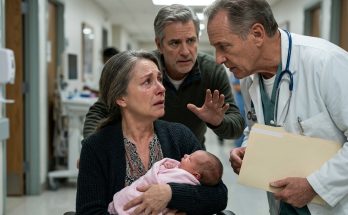
Claire read part of the unsent letter aloud. Michael wrote that he had gone to St. Anne's Hospital the day after she was born. According to Rosa, their father drove him there. Michael was told I had already signed adoption papers and did not want to see him.
I stood so quickly my chair scraped the floor. I remembered lying in the hospital bed, asking for my daughter, and believing Michael was hundreds of miles away. If he had come to the hospital, we might have been in the same building without either of us knowing.
“He could have asked for me,” I said.
Claire looked at me carefully. “He was seventeen.”
“So was I, almost.”
“I know. But he might have been frightened too.”
I turned toward the window. Noah's old basketball hoop leaned slightly toward the driveway, exactly as it had for years. I watched a car pass the house and tried to imagine Michael standing in the hospital lobby, being told I wanted nothing to do with him.
Claire was right. We had both been teenagers surrounded by adults who claimed to know what was best. That did not excuse every choice Michael made, but it reminded me that his decisions might have been shaped by the same fear and confusion I remembered.
Rosa said Michael called my parents' house repeatedly after returning to Arizona. Someone told him I had gone away and wanted no contact. We could not determine whether my mother or father answered those calls. I knew both were capable of discouraging him, but I refused to state as fact what we could not prove.
Claire wanted to establish whether Michael was her biological father before developing the relationship further. Rosa agreed to speak with him. A few days later, Michael contacted Claire and said he was willing to undergo testing.
They arranged separate appointments through an accredited laboratory using documented consent and identity verification. Nobody submitted a coffee cup or attempted to obtain a sample secretly. Claire told me she wanted every step handled properly because the uncertainty surrounding her origins had already caused enough damage.
The result confirmed a biological father-daughter relationship with a probability greater than 99.9 percent. Claire sent me a copy of the report, then called Michael. Their first conversation lasted twenty-three minutes. She told me afterward that he sounded nervous and asked many questions about her childhood. Their second call lasted nearly two hours.
I did not demand to know everything they discussed. Claire shared some details, including Michael's work, his sons, and the way he described his teenage years. Other parts of their conversations remained private. I reminded myself that being her biological mother did not entitle me to every word she exchanged with her father.
Three weeks later, Claire told me she wanted to meet him in person. Michael had offered to travel from Tucson. She planned to arrange a meeting somewhere neutral, away from either family's home. Then she asked whether I wanted to see him.
The question unsettled me more than I expected. Michael had once been central to my imagined future. We talked about finishing school, finding work, and eventually living somewhere far from our parents' expectations. Those plans disappeared when his family moved and my pregnancy became something the adults wanted hidden.
But the man Claire was preparing to meet was not the boy I remembered. He was sixty, married, and the father of two sons. I was fifty-four, still married to David although we lived separately, and the mother of three sons and a newly discovered daughter. Whatever Michael and I had once been, our present lives were different.
I told Claire I would meet him once, after she had the opportunity to speak with him privately. I wanted to understand what happened, not revive a teenage romance. Claire seemed relieved. She had worried that arranging the meeting might upset me or complicate my marriage further.
We agreed that Michael would come in March. Claire would meet him first at a private room in Mary and Thomas's church community center. If the conversation went well and I still wanted to see him, I could join them afterward.
Before March arrived, Matthew asked to speak with me. He came over on a Saturday morning without Rachel and, unusually, without any papers or printed articles. We sat in the living room while I poured coffee. He looked uncomfortable and spent several minutes discussing work before finally explaining why he had come.
He wanted to apologize for the way he had treated Claire.
I told him I appreciated the intention, but the apology belonged to her. Matthew agreed. He admitted that his questions about inheritance and financial motives had been unfair. He had focused on Claire because she was the newest person in a family that suddenly felt unfamiliar.
He described how quickly everything changed. We had been a household with three sons and two married parents. Eleanor was difficult but predictable. Then, within days, he learned he had an older sister and a niece, discovered that his father had hidden the truth for months, and watched his parents separate. Lawyers, adoption records, and DNA testing became part of conversations that had once concerned ordinary family matters.
“I knew Claire didn't cause those things,” he said. “But she was the person I hadn't known before, so I connected everything to her.”
I told him that was understandable as a reaction but unfair as a judgment. Claire had not asked to be placed at the center of our family's problems. She had been searching for information about her own life. Matthew nodded and admitted that his suspicion probably made her feel unwelcome.
I asked whether he liked Claire. He said he did. He admired her sense of humor and how she cared for Grace. He simply hadn't known how to fit her into the family without feeling that something familiar was being taken away.
I told him he did not have to feel instantly close to her because they shared a biological relationship. He was allowed to take time. What he owed her was honesty and basic respect. He looked relieved, as though he had expected me to demand immediate affection.
Then he asked whether David would be coming home. I sighed and asked whether that was part of what had been troubling him. Matthew admitted it was. He wanted his parents together again and was frightened that our separation might become permanent.
I told him David and I were still working through what happened. We had made progress in counseling, but I would not decide the future of my marriage simply to restore the family arrangement my sons remembered. Matthew understood, although he did not like the uncertainty.
He stared into his coffee for a long time. Then he told me he and Rachel had been trying to have a baby for a year.
I turned toward him. They had not told anyone, and I had assumed they were waiting until they felt ready. Matthew explained that they had begun medical evaluations because Rachel had not become pregnant as quickly as they hoped.
Then he told me she had suffered a miscarriage in December.
I reached for his hand. He looked down, struggling to speak. Rachel did not want the family to know yet, and he asked me to keep the information private. I promised I would.
Matthew explained that Grace's arrival had been especially difficult for them. He was happy for Claire and loved seeing photographs of his niece, but the baby's birth had also brought their own disappointment into sharper focus. After one family gathering, Rachel went home and cried for nearly two hours.
I understood then that Matthew's reaction had never been only about inheritance. He was frightened by changes in our family, worried about his parents' marriage, and carrying grief he had not known how to discuss. Claire and Grace had arrived during a painful period in his own life, and he had directed some of that distress toward them.
I told him I wished he had spoken to me earlier. He gave a tired smile and said our family seemed to have developed a habit of hiding painful information. I reminded him that secrecy was not always the same as privacy. Rachel had the right to decide when to share her medical experiences. David had concealed information about my own life without my consent. Those were different situations.
Matthew nodded. He and Rachel were seeing doctors and considering their options. I asked whether he wanted advice. He said no. He wanted someone to listen without trying to solve the problem. I sat beside him while he described the appointments, the disappointment, and his worry about Rachel.
Later that week, Matthew invited Claire to coffee. He apologized for questioning her motives and explained some of the fears he had been carrying. Claire listened without making him work through a dramatic confrontation. She thanked him for being honest and told him about the pregnancy she had lost before Grace.
They remained at the café for nearly three hours. Claire told me afterward that she and Matthew had more in common than either expected. They were both cautious, both uncomfortable with uncertainty, and both inclined to hide worry behind practical questions.
She sent me a message joking that my oldest son was less irritating than she had been led to believe. I replied that she should avoid encouraging him. It was the kind of ordinary exchange I had once imagined having with a daughter, and I found myself smiling at my phone.
The inheritance question still needed attention. David and I met with Kevin Cho, the attorney who handled our estate planning. We were legally married and jointly owned our home. Our retirement accounts carried beneficiary designations, and our wills had been written years earlier, before we knew Claire existed.
Kevin explained that adoption could affect inheritance rights under state law, depending on the legal status of the adoption and the wording of existing documents. Rather than rely on assumptions, he recommended that we review our estate plans and state our intentions clearly.
David and I made our decisions separately. We were still married, and certain provisions concerning the surviving spouse remained relevant, but we each needed to decide how to distribute our own assets. I thought carefully about Claire's place in my life and what I wanted my documents to express.
After the applicable provisions and specific arrangements, I chose to divide my estate into four equal shares for Matthew, Jonah, Noah, and Claire. I did not believe biology required that outcome. I chose it because I wanted to recognize all four of my children in my own planning.
When I told Claire, she protested. She worried that including her would confirm Matthew's earlier suspicion that she had searched for us because of money. I reminded her that my estate plan belonged to me and that I was capable of making the decision independently.
She said she did not want to cause another argument among the brothers. I told her I had informed them after the documents were signed. Jonah joked that four shares meant he would receive less and asked whether Claire, as the oldest sibling, could be persuaded to take financial responsibility for everyone else. Noah thought the joke was excellent. Matthew simply said he understood and hugged me.
There was no family confrontation over percentages. The decision had been made clearly, documented properly, and explained before uncertainty could turn into suspicion. I felt relieved that we had addressed the matter openly.
Claire eventually accepted my explanation, although she still looked uncomfortable. I told her she was not required to feel grateful for a decision she had never requested. I wanted her to understand only that she was not responsible for managing my sons' reactions.
As March approached, Claire finalized the arrangements for Michael's visit. He would meet her at the church community center in a private room where they could speak without interruption. Mary and Thomas knew about the meeting and supported her decision. I agreed to wait until Claire contacted me.
On the morning Michael arrived, I went through my usual routine but accomplished very little. I made breakfast, checked my school email, and folded laundry that did not need folding. Every ordinary task reminded me that someone I had not seen since I was sixteen was now in the same city.
Claire called two hours after their meeting began. Her voice sounded steady but emotional. She said Michael had been respectful, had answered her questions, and wanted to know whether I still wished to see him.
I stood in the hallway looking at my reflection. The woman in the mirror had gray strands in her hair and fine lines around her eyes. I was not the frightened girl who had waited for Michael's letters. I had raised three sons, built a career, survived loss, and recently found a daughter.
“Yes,” I told Claire. “I'll come.”
When I entered the community center, Michael was standing near the window. His hair had turned gray, and his face had changed in ways that made the years impossible to ignore. He turned when he heard the door.
For one brief moment, I recognized the boy I had known. It was not his face that brought him back to me. It was the movement of his hand. Two fingers tapped against his thigh in the same rhythm he used to make against the steering wheel when we drove along the county roads after school.
“Linda,” he said.
“Michael.”
His eyes filled. He told me he had believed I hated him.
I swallowed. “I thought you left me.”
We stood facing each other, separated by decades of decisions neither of us fully understood. Claire remained nearby, giving us room without disappearing. She was the reason we had found each other again, but this meeting was not about recovering an old romance.
It was about discovering whether two frightened teenagers had been separated by choices made around them, and whether the adults who claimed to protect us had concealed more than we knew.
Michael looked toward Claire, then back at me.
“I need to tell you what happened at the hospital,” he said.
I pulled out a chair and sat down.
This time, I was ready to hear the entire story.
Click here to continue reading: PART 9: When Michael Finally Explained What Happened at the Hospital, We Discovered That Some Questions Could Be Answered Without Undoing Thirty-Seven Years of Loss
My Husband Called Me to the Maternity Ward Before Sunrise, Where a Newborn and Two DNA Reports Challenged Everything I Believed
Part 8 of 16