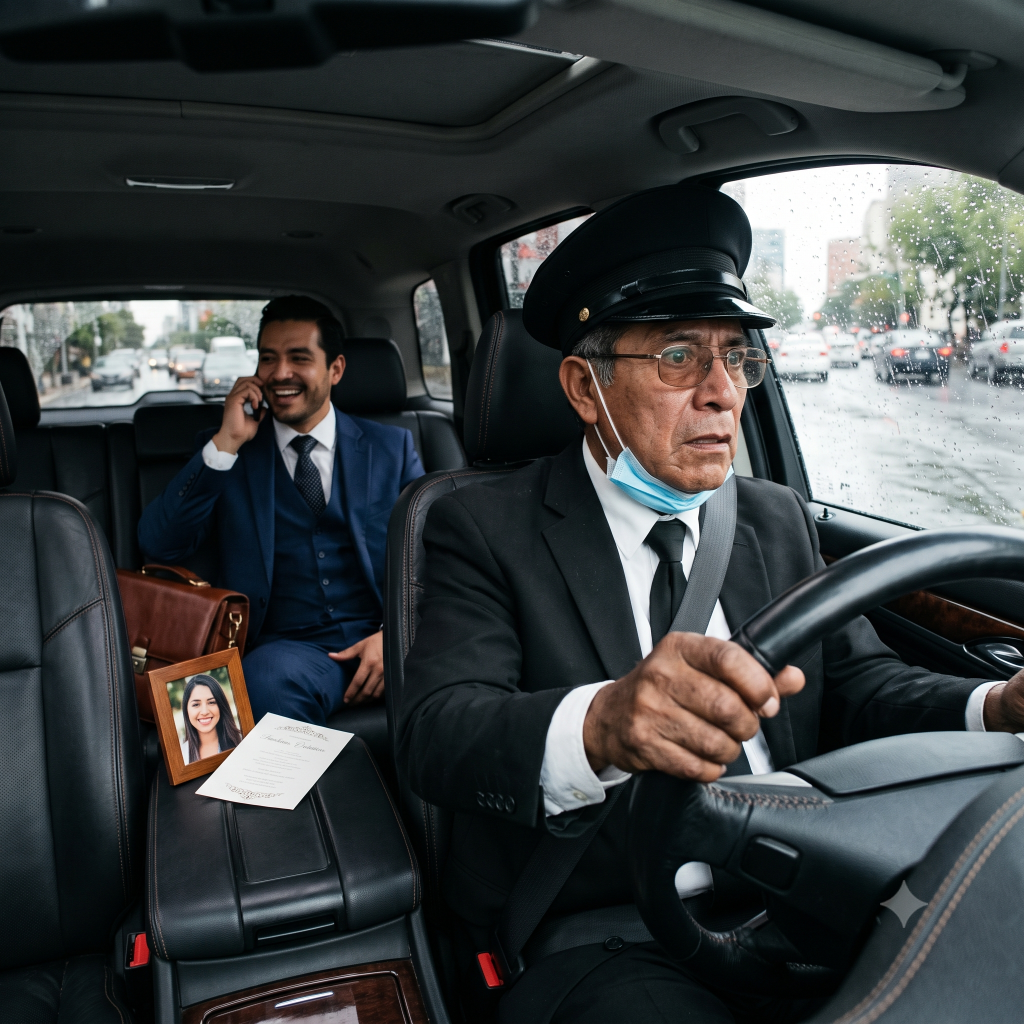
I take my daughter’s fiancé everywhere every morning, but he never recognizes me. Then, I overheard his plans for my daughter.
The morning I heard my future son-in-law say: “When we get married, he’s going to stop asking so many questions,” I almost ran a red light on Lázaro Cárdenas Avenue.
For a second I thought I had misheard. I looked in the rearview mirror. Rodrigo Ibarra was sitting in the back seat of the black truck, with his cell phone pressed to his ear, looking out the window as if he had just commented that it was going to rain, not as if he was talking about changing my daughter’s entire life without asking her permission.
My hands clenched on the steering wheel.
Advertisements
I didn’t say anything.
That was the hardest thing.
Advertisements
My name is Arturo Méndez. I am 61 years old and I have lived in Guadalajara all my life. For almost 40 years I was an electrical contractor. Houses, buildings, warehouses, schools, hospitals. If I learned anything in that trade, it was that things that are poorly connected sooner or later bring out sparks. I retired 2 years early, but retirement was not as beautiful as it was painted. After 6 months fixing things that weren’t broken and driving my wife, Laura, crazy, I agreed to work some mornings as a private driver for an executive transportation company.
He didn’t do it for money. I did it to feel like I still had a route.
Business clients, lawyers, directors, consultants. People with expensive watches, urgent calls and little habit of looking at whoever took them from one place to another. Rodrigo became a frequent passenger before I knew who he was. At first he was just another young man in a suit: 34 years old, confident smile, coffee in hand, laptop on his legs, always talking louder than necessary.
One day I heard him say a name that made my blood run cold.
Sofia.
My daughter.
Advertisements
Suddenly everything fell into place: the company, the voice, the age, the stories that Sofia had told us. It was him. Rodrigo Ibarra. The man my daughter would marry in 5 months.
Advertisements
And he had no idea that I was his future father-in-law.
There were reasons. Months before I had had complicated dental surgery and I wore a mask out of pity for temporary prostheses. He was also wearing a black company cap and dark glasses. The passengers almost never looked at me. Rodrigo less. At family dinners he was polite, yes, but he was always more concerned with recounting his achievements than remembering the faces of others.
At first it made me laugh. Every Tuesday and Thursday I took him to his meetings, and he would go 3 meters behind me talking about his life without imagining that the driver was the father of his fiancée. When I told Laura, she almost choked on hibiscus water.
“Are you telling me that he didn’t recognize you?”
“Not a little bit.”
“Arturo, that’s terrible.
“It’s also quite funny.
But over time it stopped being funny.
I began to notice details. The way he talked to waiters. The way to interrupt other executives. The ease with which he turned any conversation into a story about him. I told myself that it was not that bad. A lot of successful people were self-centered. Sofia was not naïve. She was a school counselor, she worked with teenagers, she knew how to read emotions better than many adults. After a rocky relationship in her 20s, she had become careful.
That’s why I tried not to judge.
Until that morning.
The rain was gently hitting the windshield when Rodrigo answered a call.
“No, really,” he said, laughing. When we get married, he’s going to stop asking so many questions.
I stiffened.
The voice on the other end said something I didn’t hear.
Rodrigo laughed again.
“I know her. Trust me. Right now she is still very attached to Guadalajara: her parents, her work, her friends, all that. But the further away you are from your family, the easier it becomes.
I felt my stomach close.
It was not a single phrase. It was not a joke. It was a plan.
I left him in his building without showing anything.
“See you on Thursday,” he said.
“Have a good day,” I replied, in a voice that miraculously sounded normal.
That night I didn’t say anything to Sofia. Nor the next day. For 3 days I carried what I had heard like a stone in my pocket. Every time she wrote to me about flowers, salons, or invitations, I wanted to reply, “Daughter, we need to talk.” Then he deleted the message.
Laura watched me one night from the patio.
“You keep thinking about Rodrigo.
“Maybe I misunderstood.
“You don’t sound convinced.
I told him word for word. She was silent for a long time.
“Then look,” he said at last. Don’t accuse just yet. Observe.
That’s what I did.
The following week Rodrigo got into the truck with his cell phone to his ear.
“I’ve already accepted the offer,” he said. No, Sofia still doesn’t know.
My eyes went to the mirror.
“Monterrey is perfect,” he continued. After the wedding it will make sense to move.
Monterrey.
9 hours from her family, her school, her students, the life she loved.
That Sunday Sofia came to eat at home. Laura made a mole. I was helping her lift plates when I asked, as casually as I could:
—And after the wedding, what plans do you have? Are they staying in Guadalajara?
Sofia smiled.
“Of course. My life is here. In addition, Rodrigo loves Guadalajara.
I almost dropped my plate.
From then on, the pieces began to appear on their own. Rodrigo spoke with real estate agents in Monterrey. He checked neighborhoods, travel times, rents, private schools, as if Sofia were luggage that he planned to move after the honeymoon. Another day I heard him talk about marriage agreements.
“I don’t care if he reads every page,” he said on the phone. It’s worded exactly the way I wanted. If something goes wrong, I’m not going to be left with nothing.
Sofia had never mentioned a prenuptial agreement.
Then came the thing that hurt me the most. During another call, Rodrigo talked about my daughter’s career as if it were a hobby.
—When I stop with school guidance, we simplify everything. Two admissions are not necessary. She worries too much about her independence.
I had to park at a gas station after I dropped it off. I needed to breathe.
Sofia loved her job. She didn’t get rich by helping anxious students, broken families, and lost teenagers, but she would come home talking about them with light in her eyes. For Rodrigo, that was something he eventually had to abandon.
Still, I hesitated. Because the complicated thing was that Rodrigo didn’t seem to pretend when he talked to her. One morning he called her from the back seat, and his voice became soft. They talked about a movie, a dinner, a boy at school who had drawn a picture of Sofia. He laughed tenderly. For a moment he sounded like a man in love.
That made it worse.
Obvious villains are easy to point out. The dangerous thing is the people who think they love while deciding for you.
One Saturday, Sofia came alone to drink coffee. I tried not to pressure her. I failed.
“Are you going to settle accounts after you get married?”
She looked up.
“Dad, what’s wrong with you lately?”
“Nothing. I’m just asking.
“It’s because of Rodrigo, right?”
I was silent for another second.
Sofia stood up.
“I knew you didn’t trust him.
“Daughter, I just want you to be sure.
“No, Dad. Every time something good happens to me, you expect it to break.
That hurt me because I had some truth to it. Not all, but enough.
She left upset. For almost 2 weeks he barely answered my calls. I continued to drive Rodrigo in the mornings, feeling like a miserable spy. Laura found me sitting in the workshop one night, looking at my tools.
“Make sure you do this for Sofia,” she said. Not because of your anger.
He was right.
The opportunity came on a Thursday afternoon. Rodrigo got into the truck excited, almost euphoric. He called someone and said:
“Everything is reserved. Yes, the lounge of the Country Club. Almost 100 guests. Family, friends, co-workers. No, she doesn’t know. I’m going to announce it there. It will be an unforgettable surprise.
The surprise was Monterrey.
He planned to announce in front of everyone that he and Sofia would move, without having talked to her, so that social pressure would force her to accept.
That night I called an old friend, Eliseo Vargas, a retired state police detective. We meet in a cafeteria in Zapopan. I told him everything. He listened without interrupting.
“You’re looking to prove it’s bad,” he said.
“And isn’t it?”
“Maybe. But you don’t need to try that. You need to prove that Sofia doesn’t have all the information.
That was the key.
I didn’t gather illegal secrets. Just facts: the job offer accepted, real estate emails that Rodrigo had printed and left in a folder during one of the races, the reservation of the salon, the times, the calls that he himself made in front of me carelessly. I also discreetly confirmed that Sofia had not asked for leave from her school and did not know anything about Monterrey.
The day of the party arrived with a clear sky. The lounge of the Country Club was beautiful: white tablecloths, fresh flowers, warm lights, a quartet playing near the entrance. Sofia seemed happy. When he saw us, he ran to hug us. For a second, it was my 10-year-old girl again, the one who was waiting for me awake when I returned late from a play.
I almost lost my courage.
But protecting her was no longer sparing her pain. It was letting him see the truth.
Rodrigo moved around the room as a candidate in the campaign. He greeted, laughed, accepted congratulations. At 8:15 he went on the small stage with a drink in his hand. Sofia was next to him, smiling.
“Thank you for joining us,” he began. Tonight is special because we don’t just celebrate our engagement. We also celebrate the future.
The audience applauded.
Rodrigo looked at Sofia with a huge smile.
—I have always believed that life rewards courageous decisions. That’s why I want to share a surprise with you. Sofia and I will start a new stage together in Monterrey.
At first there was applause.
Then they went out.
Because Sofia was not smiling.
“What?” she said.
The microphone picked it up.
Rodrigo froze.
“The move, love.
“What move?”
Silence.
Absolute.
Rodrigo looked for a way to laugh, but the laughter did not come out.
—The job opportunity. You know…
“No,” Sofia said, her voice trembling. I don’t know.
That was my moment.
I got up slowly. I didn’t scream. I didn’t make a fuss. I just stood by the family table.
Rodrigo saw me. First with discomfort. Then with confusion. Then his face changed. He really looked at me for the first time: the voice, the height, the name I had heard on the ride-hailing app.
“Arthur,” he murmured.
“Yes,” I said. Arturo. Your driver on Tuesdays and Thursdays. And so did Sofia’s father.
The color went from his face.
Sofia looked at me as if the floor had opened.
“Dad, what’s going on?”
I didn’t look at Rodrigo. I looked at her.
—Daughter, when did you tell you that you accepted a job in Monterrey?
She turned to him. Rodrigo did not answer.
“When did he tell you that he was already looking for a house there?”
Silence.
—When did she tell you that she thought you would quit your job as a counselor because two incomes were not necessary?
The guests began to murmur.
Rodrigo came down from the stage.
“This is not the place to talk about it.
I looked at him.
“Curious. Because it did seem like a good place to announce a move that she didn’t know about.
Sofia held out her hand.
“Dad, give me what you have.”
I handed him a folder. It wasn’t big. It didn’t need to be. Job offer, dates, reservations, printed messages, names of real estate agents, copy of the draft capitulations that Rodrigo had mentioned in front of me and that his own lawyer had mistakenly sent to a shared wedding email.
Sofia read in silence.
Each page changed his face.
Rodrigo began to speak. That it was an opportunity. That I wanted to surprise her. That he did it for both of us. That she would adapt. That one day I would thank him.
Each sentence sank him deeper.
In the end, Sofia looked up. I had tears, but not of weakness. They were tears of clarity.
“You always said ‘our future,’” he said. But all the decisions were yours.
Rodrigo lowered his voice.
“Sofia, I love you.
“I believe you.
He seemed to breathe.
Then she took off the ring and put it on her hand.
“But you never respected me.
No one applauded. No one spoke. Rodrigo stared at the ring as if he didn’t understand how something so small could weigh so much. Ten minutes later he left the room alone.
The night did not end in celebration, but neither did it end in disaster. Laura hugged Sofia at the entrance of the bathroom while she cried. I stood outside, waiting, knowing that part of his pain would also be blamed on me. And it was fine. Sometimes telling the truth doesn’t make you a hero. It only makes you accountable.
The following weeks were difficult. Sofia was angry with me. Also with herself. Also with Rodrigo. There were days when he didn’t want to see me. Laura repeated to me:
“Give him time.” You’ve done what you had to do. Now let her decide.
And so I did.
Three months later, Sofia returned home on a Sunday. He brought flan and a folder under his arm. He sat with me in the kitchen.
“I signed up for a certification in family therapy,” she said. I wanted to do it for years.
“I’m glad, daughter.
“I’m also going to buy a small apartment. Nothing fancy. But mine.
I smiled.
“That sounds like you.
She looked at me for a long time.
“Dad, you were unbearable.
I laughed.
“I know.
“Very unbearable.
“I know that too.
Then his eyes watered.
“But thank you.
I didn’t need more.
A year later, Sofia was still working as a counselor. He bought his apartment near his school. She adopted a stray dog she named Cable, because according to her “the Méndez always end up fixing connections.” Rodrigo wrote to her several times, but she never returned to him. I learned from acquaintances that he did move to Monterrey, alone, and that perhaps for the first time he understood that directing a life is not the same as sharing it.
I quit my job as a driver shortly after. I no longer needed to listen to other people’s conversations to feel useful. I returned to my workshop, but this time without hiding from retirement. I fixed lamps, helped neighbors, went to see Sofia when she invited me.
One afternoon, while I was installing a shelf in her apartment, I saw her place a photo of us on a table: she as a child, wearing a yellow construction helmet, sitting on my shoulders.
“Do you remember?” he asked.
“Of course. You wanted to send all the workers.
—I guess I always liked to decide.
I looked at her.
“And you should never apologize for that.
Sofia smiled.
That day I understood something that took me 61 years to learn. Protecting an adult child does not mean managing their life. It means lighting the way when someone else tries to turn off the lights, and then trusting that they will know how to walk on their own.
I was an electrician all my life. I know how to recognize a bad connection.
And I also know that, when corrected in time, the house does not burn down.
Only the light returns.
Disclaimer : This content may be created by AI for entertainment purposes. Any resemblance to real persons, events, or places is coincidental.