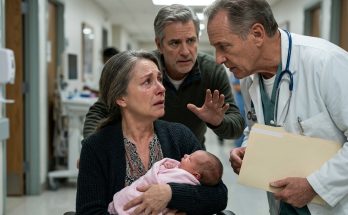
At seventy-one, I had a stroke.
Not the dramatic kind people recognize instantly from across a room. My speech began to blur while I was standing in my kitchen, and when I reached for my phone, my right hand felt strangely weak. For perhaps twenty seconds I considered sitting down and waiting.
Then I remembered Arthur.
I called 911 myself.
The hospital confirmed a minor ischemic stroke. The weakness improved quickly. My speech returned to normal. Scans showed no catastrophic damage, and the doctors expected no major permanent disability.
“Minor” is an interesting word when someone uses it about your brain.
Sarah drove from Spokane immediately. Mia came with her. I saw them enter my hospital room and hated the fear on Sarah’s face.
She had watched Elena die.
Then Thomas.
Now her grandmother lay under fluorescent lights wearing a hospital bracelet.
Emotional history can repeat even when the medical facts do not.
“I’m okay,” I said.
“You had a stroke.”
“A small one.”
“That sentence is not comforting.”
Fair.
The doctors recommended medication, blood-pressure management, follow-up appointments, and rehabilitation. I could go home, but they wanted someone checking on me during the first stretch.
Sarah offered to stay as long as necessary.
I said no.
Immediately.
Then I asked myself why.
Pride was the answer dressed up as independence.
For decades I had treated needing another person as the first step toward owing them something. After Arthur died, self-sufficiency had been survival. Now it had become reflex.
Need is not debt.
I accepted five days.
After that I hired morning home help for two weeks, and Sarah returned to work. She called daily at first. Then less often when I proved capable of taking pills without supervision.
No one became my permanent rescuer.
That mattered to both of us.
The hospital bills after insurance were manageable but not trivial. Rehabilitation, copays, follow-up imaging, medications—several thousand dollars accumulated.
I had ordinary checking and savings.
I also had the restitution account.
For nearly an hour I considered paying everything from checking.
The irrationality annoyed me. I had accepted the money legally. I had used some already. Yet spending it on something as intimate as my health made the source suddenly visible again.
Thomas.
The empty safe.
Arthur.
Vance’s Hearth.
Dr. Cole listened to my explanation.
Then asked, “Whose money is it?”
“Mine.”
“Use your money for your life.”
Sometimes therapy is annoyingly expensive for sentences that fit on a refrigerator magnet.
I paid the medical bills from the account.
Nothing happened.
No moral thunder.
No sense of Thomas purchasing forgiveness from beyond the grave.
The bills simply became paid.
Then I used the same funds to install grab bars and improve lighting. A year later, I moved into a one-level condo because the stairs in my apartment had become more irritating than useful.
That move changed how I understood the money.
Arthur had built the original reserve for emergencies and future security. Thomas stole it. Decades later, he rebuilt a larger fund.
Using that money for my health did not honor Thomas.
It restored the function Arthur had intended.
Security.
The distinction freed something in me.
I sold a few pieces of furniture and donated more. I kept the chipped blue mug. Arthur’s account book. A limited number of Thomas’s letters. The pocketknife.
Sarah helped pack only after asking.
She did not walk through my belongings deciding what she wanted someday.
Another good boundary.
I updated my estate plan after the stroke. Sarah was included, but I did not give her a spreadsheet of everything I owned.
“You are one of my beneficiaries,” I told her.
“Okay.”
She did not ask how much.
Some assets would eventually go to Sarah. I designated another portion for a cardiac rehabilitation charity in Arthur’s name. A smaller share would support a professionally administered emergency fund for struggling local businesses.
I understood now how quickly one business crisis could spread into a family.
I specifically chose not to establish anything in Thomas’s name.
His story was too complicated for a plaque.
I did not want a scholarship or fund that required reducing him either to redeemed son or notorious thief.
Sarah agreed.
Then she asked, “Why not give all the restitution money away?”
I looked at her.
“Because I’m still alive.”
She laughed.
Exactly.
I had spent much of my life around women who considered leaving money untouched for children a form of virtue. I rejected that. My housing came first. My healthcare. My security. Even my enjoyment.
Whatever remained could become inheritance.
Sarah smiled. “Dad probably would’ve wanted you to use it.”
The old reflex rose in me.
Then passed.
“Maybe.”
I no longer needed to reject every connection to Thomas. He had intended the fund to reach me. Fine. Intent did not grant him continuing authority over how I used it.
At seventy-two, I officially retired.
No clients.
No emergency payroll reconciliations.
No small-business owner calling Sunday night because he had lost a receipt from March.
I sent my final invoice, reconciled my own records, and put the red pen into a drawer.
Sarah and Mia took me to lunch.
Sarah raised her glass.
“To never balancing another stranger’s books.”
“Speak for yourself,” I said. “I still check restaurant bills.”
Mia nodded. “She does.”
Retirement unsettled me more than expected. Work had saved me after Arthur died. It provided money, yes, but also structure. Competence. Proof each morning that I could still produce something useful after my family collapsed.
Without clients, entire days belonged to me.
At first that felt suspicious.
I volunteered with a community tax-assistance program for one season. Two mornings each week. Then I stopped because I hated their software.
The ability to stop was the point.
Choice again.
My health remained stable. No second stroke. I walked every day. Took medication. Complained about statins. Attended appointments.
Normal aging.
But the stroke exposed another survival rule I had carried too long.
Never depend on anyone.
That rule had protected me at forty-two.
At seventy-two it could become dangerous.
I began building a support system deliberately. Sarah and Mia. Two neighbors I trusted. My doctors. A professional fiduciary named in documents if I ever needed one. Building management.
No single rescuer.
Security, I discovered, was not just a number in an account.
It was money, people, systems, information, and choices.
Arthur understood some of that.
I learned the rest slowly.
My stroke also changed my relationship with medical fear. Arthur’s collapse had taught me that a body could fail suddenly. For years, every strange heartbeat or tight muscle became a prediction.
Now my own body had produced a genuine emergency.
And I survived it.
That gave me a second fact.
Bodies can fail.
Bodies can also recover.
I needed both.
I learned the warning signs of stroke. Kept an emergency medication list. Updated my healthcare proxy. Followed my doctors.
Then I tried to live between appointments.
Sarah helped.
Whenever I spiraled into “what if,” she asked, “What did the doctor actually say?”
Facts again.
I had apparently raised a son who hid from facts and somehow acquired a granddaughter who kept returning me to them.
After moving into the condo, I reviewed emergency access.
For years nobody had possessed a key to my home.
That had once felt like independence.
Now it looked a little like isolation.
I gave one emergency key to building management under their policy and another to Sarah.
“Emergency only unless I invite you.”
She rolled her eyes.
“Say it.”
“Emergency only.”
“Good.”
Keys are small objects with real power. Family access should not become presumed access simply because people love each other.
Later, when I failed to answer during another medical episode and building staff contacted Sarah, the system worked exactly as intended. She used the key because there was a legitimate concern.
She did not use it to surprise me.
She did not inspect my home.
Trust worked because the boundary had been explicit before anyone needed it.
The condo move forced another decision: who needed to know the origin of the restitution funds?
My financial adviser did.
My tax preparer did.
Helen did.
My estate documents required appropriate records.
My neighbors did not.
My casual friends did not.
Sarah needed enough information to administer things eventually, but she did not need every statement today.
Healthy privacy lived between secrecy and spectacle.
Thomas had hidden information people needed to make choices. After his death, the pendulum could easily have swung toward exposing everything.
I refused both extremes.
My rule became simple.
Who needs this information to make a legitimate decision?
If the answer was no one, the story could remain private.
The same would someday apply to children in the family. They would receive truth when the truth belonged to decisions they were old enough to understand.
Information is power too.
Use it proportionately.
The night I finished updating my estate papers, I opened the restitution account online.
For once I did not see the stolen $247,800.
I saw paid medical bills.
A safer home.
A retirement I could actually live.
The money had stopped being Thomas’s apology.
It was becoming what Arthur had intended money to be before any of us knew how badly things could go.
Protection for the life still happening.
Click here to continue reading: PART 11: Sarah’s wedding brought Thomas’s absence into every joyful decision, but Eleanor refused to let guilt assign family roles that the living had never chosen
Inside Thomas’s locked safe, Eleanor found proof of his theft—and evidence that another man had helped turn one desperate choice into decades of silence
Part 10 of 16