PART 1
“If you don’t give your card to my sister, then get out of my house.”
That’s what my husband yelled at me for a few seconds before throwing the boiling coffee straight in my face.
He didn’t slip his cup. It wasn’t an accident. It wasn’t “unintentional.”
He did it because I refused to continue supporting his sister.
My name is Alejandra Moreno, I am thirty-four years old and I live in Ecatepec. Until that Saturday morning I still repeated to myself the lie that my marriage with Iván Salgado was worn out by routine, by normal fights, by fatigue. I needed to accept the truth: I was not living with a difficult man, I was living with a cruel man.
Iván was thirty-nine, sold pre-owned cars and was one of those who liked him as soon as they opened their mouths. Outside he was nice, a joker, “a real gentleman”. At home he was something else: bossy, impulsive, and increasingly accustomed to talking to me as if I were an employee who owed him obedience.
His sister, Brenda, was worse. She always came with a new need. A bag because “I almost didn’t like them,” money “just for this week,” my perfumes, my jackets, even my sneakers. And when I set a limit, Ivan would get angry as if I was disrespecting his whole family.
That morning I was in the kitchen, working on my laptop. I’m an accountant and I had to close some reports before noon. Iván saw a message on his cell phone, let out a snort and said, without even looking at me:
“Brenda is stuck this month. Swipe her your card and then they settle accounts.
I looked up and answered bluntly:
“No. I already lent him twice and he never paid me.
He put the cup down on the table with a thud.
“I’m not asking for your opinion, Ale. I’m telling you what you’re going to do.
“And I’m telling you no.
It all happened in a second. He grabbed the cup, got up, and threw the coffee in my face.
I felt my skin being torn off. The heat burned my cheek, neck, and part of my chest. I screamed, threw the chair, and ran to the sink. I turned on the faucet with trembling hands as the water dripped down my blouse. I couldn’t even pull my hair away from my forehead.
But the most horrible thing was not the pain.
It was hearing her voice behind me, cold, calm, as if she had just corrected a tantrum girl.
“Let’s see if that’s how you learn.” Brenda will come later. You give her what she asks for… or you leave.
I turned slowly. There I was, leaning against the bar, without guilt, without fear, without a hint of shame.
And then I understood.
That man no longer saw me as his wife. He saw me as something he could use, humiliate, and break.
I didn’t say anything. I took ice, a bag, my keys and my cell phone. I went down alone, asked for a taxi and went to the emergency room. There they treated me, cleaned my burn, took photos and gave me a medical report. When they asked me if I wanted to report, I said yes before fear made me change my mind.
Then I returned to the apartment accompanied by two policemen. I put my clothes, my documents, my computer, my mother’s jewelry, my hard drives, my notebooks and even the coffee maker I bought with my first Christmas bonus. Each empty drawer hurt me, but it also woke me up.
I wasn’t leaving a marriage.
I was being kicked out of my own life.
At twenty past seven I heard the key at the door. Iván was laughing with Brenda.
And what they found when they entered was not a couple’s argument.
It was the beginning of the worst nightmare of their lives.
They couldn’t imagine what was about to happen.
Iván came in smiling, with Brenda behind him, but as soon as he saw me his face was erased.
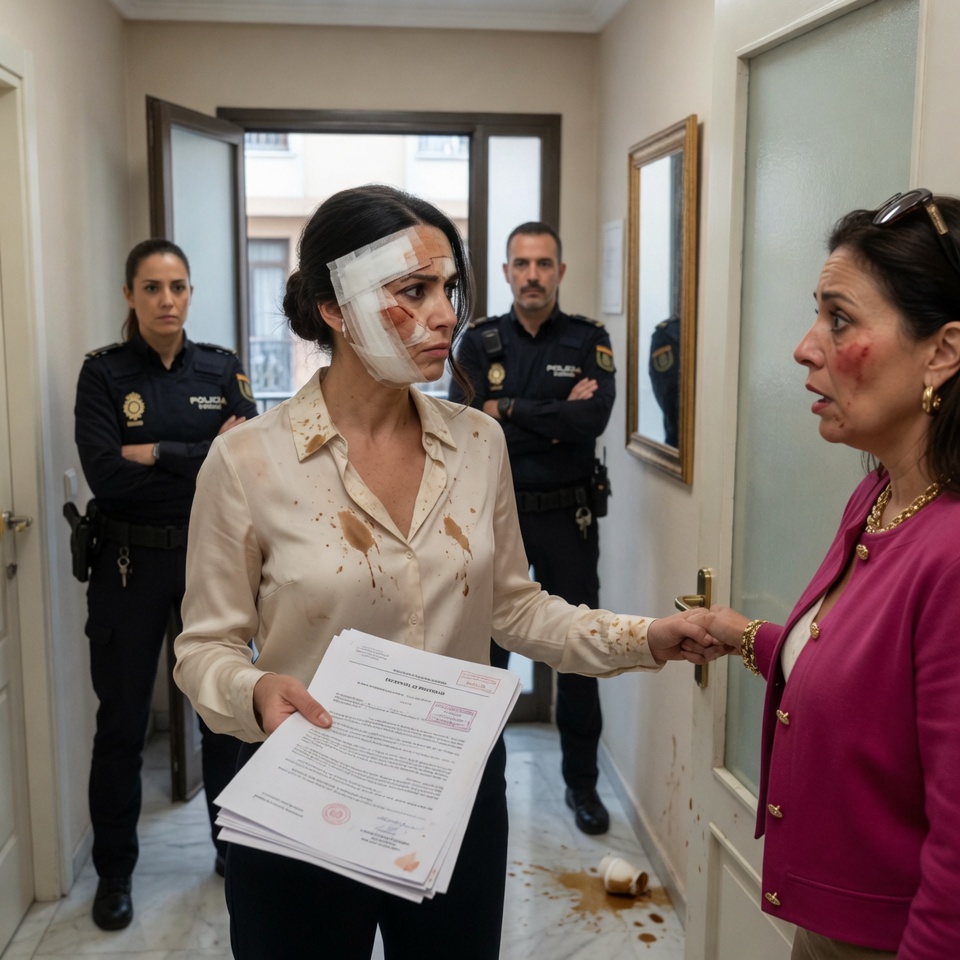
I was standing in the middle of the room with my cheek bandaged, two policemen next to me, several boxes by the door and a copy of the complaint on the table. I left my wedding ring on top.
Brenda was the first to react, but not with surprise, but with courage.
“Did you call the police because of a fight between husband and wife?”
One of the agents silenced her with a pure look.
“Moderate your tone, ma’am.
Iván ran me up and down. I’m sure he didn’t understand what he saw. He was used to me crying, locking myself in the bathroom and after a while going out to pick up what was broken. Not to finding myself firm, silent and, above all, accompanied.
“Alejandra, take two lines down this show,” he said. “You’re exaggerating.
I took the medical report out of my bag and gave it to the policeman, not him.
“I’m not going to talk to you without witnesses.
That did get him out of control.
“Witnesses? Now you want to pass me off as a criminal because a cup went out of my hand?”
I looked straight at him.
“It didn’t go away. You threw it at me.
Brenda let out a dry, hateful laugh.
“Oh, please, how dramatic. Not that I would have killed you.
The tallest policeman stepped forward.
“One more word and we will also take note of your conduct. You have already been instructed to keep silent.
I continued to put my things away. In a blue folder I carried my birth certificate, my account statements, maintenance receipts and, out of habit rather than strategy, other papers that I had been filing for months. There was the deed of the apartment, in my name, signed two years before I married Iván. There were also several messages from Brenda asking me for money and one from Iván, sent the night before: “If my sister occupies something, you give it to her and that’s it.”
When I went to the room to get my last suitcase, Ivan tried to follow me, but the officer stopped him. Then he did what he did best: adjust his shirt, put on a soft voice and act like a victim.
“Officer, my wife is upset. Let us talk alone, this can be arranged.
“I don’t want to fix anything alone with you,” I replied without turning around.
I signed the accompaniment act and left the keys to the building on the entrance cabinet. But the keys to the apartment were still in my hand.
Ivan saw them and frowned.
“And why don’t you leave those?”
I took a deep breath. That moment changed everything.
“Because this apartment is mine. I bought it before I married you.
I felt the silence fall in the room.
Brenda opened her eyes.
“Don’t be inventing.
I took out the copy of the deed and showed it to the policeman. My name was there, clear, with no room for his lies.
Ivan’s face changed color. For the first time he didn’t look angry, but scared. He’s lived there for six years and never bothered to understand that he was in a house that didn’t belong to him.
“You can’t leave my brother on the street,” Brenda shouted.
I looked at her with a calmness that I no longer knew in myself.
“I didn’t leave him on the street. He burned my face in my own kitchen to please you.
That night I went to the Public Prosecutor’s Office to ratify the complaint. I handed over photos, medical reports, messages and even an old voice note where Iván, drunk, said that “in his house they did what his family decided.” I slept at my friend Marisol’s house, with my cell phone vibrating non-stop. Her mother called me to ask me to be “prudent.” A cousin of hers wrote to me not to destroy my marriage because of “courage.” And Brenda sent me an audio demanding my bags because, according to her, “I wasn’t even going to need them anymore.”
I kept everything.
Two days later, at the family court, Iván arrived in a suit and the face of an offended man. I arrived with my lawyer and half of my face was still red. The judge reviewed my evidence, listened to their version and, when Iván insisted that it had all been an accident, asked him why he then ordered me to leave “his house” and hand over my things to his sister.
Ivan did not answer.
That afternoon they issued a provisional restraining order and prohibited him from approaching the apartment.
I left trembling, with my legs weak, but understanding something that shook me more than the coffee:
For the first time in years, the fear was no longer mine.
And yet… I still didn’t know the secret that would end up sinking them both.
When I discovered it, I understood that the worst was just to come.
I returned to my apartment three days later, accompanied by a locksmith and two agents. I changed the sheet metal that same morning. The kitchen was still the same, except for the broken cup that no one bothered to pick up. I swept it, opened all the windows, and tried to convince myself that the new air could clean up more than just the smell of burning coffee.
The following weeks were cold, exact, full of papers. My lawyer forbade me to answer calls, fall into provocations or accept meetings “to talk”. I obeyed. We filed for divorce, asked for reparations of damages and put together a complete inventory of everything that was mine.
That’s when I found something that left me cold.
Going through an old folder of account statements, I noticed several charges that didn’t add up. Small transfers at first. Then larger deposits. Online purchases. Withdrawals. Everything came out of a shared account where I deposited for household services and expenses. I kept pulling the thread and discovered that, for more than a year, Iván had been using that account to support Brenda: rent, cell phone, clothes, even the down payment on a car.
And not only that.
She had also requested, without telling me, an additional card to my line of credit using my tax information, which Brenda had been using for months as if it were her own.
My stomach turned.
It was no longer just violence. It was abuse, control and theft.
We gave everything to the prosecutor: bank movements, bank emails, arrests, dates. When Brenda was summoned, she still had the nerve to say that “her brother had told her that I agreed.” But the digital signature, the accesses, the messages and the schedules did not allow her to sustain the lie.
Four months later the main audience arrived. Iván no longer had that salesman’s smile that half the world fell in love with. He looked tired, furious, aged. Brenda was sitting in the back, with the same haughty face, although now she avoided looking at me.
The prosecutor exposed everything with brutal clarity: economic pressure in favor of a third party, refusal of the victim, aggression with boiling liquid, attempted expulsion from the home and improper use of property. The defense wanted to reduce it to “domestic problems” and “financial misunderstandings.” No one believed them.
The sentence came out weeks later.
Iván was convicted of injuries and coercion, in addition to being forced to pay compensation for the physical and emotional consequences. He also lost any right to remain in the apartment and the order not to approach or communicate with me for years was confirmed.
Brenda, for her part, had to answer for the fraud derived from the use of the additional card and return part of the money. What hurt her the most was not paying, but that the whole family found out that she had been making a living from manipulating others for years.
There was no scene from a novel. There were no knees on the floor or miraculous apologies. Just signatures, deadlines, frozen accounts and two people discovering that impunity does not last forever.
Six months later I painted my kitchen white, threw down the table where Iván yelled at me and bought another, round, small, next to the window. Marisol came to help me set up the chairs. We toasted with tea, not coffee.
That night, before going to sleep, I stared at the new lock and understood something that broke and healed me at the same time:
I hadn’t escaped. I had gotten my house, my name, and my life back.
The last time I heard from Iván was through a judicial transfer with the concept of compensation. I saw it for a few seconds, closed the bank app and continued to order my books. Outside it was raining on Ecatepec. Inside, finally, no one was in charge but me.
And since then, every time someone tells me that a woman must “hold on for love,” I remember my burned face, the broken cup, and that man’s silence when he understood that he was never going to touch me or use me again.
Because love does not humiliate you.
Because the family does not dispossess you.
Because whoever burns you to subdue you does not deserve forgiveness, deserves consequences.
And that, although it makes many uncomfortable, is also justice.