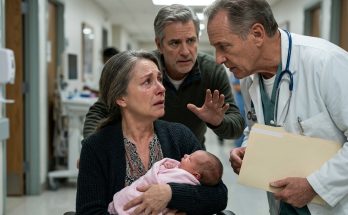
At 6:20 on a Thursday morning, my husband called from St. Matthew’s Medical Center and asked me to come immediately. He wouldn't explain why he was there. He wouldn't tell me who needed help. The only instruction he gave me was not to bring our sons. After thirty-three years of marriage, I knew David's voice well enough to recognize when he was frightened. What disturbed me most was that he sounded as though he had already decided what I was allowed to know.
“David, tell me what's happened.” I was sitting upright in bed, one hand pressed against the mattress. Outside, the first delivery truck of the morning rattled past our house. “Are you injured?”
“No. I'm all right.”
“Then who is in the hospital?”
He took so long to answer that I checked whether the call had disconnected.
“Linda, please come. I'll explain when you're here.”
I drove across town without remembering a single traffic light. At fifty-four, I had survived enough family emergencies to know that panic rarely improved anything. But this was different. David was the steady one, the man who read instructions before assembling furniture and checked the tires before every long drive. He did not summon me to a hospital without giving me a reason unless something had gone terribly wrong.
I found him outside the maternity ward, standing beneath a fluorescent light with a newborn girl against his chest. Her white hospital cap had slipped sideways, exposing a narrow patch of dark hair. One small hand rested above the blanket. David looked as though he had been awake for days. When he saw me, relief crossed his face, followed by an expression I could not identify.
“Whose baby is that?” I asked.
He stepped closer. “Her name is Grace.”
“That isn't what I asked.”
He looked down at the child, adjusted the blanket beneath her chin, and said, “She's ours.”
I stared at him. There were several ways to understand those words, and none made sense. Our youngest son, Noah, was seventeen. Matthew and Jonah were grown men. I had spent the previous evening sorting old family photographs, not preparing for another child. Yet David placed the baby in my arms as carefully as if he had been waiting years to do it.
Grace stirred. Her mouth opened in a sleepy, uncertain movement, and her fingers curled around the loose thread of my cardigan. I felt the warmth of her cheek against my wrist. Something old and painfully familiar moved inside me. I had raised three sons whom I loved beyond explanation, but there had once been another child, a girl whose existence had ended before I was permitted to hold her. David knew that history. He knew what a daughter had meant to me long before our marriage.
“David,” I said, keeping my voice low because the baby was settling. “What have you done?”
Before he could answer, a physician approached us. He introduced himself as Dr. Patel and asked whether he could speak with me privately. David immediately objected, saying we could discuss everything together. The doctor remained courteous but firm. He told David to wait outside with Grace. I handed her back reluctantly, already aware that I was being separated from the one innocent person in a situation I did not understand.
Dr. Patel's office was small, with two visitor chairs and a window overlooking the parking garage. He offered me water. I refused. He asked what David had told me about Grace, and when I said almost nothing, his expression tightened. He opened a folder and placed a laboratory report in front of me.
The first page identified David Carter and showed that biological paternity had been excluded. I read the conclusion twice before looking up.
“If David isn't her father, why did he bring me here?”
“Mrs. Carter, there's another report you need to see.”
He turned the page. My name appeared beside the laboratory's findings. The report described a close biological relationship between Grace and me, consistent with a grandmother and granddaughter. The stated probability was 99.8 percent. I could read the individual words, but my mind refused to arrange them into anything meaningful.
“That's not possible,” I said. “I have three sons. None of them has a baby daughter.”
Dr. Patel watched me carefully. “There's someone here who can explain part of this.”
A woman spoke from the hallway before he finished. Her voice was strained, and I heard a nurse ask her to move slowly. When the door opened, a pale young woman stood beside an IV pole, wearing a hospital gown beneath a loose robe. She was exhausted, visibly unsteady, and looking directly at me.
“My name is Claire Bennett,” she said. “I'm Grace's mother.”
I waited for her to continue. There was something unsettling about her face, particularly the shape of her eyes, but I was too frightened to decide why.
Claire explained that she had delivered Grace at 2:11 that morning after doctors induced labor because of severe preeclampsia. Heavy bleeding had complicated the delivery, and she had needed emergency treatment afterward. David had been listed as someone the hospital could contact while she was unable to make decisions. The explanation answered one question while making the others considerably worse.
“How do you know my husband?” I asked.
“I contacted him in May.”
It was September. Four months had passed since May. I thought of every ordinary evening during those months: David cutting tomatoes beside me, asking whether Noah had finished his homework, telling me about a problem at work. Nothing in his behavior had suggested he was carrying information important enough to bring him to a maternity ward before sunrise.
Claire noticed the direction of my thoughts. “It isn't what you're imagining. I contacted him because I was trying to find my biological family.”
She told me she had been adopted as an infant. Her adoptive parents had never concealed it, and she spoke of them with affection. The previous year, after a pregnancy that ended in miscarriage at eleven weeks, she had begun researching her family medical history. An ancestry test led to distant relatives, and a cousin helped her trace possible connections. Eventually she found my name, an old wedding announcement, and photographs of our family.
“I thought David might be my biological father,” she admitted. “I wasn't certain about the dates, and I didn't want to contact you without understanding what I might be walking into.”
The room seemed to tilt. I had known David since I was eighteen, but there had been a life before him. A summer that my family rarely mentioned. A small hospital two counties away. My mother standing beside a bed, refusing to meet my eyes.
I had been sixteen when I became pregnant. My mother arranged for me to spend the final months at a residence for unmarried girls, telling our neighbors that I was staying with relatives. At St. Anne's Hospital, I delivered a baby girl. I remembered the exhaustion afterward, the harsh brightness of the room, and my mother's voice telling me that the baby had died. When I asked to see my daughter, she said it would only make things harder.
I had believed her because I was sixteen, frightened, and dependent on the adults around me. I carried that loss into adulthood. David knew about it before we married. He understood why I bought a little pink blanket during my first pregnancy, although neither of us had any reason to expect a girl. When Matthew arrived, I folded the blanket away. After Jonah and Noah, I finally placed it in a box at the back of the closet.
“What date were you born?” I asked Claire.
She answered, and the last sound in the room seemed to disappear. It was the date written on the hospital papers I had kept hidden for nearly four decades.
Dr. Patel explained that David had undergone testing after Claire approached him. The results ruled him out as her biological father. A separate comparison involving Claire and a sample attributed to me strongly supported a mother-daughter relationship. With Claire's consent, additional testing concerning Grace had been arranged to clarify the family's biological connections and medical history.
I looked at the papers, then at Claire. She was thirty-seven, nearly thirty-eight. She had spent her life believing she had been placed for adoption. I had spent those same years believing my daughter was dead. Both of us had built entire lives around explanations that could not be true at the same time.
“My mother told me you died,” I said.
Claire pressed her lips together. “I know. David told me.”
The fact that David had already told her about my most private grief hurt in a way I could not immediately describe. He had shared something I had entrusted to him while keeping the existence of the woman standing before me a secret. I was grateful Claire knew the truth, and furious that I had not been included in the conversation.
When David entered the office carrying Grace, I asked him whether he had known Claire was my daughter before that morning. He admitted he had received the confirming results earlier. He said he had wanted to be certain before telling me. I asked why certainty had required four months. He looked toward Claire, then at the baby, and could not give me an answer that satisfied either of us.
Claire interrupted. She admitted she had asked him to keep their contact private initially because she wasn't sure she wanted a relationship with me. She hadn't been searching for money, another household, or a replacement for the parents who raised her. She wanted to understand why she had been adopted and whether the woman named in her records had chosen to give her away.
I asked who had arranged the adoption. Claire named a private agency called Family Path. She had documents showing that the adoption had been authorized, including papers bearing what appeared to be my signature. My hands grew cold. I remembered signing forms after the delivery, while my mother pointed to lines and told me they were necessary. I had never understood exactly what I was signing.
Dr. Patel reminded Claire that she needed rest. The nurse moved closer to help her return to her room. Before leaving, Claire glanced at Grace and asked whether I wanted to hold her again. I accepted without hesitation. Grace settled against me, unaware that three adults had spent the morning questioning everything they believed about their family.
I told Claire I would remain at the hospital. I wanted to speak to her when she felt stronger, and I wanted to see whatever records she was willing to share. I did not ask her to call me Mother. I had no right to demand that from a woman I had met less than an hour earlier. But when she reached the doorway, she turned and asked quietly whether I would still be there after she slept.
“Yes,” I said. “I will.”
After she left, David reached toward my shoulder. I moved away. I told him we would discuss his silence, but not while Grace was sleeping in my arms. He lowered his hand and nodded. For the first time that morning, he seemed to understand that his intentions would not erase the consequences of his decisions.
I looked down at Grace's face and understood something that frightened me more than the DNA results. The newborn was not the mystery. She was the living evidence that someone had lied to me about my first child, and that lie had shaped nearly forty years of my life. Somewhere, there were records explaining what happened at St. Anne's. Somewhere, someone had known my daughter was alive.
And I was going to find out who.
Click here to continue reading: PART 2: As My Daughter Recovered From Childbirth, David Revealed How He Had Found Her and Crossed a Boundary I Never Expected
My Husband Called Me to the Maternity Ward Before Sunrise, Where a Newborn and Two DNA Reports Challenged Everything I Believed
Part 1 of 16