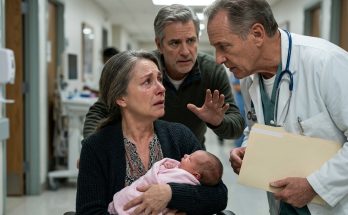
Julian stopped smiling the instant he saw the doctor holding my son. The change was so complete that, for a second, I forgot the pain pulsing through my abdomen and the exhaustion dragging at my eyelids. A moment earlier Julian had been standing near the door with the polished composure he used in boardrooms and court meetings. Now his face had gone colorless. Across the room, the doctor stared back at him with the same stunned recognition. Neither man seemed willing to speak first.
My baby made a small, irritated sound against the doctor's chest. The monitor beside my bed kept its steady electronic rhythm. I focused on the name printed beneath the doctor's photograph: Adrian Shaw, M.D., Neonatology. He looked from Julian to the baby again, studying the child's face with an intensity that made my skin tighten. Julian finally said his name. "Dr. Shaw." The doctor's answer was equally restrained. "Mr. Vance." Two ordinary greetings, yet there was nothing ordinary in the silence around them.
I pushed myself upright, and a sharp ache reminded me that I had given birth only a short time earlier. "Would one of you please explain what's happening?" Julian moved farther into the room. His suit jacket was still perfectly pressed. Mine was not a world of pressed jackets anymore. I had spent hours in labor without him. He had appeared only after our son was born, carrying no flowers, no apology, and no visible concern about what the delivery had cost me physically. "Vivian," he said, "this isn't the moment."
A bitter laugh escaped me before I could stop it. It hurt enough that I pressed a hand against my abdomen. "I gave birth without my husband, and now a doctor looks at my child as if he's recognized someone he shouldn't be seeing. I think we've passed the point where you decide what moment is appropriate." Dr. Shaw lowered his gaze briefly. When he looked back at me, his expression was careful rather than evasive. "Your son appears well at the moment," he said. That was reassuring for perhaps half a second.
"Then why did you react like that?" I asked. Dr. Shaw admitted he had spoken too quickly when he first saw the baby. Julian seized on the admission immediately. "Exactly. He made a mistake." Dr. Shaw did not support that interpretation. Instead, he explained that he knew Julian from an earlier medical situation and that information from that history might matter to my newborn's care. He could not simply disclose another patient's private records, but he believed the family history needed clarification.
My pulse accelerated. "What kind of history?" Julian's voice cut across mine. "Vivian, enough." I turned toward him. Three months earlier, he had placed divorce papers on our dining-room table while I was pregnant and described the timing as regrettable. Soon afterward my access to shared money had tightened. My health coverage disappeared so abruptly that my obstetrician's office called me about it before I understood what Julian had done. Then came the whispers about my pregnancy. Julian never directly called me unfaithful. He did something more calculated.
He told people he had concerns about the timing. He suggested that I understood why he had questions. His mother, Eleanor, repeated that the family was waiting for the truth. Nothing explicit enough to make a clean accusation. Just enough uncertainty to spread through our social circle until invitations stopped arriving and acquaintances began looking at my stomach before looking at my face. Now the same man who had allowed everyone to wonder whether the baby belonged to him stood in my hospital room behaving as if fatherhood were suddenly unquestionable.
"Get out," I said. Julian's mouth tightened. Instead of leaving, he told me we needed to discuss custody. Dr. Shaw actually turned toward him in disbelief. "At this moment?" Julian barely acknowledged him. His attorney, he explained, had advised him to establish contact with the baby immediately. That sentence told me exactly why he had come. Not because he had spent the morning worrying about me. Not because seeing his newborn son had changed him. He had come because someone billing by the hour had told him it mattered legally.
"You came because your lawyer sent you," I said. Julian's eyes hardened. "I came because he's my son." I reminded him that he had spent months encouraging people to believe otherwise. "I never said he wasn't mine." Technically, he was right. Julian had always been skilled at leaving himself room to retreat. He had supplied implication rather than accusation and let other people complete the sentence. I was about to answer when Dr. Shaw handed my son carefully to a nurse and said he wanted a cardiac evaluation.
Fear erased everything else. "Why?" Julian answered before the doctor could. "No." The room seemed to contract around that single word. Dr. Shaw's posture changed. His voice remained controlled, but the professional courtesy vanished from it. "This baby is my patient." Julian repeated his objection. Dr. Shaw reminded him that he was not the only parent present. Then he turned to me and recommended an echocardiogram and consultation with pediatric cardiology before discharge. He emphasized that nothing currently suggested an emergency.
"What did you see?" I asked. Dr. Shaw hesitated, then said my son strongly resembled a child he had treated years earlier. I looked at Julian. He was no longer merely uncomfortable. He looked frightened. "Who was the child?" I asked. Julian's answer came quickly. "That's private." Something inside me went cold. "Not if the information affects my baby's health." Dr. Shaw explained that he could not reveal another patient's confidential history without proper authorization, although Julian could permit disclosure of relevant family medical information.
"Then authorize it," I said. Julian refused. No explanation. No request for time. Just a flat refusal. The nurse beside me shifted her weight, and even through my exhaustion I noticed the reaction. Dr. Shaw's jaw tightened. He said he would document his recommendation and proceed with the baby's evaluation on the medical information legitimately available to him. He did not need to expose another patient's identity to order appropriate care. That distinction steadied me. Whatever secret existed, my son would not be denied medical attention because Julian wanted silence.
The nurse returned my baby to me. His body was astonishingly warm and light against my chest. His dark hair lay damp against his scalp, and his fingers opened and closed until one wrapped around mine. I studied his nose, his mouth, the line of his chin. Which feature had stopped Dr. Shaw in his tracks? Beside the bed, Julian watched him too, but the emotion on his face did not look like simple tenderness. It looked like someone staring at a memory he had spent years trying to bury.
I asked Julian to leave again. He took a step closer, and the nurse quietly positioned herself between him and the bed. She did not threaten him or raise her voice. She simply told him I had requested privacy. Julian reminded everyone that he was the father. "You're also the husband who filed for divorce while I was pregnant," I said. He corrected me automatically: I had already been pregnant when he decided to end the marriage. Even then he cared about precision when precision protected him.
Dr. Shaw started toward the door to contact cardiology. Julian reached out and caught his arm. The contact lasted perhaps a second, but everyone saw it. Dr. Shaw looked down at Julian's hand until he released him. "If you disagree with my recommendation," he said, "there are proper ways to address it. You will not interfere with treatment." Julian stepped back. The metal face of his expensive watch flashed beneath the fluorescent lights, and the sight of it triggered a memory I had nearly forgotten.
He had been adjusting that same watch the afternoon I told him I was pregnant. Two weeks later, while collecting financial documents after the divorce papers appeared, I found an invoice in an archived family email account. North Cascade Reproductive Medicine. Julian Vance. Confidential male fertility evaluation. I had saved it because Naomi Patel, the attorney I had quietly hired, had told me to preserve potentially relevant records I could lawfully access. At the time, the fertility invoice seemed strange but disconnected from everything else.
Now it no longer seemed disconnected. Why had Julian visited a fertility clinic immediately after learning I was pregnant? Why had he never mentioned it? I stared at him long enough that he noticed. "What?" he asked. For months he had possessed information I did not. For once, I decided not to surrender what I knew. "Nothing." His eyes narrowed. That tiny choice felt unfamiliar. I wasn't hiding information to manipulate him. I simply understood, finally, that I did not owe him every thought while he continued withholding facts that might concern our child's health.
Hospital staff eventually reinforced my request for privacy. There was no dramatic confrontation. Security did not drag Julian away. A staff member simply told him that, for the moment, he needed to leave the room. Before he went, Julian said his attorney would contact mine. I told him that was fine. He paused. "You have an attorney?" The surprise on his face almost made me smile. He had apparently mistaken reduced access to money for an inability to protect myself. "Yes, Julian. I do."
Twenty minutes later, Dr. Shaw returned. Pediatric cardiology could evaluate the baby that afternoon. I asked the question I cared about most: was my son in immediate danger? He said nothing he had observed suggested that. Then, after making sure the door was closed, he gave me as much information as professional rules allowed. More than a decade earlier, he had treated an infant connected to the Vance family. He could not identify the child without authorization, but the case involved a potentially inherited cardiac condition.
I swallowed. "What should I ask Julian?" Dr. Shaw considered his answer before speaking. "Ask whether he has ever had another biological child. And ask whether inherited cardiomyopathy has been identified in his family." The first question hit harder than the second. Another child. Julian and I had been married for five years. We had discussed children, postponing them, perhaps having them someday. Never once had he mentioned already being a father. Not during our courtship. Not during our marriage. Not when I became pregnant.
"Is that child alive?" I asked. Dr. Shaw's face changed before he answered. He said he could not discuss another patient's status. He did not need to. I looked down at the newborn breathing against me and felt the pieces begin arranging themselves into a shape I did not yet understand. A doctor who remembered a Vance infant. Julian's panic. A fertility clinic invoice. A possible inherited heart condition. Another child whom my husband had erased from every version of his history he had ever shared with me.
Dr. Shaw explained that resemblance was not diagnosis. My son might be completely healthy. Some inherited cardiomyopathies appear later; some never become severe. The correct response was evaluation, appropriate follow-up, and, if indicated, genetic counseling. His measured language helped. I did not need catastrophe. I needed facts. I gave permission for the recommended cardiac workup. Whatever Julian's secret was, I would not let fear turn my baby into a medical mystery before the doctors had evidence.
After Dr. Shaw left, I held my son and watched the rise and fall of his chest. For months Julian and Eleanor had made me feel as though I were the person under examination. My fidelity. My finances. My credibility. My ability to manage without the Vance family. Yet the documents I had preserved told another story: unexplained financial pressure, carefully worded messages, the fertility invoice, and now a physician documenting a legitimate concern about undisclosed family medical history.
I opened the encrypted drive on my phone and found the invoice again. The date sat there quietly, four days after I had told Julian I was pregnant. That detail mattered. He had sought answers almost immediately. Whatever he learned at North Cascade Reproductive Medicine had happened before most of the rumors began. I stared at the screen until the letters blurred. Julian had arrived at the hospital expecting to establish his position as Noah's father. Instead, his reaction to one doctor had exposed a question much larger than paternity.
My son shifted in my arms. I touched his cheek with one finger and made myself a promise that felt less dramatic than necessary and more permanent than anything I had said during my marriage. I would not guess. I would not exaggerate. I would not retaliate with rumors of my own. I would collect what could be proved and protect my child with facts. Somewhere behind Julian's refusal was another baby, another medical history, and a decision he had made long before I knew him. I intended to find out what it was.
Click here to continue reading: PART 2: A Fertility Invoice Revealed What Julian Knew Before the Rumors Began, but the Dead Child in His Past Changed Everything
The Doctor Looked at My Newborn, Then at My Estranged Husband, and Suddenly Everyone in the Delivery Room Went Quiet
Part 1 of 16