Noah's eighteenth birthday changed less and more than I expected.
There was cake.
Friends.
A dinner divided between households only because his schedule made that easier, not because Julian and I still required rigid separation.
There was also paperwork.
At eighteen, the assumptions that had governed Noah's childhood ended.
His medical information belonged to him.
He decided who could access it.
He could authorize us to participate.
He could revoke that authorization.
He could consent to treatment.
He could refuse.
I had known this intellectually for years.
Emotionally, I was less prepared.
At his first appointment after turning eighteen, the receptionist handed Noah the forms.
Not me.
He completed them.
When he reached the authorization section, he glanced over.
"Do you guys want access?"
Julian almost laughed.
"Yes."
Noah smiled.
"At least you're honest."
He authorized both of us for the time being.
For the time being.
Those words were implied even if nobody said them.
The permission was his gift, not our parental entitlement.
Dr. Ortiz had been preparing us for this transition. Eventually Noah would move from pediatric care toward adult inherited-cardiomyopathy specialists. He needed to understand his medications, testing schedule, symptoms, emergency plan, insurance, genetic history, and the significance of the MYBPC3 variant without relying on me to translate everything.
He did.
Mostly.
He still forgot appointments unless they were in his phone.
So did many healthy eighteen-year-olds.
Julian wanted to create a shared family calendar with every medical deadline.
Noah refused.
"I have my own calendar."
Julian looked wounded.
"You miss things."
"So remind me once."
"Once?"
"Yes."
I watched Julian's jaw tighten.
This was precisely the kind of small moment in which our entire family history could repeat itself.
Julian had information.
Julian believed his system was safer.
Therefore Julian wanted authority.
Noah looked at him.
"Dad."
Julian exhaled.
"Fine. One reminder."
That was it.
No courtroom.
No therapist.
No fight.
A son said no.
His father stopped.
I noticed how extraordinary ordinary boundaries could feel when a family had once been built around violating them.
Noah's transition into adulthood brought practical problems too. College decisions had to consider access to appropriate cardiac care, but we refused to let cardiology become the only criterion.
He visited campuses.
One was farther away than Julian liked.
Julian immediately began listing disadvantages.
Distance from specialists.
Emergency transportation.
Continuity of care.
Noah listened.
Then asked, "Do you dislike the school, or are you scared it's far away?"
Julian stopped.
"Both."
"Which one matters more?"
"The fear."
Noah nodded.
"Okay. Then let's talk to my doctor about the fear."
That was better than anything I could have said.
The cardiology team helped establish what resources Noah actually needed. A qualified adult cardiology center within reasonable reach. Transfer of records. Emergency information. Medication access. A plan for symptoms.
Not living within ten minutes of Julian.
Noah ultimately chose a school that satisfied both his academic interests and practical medical needs.
It was not the closest option.
Julian survived.
So did I.
Letting him leave was painful for reasons unrelated to his heart. His bedroom became too neat. Grocery shopping took less time. I stopped hearing music through the wall at midnight.
I had spent years protecting his right to become himself.
Then he did.
There was something almost offensive about how efficiently children use the independence their parents fight to give them.
Noah called often at first.
Then less.
Good.
He handled routine appointments.
Sometimes he invited us to participate remotely.
Sometimes he didn't.
When a follow-up showed a small change that required discussion but no crisis, he told us afterward.
Julian struggled.
"You should have called me before the appointment."
Noah said, "Why?"
"In case there were decisions."
"There weren't."
"What if there had been?"
"Then I would have made them."
Silence.
I could see Julian fighting every instinct he possessed.
Noah softened slightly.
"I'd probably ask what you thought. But asking isn't the same as you deciding."
Julian nodded.
"I know."
That became the test of everything.
Did we believe informed choice only when Noah chose what we preferred?
Or did we believe it when he disagreed?
During his second year away, Noah declined a suggestion from Julian about additional elective cardiac testing beyond what his treating team currently recommended.
Julian had found a specialist publishing promising work and wanted another evaluation.
Noah researched it.
He spoke with his doctors.
Then he said no.
Julian called me.
"Can you talk to him?"
"About what?"
"Getting another opinion."
"Does he understand the option?"
"Yes."
"Has he discussed it with his doctor?"
"Yes."
"Is there an emergency?"
"No."
"Then what do you want me to do?"
"Convince him."
I let the silence answer first.
Finally I said, "No."
Julian was angry.
Not wildly.
Not cruelly.
But angry.
"You don't think we should do everything possible?"
"I think he should make informed decisions about his body."
"He could be wrong."
"So could we."
That ended the conversation badly.
Two days later Julian called again.
"I apologized to him."
I smiled.
"For what?"
"For trying to recruit you."
"Good."
"He still said no."
"I know."
"I hate it."
"You can hate it."
That was adulthood.
The right to choose included the right to make decisions other people disliked.
Noah's condition remained part of his life but not its organizing principle. He studied. He worked. He dated. He made friends who knew nothing about the Vance divorce and had no reason to care.
Eventually he met Lena.
The first time I met her, she asked me whether Noah had always put hot sauce on nearly everything.
"Unfortunately."
Noah looked offended.
Lena laughed.
That was my introduction to the woman who would later become his wife.
She learned about his heart condition from Noah, not from us.
That mattered.
He decided when and how to tell her.
He explained Oliver.
The gene.
His own collapse.
Monitoring.
Future reproductive implications.
Lena did not run.
I thought briefly of Julian telling Dr. Park he had hidden the truth from me because he feared I would leave.
Noah had inherited Julian's gene.
He had not inherited that choice.
Years later, at Noah and Lena's wedding, Julian stood beside me before the ceremony.
We were older.
The hostility that had once made standing near him physically uncomfortable had faded into something more complicated and less consuming.
Noah appeared at the far end of the room.
Julian whispered, "We didn't ruin him."
I looked at him.
"That was never the standard."
He smiled.
"No. I suppose not."
Noah married Lena knowing his medical history, knowing his family history, knowing what genetic inheritance might mean.
Lena married him knowing too.
Nobody had protected their relationship through silence.
That difference mattered more to me than any perfect medical outcome could have.
During the reception Noah danced longer than I thought he should.
I caught myself watching.
Julian noticed.
"His doctor cleared him."
"I know."
"You're doing the face."
I laughed.
"Shut up."
It was perhaps the most normal conversation we had ever had.
Later Noah found me alone near the edge of the reception room.
"You okay?"
"I'm fine."
"You're crying."
"Those aren't mutually exclusive."
He hugged me.
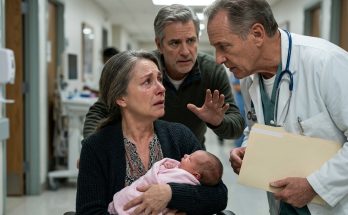
For a moment I remembered him as a newborn beneath hospital lights while Dr. Shaw looked at Julian and recognized another child.
So much of Noah's life had begun inside other people's secrets.
Now he was an adult making promises with full knowledge of the truths that affected him.
That should have felt like the conclusion.
It wasn't.
Because while Noah's life expanded, mine did too.
For years I had been known professionally as the woman whose divorce collided with paternity, inherited disease, and Vance money.
I was tired of being interesting for what had happened to me.
I wanted to become known for what I could actually do.
And the opportunity to choose between those identities arrived sooner than I expected.
Click here to continue reading: PART 12: When My Career Finally Outgrew the Vance Scandal, I Was Offered Fame for Telling Everything and Chose Which Parts of the Truth Were Mine
The Doctor Looked at My Newborn, Then at My Estranged Husband, and Suddenly Everyone in the Delivery Room Went Quiet
Part 11 of 16