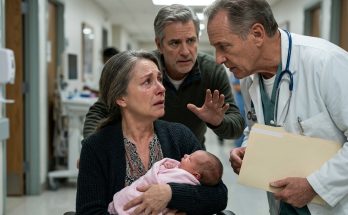
Four days later, the laboratory report arrived. The probability that Julian was Noah's biological father exceeded 99.999 percent. I sat at my kitchen table with Noah sleeping against my chest and read the number until it became meaningless. I had never doubted who I had been with. The result did not correct my memory. What it corrected was the public fiction that Julian and Eleanor had allowed to grow around me. For the first time, their insinuations had something objective standing directly against them.
Julian's attorney moved quickly. Paternity was confirmed, so he requested immediate temporary parenting time. Naomi did not oppose reasonable contact. She opposed treating a DNA report as a deed transferring possession of a newborn. I was still recovering from childbirth and breastfeeding. Julian had little recent experience caring for an infant and almost no functioning co-parenting relationship with me. Those practical realities mattered. So did his concealment of medical information. Biology established one thing. It did not automatically answer every question about schedules, decision-making, or trust.
Pending a temporary hearing, Julian received short daytime visits at an agreed family-services location with professional supervision. His lawyer objected to the supervisor, arguing there was no evidence Julian posed a physical danger. That was true, and Naomi never claimed otherwise. The initial arrangement existed because cooperation between us had collapsed and because the court had not yet reviewed the circumstances. I wanted the process to be defensible. If supervision was later unnecessary, it could be reduced. Noah's relationship with his father was not a tool for punishing my husband.
I stayed outside the room during the first visit. The supervisor's later report was almost painfully ordinary. Julian held Noah for forty-seven minutes. He fed him expressed milk from a bottle. He needed guidance changing a diaper, accepted it, and managed. Noah was returned without incident. I read the report twice. Some part of me had wanted Julian's terrible behavior toward me to make every other part of him equally terrible. Evidence refused to cooperate. He had manipulated me. He had also cared appropriately for Noah during that visit.
The temporary hearing forced us to put those separate truths in the same room. Naomi presented the fertility emails, Eleanor's pressure messages, the timeline showing my restricted access to joint funds, the health-insurance issue, the concealed family medical history, the DNA result, my work history, and my pregnancy-related expenses. She did not call Julian a monster. She did not tell the judge what emotion to feel. She moved through dates and documents with the same precision that had made me hire her in the first place.
Julian's attorney attacked the emails. He suggested I had invaded private accounts after our separation. Naomi had prepared for that. The relevant messages had been obtained from a shared archive while my credentials remained authorized. Other materials whose access status was less certain were not used. That choice cost us potentially useful information, but Naomi considered it essential. "A strong fact doesn't become stronger because we pile questionable evidence beside it," she had told me. Watching her in court, I finally understood the discipline behind that rule.
Then Julian testified. He acknowledged having undergone a vasectomy after Oliver's death. He acknowledged visiting North Cascade Reproductive Medicine after I announced my pregnancy. He acknowledged learning that viable sperm were present. His explanation was that our marriage was already collapsing and he wanted legal advice before telling me anything. Naomi let him finish. Then she asked whether he had informed Eleanor of the fertility result. "Yes." Whether he had informed me. "No." Whether he had allowed paternity uncertainty to continue publicly. His answer became more careful.
Naomi moved to the email. Julian's lawyer challenged its foundation, and the judge dealt with the evidentiary issue before allowing limited use for the temporary proceeding. Once that was settled, Naomi read the crucial line and asked Julian whether he had written it. He looked at the document for several seconds. "Yes." The room felt suddenly smaller. She asked what he meant when he said not to tell me because they needed leverage until I signed. Julian said he had been frustrated and referring to the overall divorce negotiation.
"What leverage?" Naomi asked. Julian's attorney objected, but the question survived in narrowed form. Julian rubbed his thumb against the edge of the witness stand. "Negotiating leverage." Naomi asked whether custody was part of that negotiation. A long silence followed. Then Julian said yes. There was no dramatic confession. He had not plotted to steal a baby or forge a paternity test. What he admitted was quieter and, to me, more revealing: he had knowingly preserved uncertainty about fatherhood because uncertainty gave him bargaining power.
The judge's expression did not change much, but the questions that followed became sharper. Then Naomi turned to Oliver. Julian's entire posture altered. "Do we have to discuss him?" he asked. The judge answered that a previous biological child's relevant medical history could matter when determining whether parents were capable of sharing essential information concerning a newborn. Julian looked down. For the first time since the hearing began, I saw something in him that was not calculation. It was grief, old and poorly contained.
He said Oliver's death had destroyed him. Afterward he underwent the vasectomy because he could not imagine risking another child's life with the same genetic condition. He had never found a way to talk about Oliver with me. I believed him when he said that. Grief can make silence feel like survival. But Naomi did not let explanation become absolution. Had he told me about the vasectomy before we married? No. During our discussions about children? No. After I became pregnant? No. Had he disclosed the known genetic history? Again, no.
Each answer made the issue clearer. Julian had possessed information that affected decisions I was entitled to make about my own life. His grief explained why the subject hurt. It did not explain why I had been required to make reproductive choices in ignorance. Nor did it justify allowing people to question my fidelity after he learned his vasectomy might have failed. The judge did not deliver a speech about morality. Courts rarely resemble the speeches people imagine. Instead, the judge issued practical temporary orders addressing the problems actually before us.
Julian received gradually increasing daytime parenting time, with changes tied to compliance and Noah's needs. There would be no immediate overnight schedule while Noah was still very young and feeding logistics remained complicated. Both parents were ordered to share relevant medical information. Neither of us was to make public disparaging statements concerning paternity. Temporary financial support was calculated under applicable guidelines rather than as punishment. Records connected to disputed marital assets were to be preserved. The orders were less dramatic than revenge and far more useful.
Eleanor responded badly. She did not contact me directly, probably because counsel had finally persuaded her not to. A mutual acquaintance nevertheless sent me a screenshot from a private social-media post in which Eleanor suggested that certain women used children to control respectable fathers. My fingers hovered over the keyboard. Naomi's question stopped me: did I want to spend my energy litigating social media, or did I want to finish the divorce? We documented the post and did nothing unless it became relevant.
While the legal fight moved in measured steps, Noah's medical evaluation continued. A genetic counselor met with Julian and me, first separately and later together by video. The gene variant identified in Julian was MYBPC3. The counselor explained autosomal dominant inheritance: each biological child had a fifty-percent chance of inheriting the variant. That did not mean each carrier would develop severe disease. Some people developed significant cardiomyopathy. Others had mild findings. Some might never experience the course that Oliver had.
Testing Noah made medical sense because knowing whether he carried the variant would affect surveillance during childhood. Julian consented. So did I. Then we waited. Again. The divorce had taught me that real life contains far more waiting than dramatic stories admit. We waited for laboratories, hearings, records, medical appointments, accountants, and attorneys. Meanwhile Noah demanded milk every few hours and protested every diaper change as though I had committed a personal betrayal. His complete indifference to the Vance family's crisis kept me tethered to reality.
One morning after barely sleeping, I opened the encrypted evidence drive while Noah rested beside me. There were dozens of folders: finances, insurance, emails, medical documents, screenshots. For months I had checked them compulsively because discovering the next hidden fact seemed necessary for survival. That morning I realized Naomi already possessed the material that mattered. Searching continuously would not make me safer. It would only keep Julian's decisions occupying every hour of my life. I closed the laptop and picked up my son instead.
Noah was six weeks old when the genetic result arrived. He carried Julian's MYBPC3 variant. I managed to read the sentence once before tears blurred the screen. The fear was irrational in one sense and completely understandable in another. Noah was healthy. His echocardiogram was normal. Yet suddenly Oliver's story was no longer confined to Julian's past. The same inherited risk existed in the child sleeping a few feet away from me. For several minutes I could not stop imagining a future nobody had told me would happen.
Dr. Ortiz called and brought me back to what was actually known. Noah did not have diagnosed cardiomyopathy. He had a genetic variant associated with increased risk. That meant surveillance: pediatric cardiology visits, scheduled echocardiograms, electrocardiograms when appropriate, attention to symptoms, and adjustments if findings appeared. It did not mean wrapping him in fear or restricting a healthy child without medical reason. "We have a plan," she told me. I wrote those words on a note and left it beside the crib.
Julian sent a message through the co-parenting application soon afterward. It contained only two words: I'm sorry. I stared at them longer than they deserved. Sorry that Noah inherited the variant? Sorry about Oliver? Sorry he had hidden the risk? Sorry he had let people question me while he knew biological paternity was possible? A vague apology could hold anything, which meant it could also hold nothing. I did not ask him to clarify. There was a more urgent question between us.
I replied with one sentence asking him to confirm that he had received Dr. Ortiz's surveillance schedule. He answered that he had. That was enough for the moment. There would be a time to address what he had done to me, but Noah's medical care could not become the arena in which we fought about our marriage. I began using a rule that would eventually shape nearly every interaction with Julian: separate the categories. Medical coordination belonged in one category. Divorce misconduct belonged in another. Parenting performance had to be judged on its own evidence.
That rule was tested almost immediately. Julian's parenting visits expanded after the court reviewed the supervisor's reports. He remained emotionally difficult with me but attentive to Noah. I wanted those facts to contradict each other. They did not. A man could be manipulative toward his wife and still learn to warm a bottle correctly. He could hide a devastating family history and still sit for an hour holding his son with visible tenderness. Acknowledging the second fact did not erase the first.
By then the financial side of the divorce was becoming impossible to postpone. There were transfers from joint accounts, questions about my insurance, family money flowing through entities controlled by Eleanor, and expenses that no longer made sense once dates were aligned. Naomi warned me that financial discovery would probably be less emotionally satisfying than the paternity issue. Some suspicious transactions would have legitimate explanations. Some ugly conduct might not create a legal remedy. If I wanted credibility, I would have to accept facts even when they disappointed me.
I looked at Noah asleep in his bassinet beside a stack of documents and understood the challenge. I had spent months being disbelieved, which made it tempting to turn every inconsistency into proof of conspiracy. That would be a mistake. Julian had already given us enough genuine evidence. We did not need to invent more. The next phase would be about money, and money left trails. If I expected Julian to answer for what the records actually showed, I had to be equally willing to admit what they did not.
Click here to continue reading: PART 4: Following the Money Exposed a Campaign to Exhaust Me, Yet the Hardest Evidence Forced Me to Abandon the Revenge I Expected
The Doctor Looked at My Newborn, Then at My Estranged Husband, and Suddenly Everyone in the Delivery Room Went Quiet
Part 3 of 16