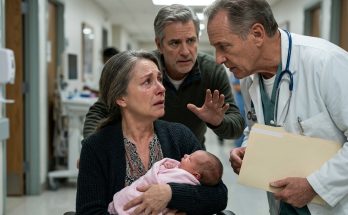
Julian was sixty-eight when Noah called from the hospital and said his father had suffered a stroke.
Mild to moderate, the doctors were calling it.
His speech was affected. His right hand was weak. His cognition appeared largely intact.
Then Noah said, "Dad wants to see you."
My first reaction surprised me.
Not anger.
Not fear.
Simply: Why?
Julian and I had been divorced for more than thirty years. We had raised Noah, become grandparents, shared hospital waiting rooms and birthdays, and learned to speak without turning every sentence into history. We were cordial. Sometimes even friendly.
We were not each other's emergency people.
Julian had dated after our marriage but never remarried. There was no long-term partner waiting beside him. Noah was his healthcare proxy, which made sense.
"Does he need something only I can provide?" I asked.
Noah hesitated.
"He keeps talking about a box in his home office. Old medical records from Oliver. He says you should know what happens to them if he dies."
I closed my eyes.
Of course.
Documents.
Some roles had remarkable endurance.
I went to the hospital.
Julian looked smaller in the bed. Hospital gowns have a way of removing the social architecture people build around themselves. No expensive suit. No polished office. No Vance authority.
Just an aging man trying to make his mouth cooperate.
"Cabinet," he said slowly. "Bottom."
"Noah has access to the house."
Julian nodded impatiently.
"Now."
I recognized the urgency.
Not medical urgency.
Fear becoming a command.
"You're worried you'll die before we understand what you mean."
He nodded.
"Then tell us what matters. We don't have to move a box tonight."
His shoulders relaxed slightly.
The records included Oliver's original genetic report, old cardiology notes, and later updates Julian had accumulated as the family history evolved. Some documents duplicated information Noah already possessed. Others contained details involving Mara.
That mattered.
Julian's stroke did not magically erase other people's privacy.
We did not empty the box into Noah's files merely because Julian was frightened.
After his condition stabilized and his speech improved enough, Julian worked with his attorney to clarify what could appropriately pass to Noah, what needed authorization, and what should remain protected or eventually be destroyed.
No panic transfer.
No assumption that family relationship overrode purpose.
That alone showed how far we had come.
The stroke left Julian with mild speech difficulty for several months. He hated dependence. I understood that in him because I had always hated it too.
Noah offered to manage all of Julian's finances.
Julian agreed immediately.
I interrupted.
"No."
Both men looked at me.
Noah frowned. "Mom, he asked me."
"I heard him."
Julian tried to speak, became frustrated, and gestured sharply.
"You're still competent," I told him. "You have an attorney, financial adviser, accountants, and existing systems. 'Noah handles everything' isn't a plan."
Noah's expression changed.
He understood.
We had seen vague authority before.
The three of us met with the appropriate professionals. Responsibilities were divided. Noah received limited access where useful and could serve as backup agent if Julian's capacity later changed. Professional accounting remained in place.
Distributed roles.
Specific authority.
Documented limits.
Julian laughed about it later when his speech had improved.
"Still auditing me."
"No. I'm stopping you from turning Noah into your entire infrastructure because you're scared."
He nodded.
"Fair."
There was an irony in becoming the person protecting Julian from overreaching arrangements.
I noticed it.
I did not savor it.
Caregiving can recreate old power patterns in reverse. The person who once controlled becomes dependent. The injured person gains knowledge, access, or influence.
For perhaps half a second, there was satisfaction in seeing Julian understand vulnerability.
Then it disappeared.
Revenge through care would still have been revenge.
He deserved dignity not because the past had been erased but because vulnerable adults deserve dignity.
His recovery was good.
Speech improved. Strength returned. He stopped driving while he underwent rehabilitation and formal evaluation.
Noah wanted him to stop permanently.
Julian disagreed.
I stayed out of it unless asked.
Concern did not automatically create authority.
Apparently that lesson never stopped being useful.
Months later Julian passed a driving assessment with restrictions. Two years after that, as his health and reflexes changed, another evaluation made the limitations harder to ignore.
This time Julian stopped driving voluntarily.
No family intervention.
No keys secretly removed.
His decision.
During those years, Julian and I spoke more often.
The conversations were practical.
Maya's birthday.
Noah's device follow-up.
Holiday schedules.
Family gatherings.
Occasionally medical history.
One afternoon Julian asked me, "Do you hate me?"
I was seventy years old.
I stared at him.
"You're still asking that?"
"I never got an answer."
"You got a divorce."
He smiled.
"Fair."
Then his expression changed.
"I mean now."
I thought carefully.
"No."
His eyes filled.
I continued before he could mistake the answer.
"That doesn't mean what you did became acceptable."
"I know."
"I just stopped needing you to suffer for it."
He looked away.
Maybe that was forgiveness.
Maybe it wasn't.
By then the label mattered less than the behavior.
Julian said, "I spent years terrified of what people would do if they knew the truth."
"Yes."
"And then I made you afraid because I was afraid."
"Yes."
No comforting language was necessary.
He sat with it.
Then he said, "I'm sorry."
I sighed.
"You've apologized."
That surprised him.
Accountability needed somewhere to end. Otherwise it could become another identity, another way to keep the old event at the center of every relationship.
I no longer needed Julian to confess repeatedly.
I needed him to continue behaving differently.
He did.
At seventy-three, he decided to sell the large Vance house and move into a smaller condo near Noah. Stairs had become inconvenient. Maintenance was exhausting. His health was no longer something he could pretend would remain unchanged.
"I'm trying something new," he told me.
"What?"
"Making a decision before the crisis."
I laughed.
"Revolutionary."
The old house sold.
I expected to feel something.
For years it had represented security, marriage, status, betrayal, and the life I thought I was building before Julian handed me divorce papers.
Now it was real estate.
Noah asked whether I wanted anything from it before the final clearing.
"No."
Then, hours later, I remembered.
There had been a small wooden box my father made before he died. I had owned it before marrying Julian. Somehow it had remained in storage through the divorce.
Julian found it.
He handed it to me without ceremony.
No claim that he had preserved it for sentimental reasons. No attempt to make the exchange mean more than it did.
Just my property returning to me.
I placed it on a shelf at home.
Clear ownership felt unexpectedly satisfying after a life in which information, money, access, and authority had once been deliberately blurred.
Julian's stroke did not reunite us romantically.
I was grateful.
Illness should not automatically erase old boundaries.
By then Eric had long been part of my life, a relationship built without secrecy about the history that came before him. Julian occupied another category.
Ex-husband.
Noah's father.
Maya's grandfather.
A source of family medical history.
Sometimes a friend.
That was enough.
One day Noah asked me whether Julian had become a good person.
I disliked the question immediately.
"Good compared with what?"
"He hurt you."
"Yes."
"He changed."
"Yes."
"So what is he?"
I looked at my son.
People love moral arithmetic because it promises one answer that can replace a lifetime of contradictory evidence.
"Your father did harmful things," I said. "Later he did many better things. I don't need one adjective to cover sixty years."
Noah considered that.
"Do I have to forgive him?"
"No."
"Do you?"
"No."
He looked surprised.
"You get to decide your relationship with him based on your experience," I said. "Don't borrow mine."
That mattered.
Noah's remembered father was not primarily the man who manipulated his pregnant mother. Noah remembered a father who attended cardiology appointments, learned to stop controlling medical decisions, showed up after his collapse, and eventually accepted the word no.
Both versions were true.
Noah could love Julian without betraying me.
I could acknowledge Julian's growth without rewriting my pregnancy.
Julian later asked Noah for help organizing finances after another complicated tax year.
Noah set the boundary immediately.
"I'll attend the meeting. I'm not becoming your accountant."
Julian accepted.
I nearly applauded.
Help no longer had to mean total access.
Love no longer required control.
At Maya's birthdays, strangers sometimes assumed Julian and I were grandparents who had remained close after an easy divorce.
We did not correct everyone.
There was no need to deliver thirty years of context beside a birthday cake.
We could sit at the same table.
Pass photographs back and forth.
Argue about whether Maya looked more like Noah or Lena.
Then leave separately.
Peace did not require retroactively calling our divorce amicable.
One evening Julian said, "I think people want us to be a redemption story."
"You especially."
He laughed.
"Fair."
Then he grew serious.
"I used to want you to tell me I'd become a good person."
"And now?"
"I'd rather behave like one and let you think whatever you think."
I studied him.
That answer was worth more than another apology.
Not because it proved he had become good.
Because it released me from the job of deciding.
Years later, I would need other people to offer me that same dignity—to respond to what was true in the present instead of forcing my entire history into one conclusion.
I just didn't know it yet.
The next threat to my independence would not come from Julian, Eleanor, money, or the Vance name.
It would come quietly, inside my own memory.
Click here to continue reading: PART 15: When My Memory Began Failing, the Evidence That Once Protected Me Threatened to Make Every Old Betrayal Feel New Again
The Doctor Looked at My Newborn, Then at My Estranged Husband, and Suddenly Everyone in the Delivery Room Went Quiet
Part 14 of 16