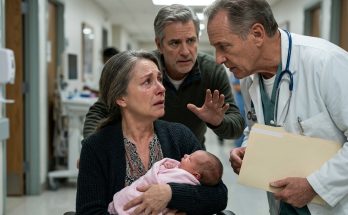
Noah and Lena waited three years after their wedding before they began seriously trying to have a child. They did not give me a running account of every appointment, every conversation, or every private fear. I was grateful for that. By then, I had spent enough years learning that closeness did not require unlimited access. I knew they had met with a reproductive endocrinologist and a genetic counselor. I knew they were asking questions about Noah's MYBPC3 variant. The rest belonged to them until they decided otherwise.
One Sunday afternoon, Noah called while I was cleaning up after lunch. His voice was casual in the way people sound when they have practiced saying something important. "We're going to do IVF." I sat down at the kitchen table. "Okay." He laughed. "That's it?" I looked at the phone. "What were you expecting?" "I don't know. Questions. Advice. A spreadsheet." "I can make you a spreadsheet if you're desperate." He laughed again, but beneath it I heard tension.
The Vance family had spent generations anticipating other people's reactions and then controlling information to avoid them. Noah had grown up differently, but habits can survive even when nobody deliberately teaches them. I asked, "What do you actually want from me?" He was quiet. "Maybe help reading the paperwork. You're better at complicated documents than we are." That I could do. Document reader. Not decision-maker. The distinction sounded simple. I knew how easily it could disappear.
Noah and Lena were considering preimplantation genetic testing for the known familial variant. The medical process was complicated enough without the emotional history attached to it. Hormonal stimulation. Egg retrieval. Embryo creation. Genetic testing. Waiting. The possibility that embryos might carry the variant. The possibility that embryos without it might have other abnormalities or fail to develop adequately. The possibility that a transfer could fail despite every careful decision.
I read the clinic's consent forms because they asked me to. I highlighted ambiguous language. I wrote questions in the margins. When I reached the provisions governing stored embryos, I slowed down. The forms required decisions about what should happen in circumstances people rarely want to imagine while trying to create a family: death, divorce, prolonged nonpayment of storage fees, disagreement, abandonment of treatment.
Noah frowned at the page. "We have to decide that now?"
"That's why they ask now."
"That's awful."
"It's uncomfortable. That's different."
He looked at Lena.
I closed the folder.
"This part is yours."
They discussed it privately. I did not ask what they chose when they returned. I only checked that the completed section matched their instructions and that they understood what they were signing.
The restraint felt more important than any advice I could have given. Decades earlier, Julian had known something fundamental about his fertility and genetic history and decided that my possible reaction justified keeping it from me. I now possessed knowledge that Noah and Lena wanted. That did not transform me into the person entitled to steer their reproductive decisions.
Julian had more difficulty.
His first response to IVF was financial.
"I'll pay for all of it."
Noah refused.
Julian called me afterward, genuinely confused. "Why would he turn that down? It's expensive."
"Ask him."
"I did."
"And?"
"He said they want control over the process."
There it was. Money, the Vance family's oldest second language.
I reminded Julian of Noah's trust and the advisory committee we had fought to remove years earlier. Money could help. Money could also create the sensation that the person paying had earned information, influence, or gratitude beyond the gift itself.
Julian eventually offered a fixed contribution instead. No conditions. No demand for access to clinic reports. No requirement that they continue treatment if they wanted to stop. Noah and Lena accepted part of the help. The existing trust could also cover certain qualifying expenses according to its objective terms. Eleanor did not get a vote. Neither did I.
Their first cycle produced five embryos that reached the stage for evaluation.
Two carried the familial MYBPC3 variant.
One had another chromosomal abnormality.
Two were considered suitable for transfer under the clinic's assessment.
Noah called after receiving the results. His voice sounded different from the man who had once joked about his emergency card looking childish.
"This is strange, Mom."
"What is?"
"Seeing the gene listed on an embryo report."
I waited.
"It feels like we're deciding which possibilities get to continue."
There was no sentence I could give him that would make that morally or emotionally simple. He had counselors. He had Lena. He had medical professionals who could explain probabilities and limitations.
So I said, "I can listen."
He exhaled.
That was what he needed.
The first transfer failed.
Lena had understood that failure was possible. Understanding did nothing to soften the actual call from the clinic. She withdrew for several days. Noah tried to function normally and failed at it in quieter ways.
Julian heard and immediately offered to pay for another cycle.
Noah snapped.
"Dad, stop trying to fix everything with money."
Julian called me later.
"I thought I was helping."
"I know."
"Was I wrong?"
"Your timing was."
He was quiet.
"They're grieving something," I said. "Don't turn grief into a project before they ask."
Julian apologized to Noah. Specifically. No explanation about good intentions. No defense about the cost of treatment. He said he had tried to solve a painful moment instead of sitting with it.
That was enough.
The second transfer resulted in a pregnancy.
Noah and Lena waited until twelve weeks before telling us. I respected the choice even though I later learned Julian had nearly guessed because Noah had become incapable of speaking normally around him.
When they finally announced it, Julian cried.
I cried.
Eric, who had become my long-term partner years after the divorce and had learned not to be surprised by Vance family tears, looked around the room and began crying because everyone else was.
"Apparently this is mandatory," he said.
Lena laughed so hard she had to sit down.
The baby was a girl.
They named her Maya.
Testing associated with the embryo selection showed that the transferred embryo did not carry the known familial MYBPC3 variant. The news brought relief, but I refused to call it a guarantee. No child is promised perfect health. Maya simply did not inherit this particular known risk.
When I first held her, she was warm and furious about being wrapped too tightly.
For a moment I thought of Oliver.
Then I stopped myself.
Maya was not the conclusion of Oliver's story. She was not proof that the family had finally defeated a gene. She was not genetic redemption.
She was a hungry newborn making an outraged face at a blanket.
That was enough.
Noah became exactly the kind of father I should have predicted. He read everything. He tracked feedings. He researched sleep recommendations until Lena threatened to confiscate his phone. At one point he purchased a pulse oximeter they had no medical reason to own.
Lena made him return it.
I laughed when he complained.
"Your father once bought three blood-pressure cuffs when you were a teenager."
"Why three?"
"I never understood."
"Don't tell him I bought the oximeter."
"I absolutely will."
Humor had become one of the healthiest things we inherited.
Around the same period, Julian's own cardiac condition progressed. The mild phenotype he had developed in his fifties became more significant in his early sixties. Imaging showed increased hypertrophy. He developed atrial arrhythmias. There was no dramatic arrest, but the risk profile changed enough that his cardiologist recommended an implantable cardioverter-defibrillator.
The same kind of device Noah had received years earlier.
Julian called me before the procedure.
Not because I was his wife.
Not because he needed permission.
Because I understood what the recommendation meant to him.
"I'm scared," he said.
The simplicity of the sentence stopped me.
There was a time when Julian's fear became secrecy, financial pressure, legal maneuvering, and control. Now he simply named it.
"I know."
That was all.
The procedure went well. Noah visited during recovery. Later he told me that Julian had apologized for making the gene feel like a family curse throughout Noah's childhood.
Noah's response had been less solemn.
"You made everything dramatic."
Julian apparently laughed until his incision hurt.
That sounded right.
Eleanor died at eighty-four after a stroke.
There was no prolonged final illness and no last-minute revelation. Her estate followed the documents she had created. Noah's trust continued under its existing structure. Julian inherited what the plan provided. I received nothing, which was entirely appropriate. Eleanor and I had eventually reached a form of peace, but we were not family in any legal sense.
I attended her funeral because Noah asked me.
Julian's eulogy did not turn Eleanor into a saint. He spoke about her intelligence, her discipline, her love of order, her impossible standards, and her fierce devotion to family. He did not pretend that devotion had always produced good behavior.
After the service, he handed me a small envelope.
"She left this for you."
My first instinct was to refuse it.
I opened it instead.
Eleanor had written only a page. She said she had once believed controlling outcomes could prevent grief. She now understood that it had merely forced other people to carry her fear. She apologized for what she had done during my pregnancy. She hoped Noah remembered more about her than those actions, but she explicitly said I was not responsible for shaping his memory on her behalf.
No money.
No request that I forgive her.
No demand for absolution from beyond the grave.
I kept the letter for a year.
Then I gave it to Noah.
"Grandma wrote this to you?"
"Yes."
"Why are you giving it to me?"
"Because your relationship with her is yours."
He read it.
He cried.
He kept it.
I did not need to.
By then, I understood that generational patterns rarely end because one person gives a perfect apology. They weaken when someone recognizes the pattern in a new situation and chooses differently.
Julian had done that with Noah.
Noah had done it with Lena.
Lena would do it with Maya.
Eleanor had done it, imperfectly, when she allowed the trust to become a genuine gift instead of another source of authority.
I had done it by reading Noah's IVF documents without telling him what reproductive decision he should make.
Small interruptions.
Repeated enough, they changed direction.
Maya changed Julian visibly.
The first time Noah tried to place her in his arms, Julian hesitated.
"Support her head," Noah said.
"I know how to hold a baby."
"Then take her."
Julian looked almost frightened.
Maya did not carry the familial variant. That was not what frightened him.
Newborns themselves still led somewhere in his mind.
Back to Oliver.
Back to helplessness.
Back to the hospital room where his first son died.
Noah saw it too.
"Dad. She's not going to break."
Julian gave a nervous laugh and finally took her.
Five minutes passed.
Then ten.
Maya slept against his chest.
Nothing terrible happened.
There was no dramatic declaration. Nobody announced that Julian was healed.
He simply remained in the chair holding his granddaughter.
Decades earlier, another newborn had triggered him into suspicion, secrecy, and control.
This time fear arrived and he stayed present.
That difference was enough.
Noah later made Maya a family photo book. Lena's parents were there. I was there. Julian. Eleanor. And one photograph of Oliver.
No hierarchy.
No hidden page.
When Maya was little, Oliver's explanation was simple: Grandpa Julian's first son, who died when he was very small.
As she grew, the explanation could grow with her.
No sudden revelation from a startled doctor.
No adult deciding indefinitely that she could not handle the truth.
No mythology about a cursed family.
Noah also created a concise medical-history summary for practical use: the known MYBPC3 variant, his own phenotype, Julian's history, Oliver's severe childhood disease, and Maya's documented negative status for the known familial variant.
No divorce story.
No fertility betrayal.
No accusations.
Just medically useful facts.
That separation pleased me more than I could explain.
The family had finally learned that privacy and secrecy were not the same thing.
Medical information could travel where it needed to go without dragging every old wound behind it.
A gene was biology.
What a family did with knowledge was culture.
We could not rewrite the first.
We had changed the second.
And that change would soon be tested again, not by Noah's heart or Maya's future, but by Julian's aging body and the old question of what happens when the person who once controlled information becomes the vulnerable one.
Click here to continue reading: PART 14: Julian’s Stroke Made Him Dependent on the People He Once Tried to Control, but I Refused to Turn His Vulnerability Into Revenge
The Doctor Looked at My Newborn, Then at My Estranged Husband, and Suddenly Everyone in the Delivery Room Went Quiet
Part 13 of 16