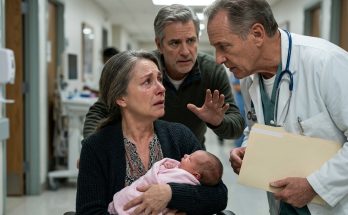
Noah collapsed at eighteen during an ordinary afternoon.
There was no dramatic storm, no reckless choice, no warning speech from a doctor that morning. He had been helping a friend move equipment after a school event when he became dizzy. Someone heard him say he needed to sit down.
He did not make it to the chair.
The call came while I was at work.
By the time I reached the emergency department, Noah was awake.
That fact became the only sentence my brain could hold.
Awake.
He was pale and irritated by the adhesive pads on his chest.
"Mom."
I touched his face.
"I'm okay."
"Don't tell me that before the doctors do."
He sighed.
"You're still you."
I nearly cried from relief.
Julian arrived less than ten minutes later.
He stopped at the doorway.
Noah looked toward him.
"Dad, I'm awake."
Julian's hand went to the doorframe.
I understood immediately.
Oliver.
A hospital.
Cardiac monitors.
His son on a bed.
For several seconds Julian could not move.
Then he crossed the room and sat beside Noah.
"What happened?"
Noah explained it himself.
The medical team evaluated the episode carefully. There were rhythm findings that required more investigation. His inherited cardiomyopathy had progressed from something monitored largely through imaging into a condition demanding more active management.
The exact decisions came through specialists, testing, and discussion rather than one cinematic announcement.
That helped.
Facts arrived in pieces small enough to hold.
Julian asked questions.
I took notes.
Noah interrupted both of us when we began speaking about him as though he were absent.
"I'm literally here."
The cardiologist smiled.
"Good reminder."
Noah was eighteen now.
Legally and practically, that mattered.
The doctors addressed him first.
When decisions about further monitoring and possible intervention arose, Julian and I could advise.
Noah decided.
That reversal was harder than either of us admitted.
After years of managing appointments, schedules, records, insurance, emergency plans, and activity recommendations, our authority had reached its natural edge.
Love remained.
Control did not.
The hospital kept Noah overnight.
At two in the morning, Julian returned from the cafeteria carrying two coffees.
He handed one to me.
I looked at it.
One cream. No sugar.
Exactly how I had taken coffee during our marriage.
"You remembered."
Julian sat down.
"I remember a lot of things."
There was no invitation in the sentence.
No romantic music inside my head.
Just history.
I drank the coffee.
We sat in silence while Noah slept.
For once, being near Julian did not require deciding what our relationship meant.
We were Noah's parents.
That was enough.
The next morning brought additional consultation. Noah's rhythm findings, symptoms, family history, and genetic diagnosis had to be considered together. His doctors discussed management options, including more intensive monitoring and intervention if risk markers justified it.
Julian listened without interrupting.
I watched his hands.
They were trembling.
During a break I said, "You can step outside."
"No."
"You don't have to prove anything."
"I'm not."
He looked through the glass toward Noah.
"I left the room emotionally when Oliver was sick. Even when I was physically there, half of me was already preparing for him to die."
I said nothing.
"I'm not doing that to Noah."
That sentence explained more than any apology.
Noah's care eventually moved forward with a more intensive management plan. The immediate crisis passed, but nobody pretended the collapse meant nothing. His condition had declared itself more clearly.
The difference was that this time the family did not respond with secrecy.
Eleanor received information Noah agreed could be shared.
Not everything.
Enough.
She did not arrive at the hospital with lawyers or specialists of her choosing. She sent Noah a message.
He showed it to me.
Thinking of you. I love you. Tell me if you want company.
No instruction.
No demand.
No comparison to Oliver.
Noah asked her to visit the next afternoon.
She stayed twenty minutes.
When she entered, I saw the old terror cross her face.
She controlled it.
She kissed Noah's forehead.
"You look terrible."
He laughed.
"Thanks, Grandma."
"You're welcome."
Normal.
Painfully normal.
After discharge, Noah recovered at my apartment for several days because it was closer to his follow-up care. Julian came and went according to what Noah wanted.
That arrangement would once have been impossible.
Now Julian brought groceries, repaired a loose cabinet hinge without being asked, and left when there was nothing useful to do.
One evening he lingered by the door.
"Do you need anything?"
"No."
He nodded.
Then I surprised myself.
"Thank you for today."
He looked at me.
"For what?"
"For not making me manage you too."
He understood.
"You're welcome."
That was the closest thing to intimacy between us.
Not romance.
Reliability.
Several weeks later, Mara contacted Julian through a route connected to the genetic clinic. She had heard, with appropriate consent and limited information, that Noah's cardiac condition had become more significant.
Julian told me before responding.
Not because he needed permission.
Because Mara was Oliver's mother, and anything involving Oliver had once been a chamber of secrets.
Mara eventually wrote to me directly.
The message was restrained.
She did not accuse Julian.
She did not ask me to comfort her.
She said she had heard Noah was doing reasonably well after a difficult event and hoped his course remained different from Oliver's.
Then she offered something I had never seen.
A photograph.
I asked Noah whether he wanted to look.
He said yes.
The picture showed Oliver at perhaps eighteen months, sitting in grass with one hand lifted toward the camera.
Noah stared.
"He looks like me."
He did.
Not identical.
But enough that I understood Dr. Shaw's reaction in the delivery room all over again.
The eyes.
The shape around the mouth.
Something in the expression.
Julian sat nearby.
Noah asked, "Did he suffer?"
Julian's face tightened.
I let him answer.
"Sometimes."
Noah waited.
"He was sick," Julian continued. "There were hospital stays. Tests. Some bad days."
"Was he scared?"
"Probably sometimes. But he was also loved. He laughed. He liked music. He hated peas."
Noah smiled faintly.
That detail mattered more than the clinical history.
Oliver stopped being merely the dead Vance baby whose genetic condition had shaped our lives.
He became a little boy who hated peas.
Noah looked again at the photograph.
"I thought about him when I collapsed."
Julian closed his eyes.
"I figured."
"I thought maybe this was how it starts."
Julian leaned forward.
"I need you to hear something. What happened to Oliver is information. It is not your ending."
The words could have sounded rehearsed.
They didn't.
Julian had spent eighteen years learning them.
Noah nodded.
Later, after he went to bed, Julian and I remained in the kitchen.
"He asked if Oliver suffered," Julian said.
"I heard."
"I almost told him everything."
"But you didn't."
"No."
There were details about Oliver's final arrest, the resuscitation, Julian's CPR, the ambulance, the hospital, and the moment treatment stopped. Those facts existed.
Noah did not need all of them simply because they were true.
Transparency still required judgment.
Truth was not the same as emotional dumping.
Months passed.
Noah returned to school, friends, ordinary arguments, and the irritating administrative work of being a young adult with a medical condition.
His collapse changed our vigilance.
It did not become his identity.
Julian and I became better at coordinating through difficult appointments.
People occasionally mistook that cooperation for reconciliation.
We corrected them.
No.
We were not remarrying.
We were not rediscovering some hidden romance.
A crisis had reminded us that two people could become trustworthy partners in one category without becoming partners in every category.
The marriage had ended for reasons that remained true.
Julian had manipulated me.
I had rebuilt a life outside him.
He had become a better father.
All three statements could coexist.
At Noah's next major follow-up, his condition was stable enough for the doctors to discuss the future rather than only the previous collapse.
College.
Independent living.
Medication management if needed.
Emergency planning.
Adult cardiology transition.
Noah listened.
Then he looked at us.
"I need both of you to stop making that face."
"What face?" I asked.
"The one where you're planning my entire life because I fainted once."
Julian started to object.
Noah raised a hand.
"I know it was serious."
That stopped him.
"But it's my life."
I felt the sentence settle between us.
For years, Julian and I had fought over who had authority over Noah.
We had spent even longer learning not to let fear exercise that authority for us.
Now the answer was changing completely.
Soon, Noah himself would hold the legal right to say yes.
Or no.
And we would have to prove that everything we had taught him about informed choice applied even when his choices frightened us.
Click here to continue reading: PART 11: When Noah Became the Legal Owner of His Medical Decisions, Julian and I Discovered Whether We Truly Believed Everything We Had Taught Him
The Doctor Looked at My Newborn, Then at My Estranged Husband, and Suddenly Everyone in the Delivery Room Went Quiet
Part 10 of 16