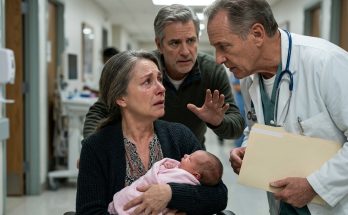
Naomi Patel arrived before pediatric cardiology did. She carried a slim leather case, wore sensible shoes, and listened without interrupting while I told her everything that had happened. Dr. Shaw recognizing Julian. The recommendation for an echocardiogram. The reference to another biological child. Julian's refusal to authorize disclosure. Then I told her about the fertility invoice I had saved. Naomi's expression barely changed, but she stopped taking notes for a moment. "Show me exactly what you have," she said.
I opened the encrypted drive where I had stored documents collected before Julian changed the passwords on our shared accounts. Naomi had been strict about that from the beginning. Being married did not mean I could continue entering systems after authorization was revoked. Preserve what I had obtained legitimately, she had told me. Do not go hunting through restricted accounts simply because I suspected wrongdoing. That advice had seemed frustrating at first. Now I understood why it mattered. Evidence was only useful if we could explain how I possessed it.
The invoice carried the name North Cascade Reproductive Medicine and Julian's information. Beneath the date, four days after I announced my pregnancy, were several billing descriptions. Semen analysis. Fertility consultation. Post-vasectomy evaluation. I read the last phrase twice. "Post-vasectomy?" My voice sounded distant. Naomi leaned closer but did not leap to a conclusion. An invoice, she reminded me, was not the same as a complete medical record. Still, the billing language strongly suggested Julian had undergone a vasectomy before our marriage.
Five years. I replayed five years of conversations in seconds. Early in our marriage I had said I might want children once our lives settled down. Julian had always answered with something vague: later, maybe, we'll see. Six months before he filed for divorce, I had asked whether we should stop postponing the decision. He had said the timing was bad. Never once had he told me conception might be medically unlikely because he had deliberately undergone sterilization. Whatever his reasons, he had allowed me to plan my reproductive life without essential information.
"I want the paternity test," I told Naomi. She studied me. "Because you have doubts?" "No. Because he manufactured them." Julian had spent months allowing other people to question who fathered my baby. I wanted that question closed through a proper process. Naomi agreed but warned me against shortcuts. No secret collection, no theatrical hospital-room swab, no test arranged solely because Julian's lawyer wanted urgency. Identification, consent, chain of custody, and whatever legal procedure applied would matter if the result later reached court.
My phone buzzed with a call from an unfamiliar number. Naomi glanced at it and told me to let voicemail take it. While the phone vibrated itself quiet, I looked at the sleeping newborn in the bassinet. I had spent months calling him Little Man because Julian and I had never reached the naming conversation I once imagined we would have. Suddenly I did not want to wait. "Noah," I said. Naomi looked up. "His name." Noah James Vance, at least for now. James was my father's name.
The decision gave me one small piece of solid ground. There would be no Vance family meeting to choose an heir's name, no negotiation with Eleanor, no bargaining with Julian. Noah James. My son slept through the announcement. Soon afterward Dr. Lena Ortiz from pediatric cardiology examined him. She listened carefully to his chest, checked his oxygen level, and reviewed what little family history I could provide. There was no murmur. His newborn examination looked normal. She scheduled the echocardiogram anyway.
Dr. Ortiz was careful not to promise too much. A normal scan at birth would be reassuring, she explained, but certain inherited forms of cardiomyopathy might not be visible immediately. Genetic testing would require a clearer family history and counseling rather than being ordered as if it were a routine blood panel. Her calmness helped more than false reassurance could have. Later, when Noah's echocardiogram showed no abnormality, I cried. Then Dr. Ortiz gently reminded me that normal today did not necessarily mean no inherited risk tomorrow.
Naomi listened to the voicemail from Julian's attorney in the hallway. When she returned, she told me he wanted temporary parenting arrangements and voluntary confirmation of paternity. The timing was almost absurd. For months Julian had encouraged uncertainty. Now, hours after Noah's birth, his side wanted speed. They proposed a rapid DNA test, immediate recognition of Julian as father, and joint decision-making beginning at discharge. "No," I said, then winced because laughing would hurt. Naomi nodded. Biology and custody were separate legal questions.
She asked whether I still possessed the messages involving Eleanor. I did. One suggested that if life became difficult enough, I would eventually sign what they wanted. Another implied that if I believed Julian might refuse to acknowledge the baby, fear would make me easier to pressure before delivery. We had always treated those messages cautiously. They suggested a strategy, but Naomi refused to claim more than the words established. She had drilled that discipline into me. Let documents say what they say. Do not improve evidence by exaggerating it.
Then she found an archived email I had sent her weeks earlier. At the time, neither of us had understood its importance. Eleanor had asked Julian what the fertility clinic said. His response reported viable sperm and a doctor's explanation that spontaneous recanalization, though uncommon, could occur after vasectomy. He was planning another test. I felt the hospital room tilt. Four days after learning about my pregnancy, Julian had discovered that biological fatherhood was not impossible. He had known before most of the whispering began.
There was another email. This one stripped away the remaining ambiguity. The repeat test was positive. Julian told Eleanor not to tell me yet. He said they needed leverage until I signed. Naomi read it twice, then became very still. Until that moment we could have argued that Eleanor was driving the pressure while Julian passively failed to stop her. This was different. Julian himself had chosen to withhold information that weakened the paternity doubts while negotiations were underway. Whatever he later said about his motives, the written word leverage was his.
"Don't contact him," Naomi said. I had no intention of doing so. She began arranging proper preservation of the email, explaining that a screenshot alone would not magically become unquestionable evidence. Authentication, metadata, source, and the circumstances of access might all matter. I appreciated her insistence on procedure because Julian had spent months creating fog. I wanted no fog on my side. If a judge ever saw that message, I wanted the argument to be about what Julian wrote, not whether I had obtained it improperly.
The paternity test was arranged through an approved laboratory with proper identification. Results would take days. Julian apparently disliked the delay. Eleanor called the hospital more than once asking to visit "her grandson." I declined. The nurses offered to flag my chart so that visitors could not appear without permission. I accepted. No shouting. No security spectacle. Just a boundary entered into a hospital system. After months in which the Vance family had treated boundaries as obstacles to negotiate, the simplicity of a nurse saying no felt almost luxurious.
That afternoon Dr. Shaw returned. Julian, he said, had finally signed a limited authorization permitting disclosure of medical history from the earlier child's case insofar as it related to Noah. I sat straighter. Dr. Shaw pulled a chair closer. The child had been named Oliver. He was Julian's biological son, born twelve years earlier to a woman named Mara Kent. At first the name meant nothing to me. Then Dr. Shaw told me what had happened, and every other problem in my life temporarily disappeared.
Oliver developed severe hypertrophic cardiomyopathy during infancy. Genetic testing eventually identified a likely pathogenic variant in a gene called MYBPC3, inherited from Julian. Doctors treated Oliver, monitored him, adjusted medication, and tried to manage a disease that had declared itself frighteningly early. He died at twenty-two months after a sudden cardiac event. Dr. Shaw had been part of his care team. That was why grief had crossed his face when he first looked at Noah. Around the eyes and mouth, the resemblance was immediate.
I stared at my sleeping son and tried to understand the dimensions of what Julian had hidden. Before I met him, he had become a father. He had watched his child become critically ill. He had lost that child before the boy turned two. After Oliver's death, Julian underwent a vasectomy. Dr. Shaw had known about that decision. When he saw Julian standing beside a newborn who resembled Oliver, his shocked remark suddenly made sense. He had believed another biological child should have been extremely unlikely.
For the first time since the divorce began, my anger toward Julian collided with pity so violently that I could not separate them. Losing Oliver explained something profound about him. It explained the vasectomy, perhaps his evasiveness whenever I discussed children, perhaps even the panic in the delivery room. But explanation did not erase what he had done afterward. He had married me without telling me about the vasectomy. He had hidden a hereditary medical risk. And after discovering that his fertility might have returned, he had still allowed suspicion to gather around me.
Dr. Shaw was careful about Noah. Oliver's history did not mean Noah would become ill. A normal newborn echocardiogram remained good news. The next steps would involve obtaining the relevant genetic information, consulting specialists, and determining whether testing was appropriate. "We don't turn resemblance into diagnosis," he said. I held on to that sentence. Noah was not Oliver. He was not a tragedy waiting to happen. He was a newborn with a possible inherited risk, and that risk could be managed through information rather than fear.
When Dr. Shaw left, Naomi and I sat quietly for several minutes. There was too much to fit into one emotion. The secret child. The gene. The vasectomy. The fertility tests. The messages about leverage. I thought of every conversation during our marriage in which Julian knew something that would have changed my understanding of our future and chose not to say it. What frightened me most was no longer any individual secret. It was the pattern. He had built our marriage on an unequal distribution of information.
The paternity result had not yet arrived, but I no longer needed it to understand why Julian's behavior changed after my pregnancy announcement. At first, he had probably believed conception was impossible. Then the clinic told him it was not. Instead of coming home and telling me what he had learned, he told Eleanor. They kept the information between them while I was financially squeezed and publicly doubted. I could not know every motive yet. I did know the chronology. Dates were beginning to do what accusations could not.
Noah stirred and opened his eyes for a few seconds. I slipped my finger into his hand. My instinct was to promise that nothing bad would ever happen to him, but motherhood had already taught me how meaningless that promise would be. I could not guarantee his heart would remain healthy. I could not guarantee a judge would see every event as I did. I could not guarantee Julian would become honest. What I could do was make sure no medically important fact about Noah disappeared into family silence again.
Before Naomi left, she asked whether I wanted her to pursue the relevant fertility records through appropriate legal channels. "Yes." She asked whether we should continue with formal paternity testing despite what we now knew. "Absolutely." One result would answer biology. The fertility records would answer timing. Julian's emails would help establish what he knew when he made particular choices. Oliver's history would guide Noah's doctors. Separate questions, separate evidence. I was beginning to understand that separating them might be the only way through this.
That night, long after the hospital corridor quieted, I reopened Julian's message on the encrypted drive. The words were not dramatic. That made them worse. He had known the repeat fertility result was positive and deliberately chosen not to tell me because he wanted leverage until I signed. I locked the phone and placed it facedown. Julian had spent months relying on the fact that he possessed the map and I did not. Now, for the first time, the map was beginning to unfold in front of me.
Click here to continue reading: PART 3: The DNA Result Settled Noah’s Paternity, but Julian’s Own Testimony Exposed Why He Had Kept Me Uncertain for Months
The Doctor Looked at My Newborn, Then at My Estranged Husband, and Suddenly Everyone in the Delivery Room Went Quiet
Part 2 of 16