By the time Noah was firmly established as an adult, my career had become larger than the divorce that once threatened to consume it.
I had moved from contract auditing into senior compliance work, then into broader advisory responsibilities involving procurement integrity, internal controls, billing investigations, and evidence preservation.
I was good at it.
That statement took me years to say without adding an explanation.
I had always been good at it.
The divorce had interrupted my career.
It had not created my abilities.
Colleagues increasingly knew me as Vivian Mercer before they knew anything about Julian Vance.
That felt like a quiet victory.
I trained younger investigators to distinguish suspicious behavior from provable misconduct. I taught them to document what records established, what they merely suggested, and what remained unknown.
The lesson had professional roots.
It also had scars.
One of my favorite phrases in training was simple:
"Separate the categories."
Financial irregularity was not automatically fraud.
Bad behavior was not automatically illegal.
A believable story was not automatically evidence.
A person could be dishonest in one area and accurate in another.
I had learned every one of those distinctions at enormous personal cost.
Eventually I was invited to speak at a professional conference.
The topic was evidence discipline under emotional pressure.
I accepted.
I did not tell the audience about Noah.
I did not tell them about Oliver.
I did not put Julian's fertility emails on a slide.
Instead, I spoke about methodology.
How investigators should preserve records lawfully.
How confirmation bias turns facts into decorations for conclusions already chosen.
How emotional certainty can outrun evidence.
How ambiguous transactions require tracing rather than accusation.
The room was full.
Afterward, several people approached me with questions.
One woman said, "You talk like someone who's had evidence used against her personally."
I smiled.
"Most people in compliance eventually have."
That was enough.
Months later, a publisher contacted me.
The editor had apparently learned more about my history through public court records, old social connections, and the remnants of gossip that never entirely disappeared.
They proposed a memoir.
The money was significant.
The concept was obvious.
A woman becomes pregnant.
Her wealthy husband files for divorce.
His family questions paternity.
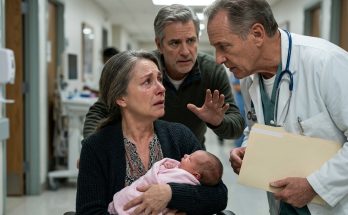
A doctor recognizes the newborn because of a dead child nobody mentioned.
Genetic secrets.
Money.
Custody.
Evidence.
A powerful family.
It practically wrote its own marketing campaign.
The editor described it as a story about "taking down a dynasty."
I disliked that phrase immediately.
I had not taken down the Vance family.
I had survived a divorce.
I had established facts.
I had protected my ability to parent.
Julian still had his business.
Eleanor had remained Noah's grandmother.
No dynasty had fallen.
The truth was less cinematic.
The editor said that was precisely why a memoir could be powerful.
Maybe.
I took the proposal home.
For several days I imagined writing it.
There were things I wanted to say.
About financial coercion that hides inside technically lawful actions.
About how reputational attacks work when nobody makes one explicit accusation.
About medical information used as power.
About the danger of confusing trauma with permission.
About how difficult it is to separate justified anger from useful evidence.
I could write those things well.
Then I began listing the people whose lives would become material.
Julian.
Eleanor.
Mara.
Oliver.
Noah.
Lena.
Doctors.
Lawyers.
Friends.
Some of the story belonged to me completely.
Some did not.
Oliver had been dead before I ever met Julian.
His medical history had affected my life profoundly, but that did not make every detail mine to publish.
Noah's genetic status was part of my experience as his mother.
It was also his medical information.
He was an adult now.
I could not spend years teaching him that his health belonged to him and then sell it because a publisher offered enough money.
The irony would have been unbearable.
I called Noah anyway.
Not to ask permission.
To tell him what I was considering.
He was quiet.
"Do you want to do it?"
"I don't know."
"Would you have to talk about my heart?"
"Probably."
"Oliver?"
"Probably."
"Dad?"
"Definitely."
Noah laughed softly.
"That's a lot of probably."
"It is."
He did not tell me no.
That almost made the decision harder.
"If you want to write about your life, Mom, you should."
There it was.
The freedom I had spent years trying to give him returned to me.
My life.
But the book the publisher wanted required more than my life.
I declined.
The editor offered a revised structure.
Less medical detail.
More focus on financial manipulation.
I still declined.
Not because I believed silence was noble.
Not because Julian deserved protection from every consequence.
Because I no longer wanted my professional identity attached permanently to the most destructive period of my marriage.
I had spent too long escaping that orbit.
Instead, I kept speaking about evidence, ethics, and compliance without turning private people into case studies.
My conference talk became popular within my field.
Eventually I developed a training program around evidence discipline under emotional pressure.
No sensational title.
No Vance name.
No dead child on a book cover.
The work stood on its own.
Julian heard about the memoir offer through Noah.
He called me.
"You turned it down?"
"Yes."
A pause.
"Because of me?"
"Not mainly."
Another pause.
"Thank you anyway."
"I didn't do it for you."
"I know."
That exchange would once have become an argument.
Now it ended there.
By then Julian had begun developing his own clearer cardiac phenotype. He was in his fifties when imaging showed mild changes that required medication and follow-up.
He told Noah.
Eventually he told me because the information was relevant to family history.
I asked whether he had known earlier.
He hesitated.
That hesitation irritated me instantly.
"Julian."
"I knew there were mild changes."
"For how long?"
"A while."
I stared at him.
"Why didn't you say anything?"
His answer sounded painfully familiar.
"I thought if I didn't make it important, it wouldn't become important."
I almost laughed.
Not because it was funny.
Because after all those years, the man could still believe naming danger gave it power.
"You know that's not how disease works."
"I know."
"Do you?"
He looked tired.
"More than I used to."
His condition was manageable. He started medication. Follow-up became part of his routine.
Noah reacted with concern but not panic.
That alone showed how much had changed.
Medical information entered the family.
People used it.
Nobody weaponized it.
Nobody buried it.
Life continued.
My own life continued too.
I traveled occasionally for work. I mentored younger colleagues. I built savings that had nothing to do with Julian's support. I made friends who knew him only as Noah's father.
The investigative phase of my life truly ended.
Boxes from the divorce remained in storage.
Emails.
Financial summaries.
Court documents.
Medical records.
Evidence that had once felt like armor.
I rarely opened them.
Still, I could not bring myself to destroy everything.
Some records mattered legally.
Some mattered medically.
Some might matter to Noah.
Others existed only because once, long ago, I had been terrified that if I failed to preserve every fact, somebody more powerful would rewrite my life.
I kept the archive.
For now.
Years later, that decision would become more complicated than I could imagine.
But at the time, the papers stayed sealed in labeled boxes while my real life moved beyond them.
Noah and Lena began talking seriously about children.
That conversation changed the meaning of our genetic history again.
The MYBPC3 variant was no longer merely something Noah had inherited from Julian.
It was something he might pass forward.
There were reproductive options now that Julian had never allowed me to consider because he had withheld the facts.
Noah and Lena would know before choosing.
They would meet specialists.
They would hear probabilities.
They would decide what risks they could accept.
And I would face a test I had not expected.
After spending half my life fighting other people who believed knowledge gave them authority, I would have to resist making the same mistake myself.
Click here to continue reading: PART 13: Noah and Lena Chose IVF With the Knowledge Julian Once Denied Me, and I Had to Learn That Information Still Wasn’t Authority
The Doctor Looked at My Newborn, Then at My Estranged Husband, and Suddenly Everyone in the Delivery Room Went Quiet
Part 12 of 16