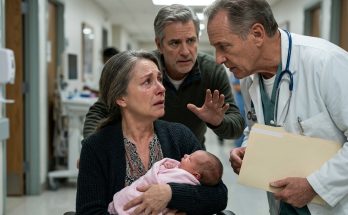
The divorce became final sixteen months after Noah's birth. There was no packed courtroom, no devastating cross-examination, no judge delivering a speech that reduced the Vance family to silence. Most issues settled through negotiation. One remaining property-classification question required a brief hearing. Then the decree was entered, signatures became final, and the marriage that had once occupied nearly every corner of my life ended with paperwork.
People who knew fragments of what happened seemed disappointed by the lack of spectacle. They wanted Julian punished dramatically, Eleanor publicly exposed, and Vance money transferred to me in amounts large enough to resemble revenge. Real divorce did not work that way. I received my proper share of marital property, defined spousal support, child support calculated under the relevant guidelines, reimbursement for specific prenatal expenses, and contributions toward some legal and forensic-accounting fees because Julian's financial conduct had increased the work required.
I did not become fabulously wealthy. I became stable.
That was better than it sounded.
I rented a two-bedroom apartment close enough to Noah's cardiology clinic that appointments no longer required planning half a day around traffic. I bought a dependable used SUV with enough room for his car seat, stroller, groceries, and the ridiculous quantity of equipment a toddler seemed to require. I bought a good desk for work. I restarted retirement contributions. None of those choices would have impressed the people who wanted a dramatic ending.
To me they were beautiful.
The final agreement included a mutual non-disparagement clause, but Naomi fought hard to keep its language narrow. She refused to let "don't publicly attack each other" become "Vivian cannot truthfully describe what happened." If I told a therapist that Julian knowingly used paternity uncertainty as leverage, I did not want a lawyer claiming I had violated the decree. The final language focused on malicious public statements, not private truth, legal communication, or medical necessity.
Julian also sent the factual correction required by our agreement. Paternity testing had established that he was Noah's biological father. Previous speculation concerning my fidelity had been unsupported and should not continue. Cold language. Useful language. Some people who had disappeared during my pregnancy tried to return afterward. I did not reopen every door.
Brent and Olivia, a couple we had once seen regularly, sent a long apology. They admitted repeating Eleanor's version of events at a dinner party. I appreciated that they named what they had done. I still did not want them in my life. Talia stayed. A few former coworkers gradually returned. My social circle became smaller, quieter, and far less interested in proximity to the Vance name.
I returned to consulting more seriously. Twenty hours a week became thirty. Eventually a law firm hired me on a long-term contract reviewing procurement and billing audits. Noah went to daycare three days a week. I missed him at first with an intensity that surprised me, then discovered that completing a full morning's work without a bottle warming beside my laptop felt almost luxurious.
Julian's parenting time expanded as Noah grew. We did not jump immediately to equal overnights. The schedule changed according to Noah's age, feeding, established caregiving, our work demands, and practical distance. By two, he had regular overnight time with his father.
I hated the first overnight.
That was not evidence. It was injury.
Julian had prepared carefully. He had a proper crib, medication information, emergency contacts, cardiology records, and supplies. He had completed infant CPR training. Still, while standing in his doorway, I began giving instructions as if Noah were leaving the country.
"If he has any trouble breathing—"
"I know."
The words came too sharply.
I froze.
Julian exhaled. "Sorry. Finish."
That small correction mattered more than he probably knew. I finished. He listened.
The next morning Noah came home cheerful, well fed, and apparently delighted by the novelty of waking up somewhere else. Nothing had gone wrong. Another fear answered by evidence.
We continued using the co-parenting application. The formality became a relief. Schedules stayed organized. Medication updates were searchable. Nobody could call at midnight and turn a practical question into an argument about the marriage. Months passed that way.
Then one afternoon Julian sent a message unrelated to logistics.
I want to apologize for the paternity rumors.
I stared at the screen. For almost two years I had heard explanations involving Eleanor, grief, lawyers, uncertainty, and the collapse of our marriage. I had never heard Julian state plainly what he himself had done.
I replied: If you're going to apologize, be specific.
Two hours passed.
Then another message appeared.
He said he had known before Noah's birth that the vasectomy might have failed. He admitted that despite knowing biological paternity was possible, he allowed others to believe I had been unfaithful because he thought uncertainty would improve his position in the divorce. He said it had been wrong.
Then he apologized.
I cried.
Not because the words repaired our marriage. They did not. Not because forgiveness suddenly arrived. It did not.
I cried because the sentence finally had a subject.
Julian.
Not Eleanor. Not the family. Not trauma. Not "mistakes were made."
He had done it.
I answered only: Thank you for stating it clearly.
No heart emoji. No declaration of forgiveness. No invitation to discuss us. The apology did not alter the settlement or parenting schedule. It bought Julian nothing. That was precisely why it mattered.
Several months later, he asked whether we could discuss Oliver outside a courtroom or legal filing. Noah's medical future made family history relevant, so I agreed to one mediated session with Dr. Helen Park, a therapist experienced in high-conflict co-parenting. I did not go because I wanted to carry Julian's grief. I went because I wanted Oliver's story to stop arriving in fragments whenever fear entered the room.
Julian was twenty-seven when Mara became pregnant. Oliver's illness was discovered after a murmur led doctors to imaging. What followed was not a single catastrophic day but months of worsening disease: medication, repeated appointments, hospital admissions, new symptoms, brief improvements, then fear again.
Eventually Oliver suffered a sudden cardiac arrest.
Julian performed CPR while waiting for paramedics.
His son died anyway.
For the first time, I understood the vasectomy not as the beginning of a deception but as a frightened man's attempt to make sure he could never experience the same loss again. After Oliver died, Julian decided there would be no more biological children. The procedure made that decision physical.
Then he met me.
"Why didn't you tell me?" I asked.
Julian looked at the floor. "I thought you'd leave."
There it was again. A familiar structure wearing a different emotion.
"So you made the decision for me."
"I loved you."
"If you loved me, you should have let me choose what I could live with."
His face folded. He cried quietly, without hiding it.
I felt something shift, though not toward reconciliation. His secrecy had begun in terror. Over time it became habit. Later, during the divorce, habit became strategy. Grief explained the first movement without excusing where he eventually took it.
Dr. Park asked what I needed from Julian now.
I had thought about the question beforehand.
"Accurate medical information. Reliable parenting. And no rewriting what happened."
Three things.
Not punishment. Not endless confession. Not restored intimacy.
Julian nodded.
"I can do that."
The session did not repair our marriage, and I was grateful for that. Some endings should remain endings. What changed was our ability to stand on opposite sides of a parenting decision without automatically treating disagreement as war.
The divorce also forced me to decide what to do with my name. For sixteen months I remained Vivian Vance on medical forms, financial records, tax documents, and Noah's paperwork. Some days I hated seeing it. Other days it was merely a sequence of letters. Friends assumed I would change it immediately.
I waited until I wanted the change for myself.
Then I returned legally and professionally to Mercer.
Vivian Mercer.
Noah remained Noah Vance.
People occasionally treated that as another symbolic battle. It wasn't. His surname did not prove loyalty to Julian any more than changing mine proved rejection. Noah did not need to carry my name to validate my motherhood.
Julian noticed at an exchange.
"You changed it."
"Yes."
Something crossed his face—hurt, perhaps, or simply recognition that another piece of the marriage was gone.
Then he said, "Okay."
That was all.
The decree required us to keep using the co-parenting application for nonemergency communication for a defined period. What initially felt absurdly formal became one of the most useful parts of the arrangement. Structure reduced the number of situations in which either of us needed to trust the other's mood.
Over time I stopped believing healthy relationships were always the ones that needed the fewest rules. Sometimes rules allowed two people who had damaged each other badly to behave responsibly long enough for better habits to form.
And better habits were about to matter.
Because by Noah's fourth birthday, the heart we had been calmly monitoring would finally show its first change.
Click here to continue reading: PART 7: Noah’s First Abnormal Heart Scan Awakened Every Fear Julian Had Buried, and We Had to Decide Whether Fear Would Parent Him
The Doctor Looked at My Newborn, Then at My Estranged Husband, and Suddenly Everyone in the Delivery Room Went Quiet
Part 6 of 16