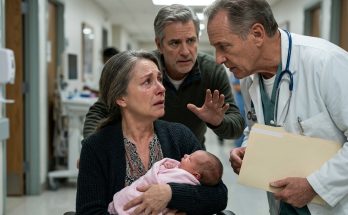
Eleanor first met Noah when he was three months old. By then he had begun smiling deliberately, though mostly at ceiling fans, bright windows, and anyone willing to make ridiculous noises near his face. His cardiology follow-up remained reassuring. His heart looked normal, and Dr. Ortiz kept reminding us that carrying the MYBPC3 variant meant surveillance, not a prediction of disaster. I repeated that sentence often enough that it became almost a prayer. Noah was healthy today. Today had to be allowed to count.
I did not invite Eleanor to my apartment. She did not ask me to bring Noah to the Vance house either. Her first visit took place at the same family-services center we had used earlier for Julian. Thirty minutes. A professional supervisor named Ms. Ramirez would remain in the room. Julian would not be there, and neither would I. That separation was deliberate. Eleanor's relationship with her grandson needed to develop independently of the unfinished war between Julian and me.
Afterward, Ms. Ramirez gave me a concise report. Eleanor arrived early. She brought a small knitted blanket but no extravagant gifts. She asked permission before picking Noah up. She cried almost immediately. None of that concerned me. What bothered me was Oliver. Eleanor said his name twice. The first time seemed accidental. The second came when she studied Noah's face and remarked on the resemblance around his eyes. My chest tightened when I read that line.
I called Naomi. "Should I stop the visits?" She was quiet for a moment. "Because she mentioned Oliver twice?" I hated when Naomi answered a question with another question because it usually meant she wanted me to hear myself. "No," I admitted. "Then don't make a permanent decision from one emotionally difficult visit." She was right. Eleanor had lost a grandson at twenty-two months. Expecting her to walk into a room with Noah and feel nothing about Oliver would have been unreasonable. Expecting her not to turn Noah into Oliver's replacement was entirely reasonable.
The second visit went better. Eleanor called him Noah. She did not compare his face, hands, temperament, or anything else to the child she had lost. She stayed within the scheduled time and did not ask for more. A week later, through her attorney, she requested a private conversation with me. No Julian. No baby. One meeting. I considered refusing, but unanswered questions still sat between us. I agreed on the condition that Naomi arrange the setting.
Eleanor entered the conference room wearing a cream wool suit and pearls. The sight of her brought an involuntary physical memory: the dining room, the divorce papers, Julian sitting across from me while Eleanor stood behind him as though a marriage ending were another family transaction requiring supervision. My body remembered before my mind did. My shoulders tightened. Eleanor noticed but said nothing. She sat opposite me, placed her handbag beside the chair, and folded her hands.
"I'm sorry," she said.
I almost laughed. "You're going to need to narrow that down."
Her mouth tightened, but she nodded. Then she did something I had not expected. She became specific. She apologized for helping Julian restrict me financially. She apologized for encouraging people to question my pregnancy after she knew his vasectomy might have failed. She admitted writing that enough pressure could make me sign. Finally, she said she had treated my pregnancy as a strategic problem rather than the arrival of a child.
I did not tell her it was all right. It wasn't. I let the silence remain where she had placed it.
Eleanor looked down at her hands. "When Oliver died, Julian broke."
"So did you," I said.
Her eyes lifted. "Yes."
That, at least, I believed without evidence. Oliver had lived twenty-two months. Long enough to learn voices and reach for people. Long enough to develop habits and preferences. Long enough for a grandmother to build an entire future around him before losing it. Grief did not excuse what Eleanor had done to me, but denying that grief would have been another kind of dishonesty.
She told me that after Oliver's death, Mara Kent withdrew from the Vance family's life. There had been blame, arguments, and the kind of unbearable conversations families have when everyone wants an explanation for something medicine cannot make emotionally fair. The Vances responded the way they often responded to pain: they sealed it away. Photographs disappeared into storage. Oliver's name was rarely spoken. Julian's vasectomy became another private fact protected by silence.
Then Julian met me. Eleanor knew he had never told me about Oliver or the vasectomy. He kept saying he would eventually. "Eventually lasted five years," I said. Eleanor flinched. I asked whether she had ever believed I deserved that information before marrying him. She said yes. "Did you tell him?" Her answer came quietly. "No." That answer mattered more than another apology. She had privately recognized my right to know and publicly supported the system that kept me ignorant.
"You called it his trauma," I said.
"I did."
"It was also my reproductive life."
"Yes."
No defense. No attempt to redirect the conversation toward Julian's suffering. That was the first moment I believed Eleanor might actually understand part of what she had done.
Then I asked the question that had bothered me since the fertility emails surfaced. "Once you knew Julian had viable sperm, why keep letting people think I cheated?" Eleanor stared at the table for several seconds. "I was angry." "At me?" She started to say at everything, then stopped herself. Something changed in her face. "I think I wanted the baby not to be his," she said.
The honesty was ugly enough to feel true. If Noah were not Julian's son, then Oliver's genetic history could remain buried. There would be no second child carrying the same family risk. No new cardiology appointments. No reason to reopen the worst years of their lives. No obligation to explain Oliver to me. My supposed betrayal had offered them an escape route from grief.
"When the first fertility result came back," Eleanor said, "I should have stopped everything."
"But you didn't."
"No."
"Why?"
"Because by then the divorce had become a war."
I shook my head. "Wars don't appear on their own, Eleanor. People make decisions."
She absorbed that without argument.
Then she told me something I had only partly understood from the messages. She had been encouraging Julian to secure a parenting agreement that would give him primary legal authority if paternity was established. Her stated concern had been Noah's medical care. The Vance family had money, specialists, connections, and experience with inherited cardiomyopathy. Eleanor feared that I would panic when I learned the truth, overreact medically, and possibly keep Noah away from them.
I stared at her. "You planned to reduce my decision-making because you were afraid of how I might react to information you were deliberately hiding from me."
Eleanor closed her eyes.
"Yes."
The answer ended something inside me. Not anger. The anger remained. What ended was confusion. Their strategy finally made internal sense. They had deprived me of information, then treated my lack of information as proof that I could not be trusted to make informed choices. Every step justified the next. Secrecy created uncertainty. Uncertainty justified control. Control required more secrecy.
"You don't get to manage my reaction by controlling what I'm allowed to know," I said.
"I understand that now."
"I hope you do."
The meeting lasted forty-five minutes. There was no embrace afterward. No sudden transformation into family. Eleanor asked whether she would be permitted to know Noah as he grew. I thought about Oliver's name slipping from her mouth during that first visit. "If you can know him as Noah," I said. Her composure cracked. "I can." I stood. "We'll see." Trust was not something she could schedule through counsel.
Over the following year, Eleanor's access expanded slowly. Supervised visits came first. Later she spent time with Noah while Julian was present. Eventually she had occasional short periods with him during Julian's parenting time. No independent overnight visits. No medical authority. No access to my private records. She followed the boundaries. I noticed. Trust did not return because she apologized, but repeated behavior gave the apology somewhere to stand.
Julian changed more slowly. With Noah, he remained attentive. With me, he communicated as though every sentence might someday become an exhibit. Perhaps some messages were drafted by counsel. I found I preferred excessive formality to emotional manipulation. Meanwhile the financial case moved toward settlement. Naomi reminded me repeatedly not to confuse categories. Julian becoming a competent father did not erase disputed property issues. Julian remaining cold toward me did not entitle me to money the law did not otherwise recognize.
The proposed settlement sold the house and divided the marital brokerage account after appropriate adjustments. The unexplained portion of the forty-two-thousand-dollar transfer was restored to the marital accounting. Temporary support would transition into a defined final arrangement based on the length of the marriage, our incomes, and my ability to return to work. Child support would be calculated separately and remain modifiable under the applicable rules. Noah's medical expenses would be divided according to a formula.
The provision I cared about most concerned cardiology. Both parents had to provide relevant medical information promptly. Neither could interfere with recommended follow-up. Major decisions would follow the parenting plan and medical advice rather than whichever parent became most frightened first. I remembered Julian standing in the hospital saying no to Dr. Shaw's cardiac evaluation. I would never again allow our son's heart to become collateral damage in a contest over authority.
Then Julian proposed a confidentiality clause. He wanted both of us prohibited from publicly discussing Oliver or Noah's genetic status. I understood the concern about Noah. A child's medical information should not become material for public revenge. But the language Julian initially wanted was broader. It could have restricted what I said to therapists, doctors, attorneys, family members, or a future partner about my own marriage and the circumstances surrounding Noah's birth.
I refused.
Julian's fear of exposure had already controlled too much of my life. I would protect Noah's privacy. I would not sign myself back into silence.
The lawyers narrowed the language. Noah's private medical information would not be publicly exploited or disclosed unnecessarily. Necessary communications for care, legal proceedings, and appropriate family circumstances remained protected. Existing privacy rules concerning Oliver stayed intact. Nothing prevented me from discussing my own experience truthfully in private or obtaining professional help. Once the categories were clear, I agreed.
By Noah's first birthday, his echocardiogram remained normal. No thickening. No symptoms. Dr. Ortiz gave me the same message she had repeated from the beginning: continue surveillance. No prophecy, no promises. A plan.
I bought Noah a small cupcake and watched him destroy it with astonishing efficiency. Frosting went into his hair, across his cheeks, and somehow behind one ear. He laughed when I tried to wipe him clean and immediately shoved his hand back into the icing.
Eleanor attended a separate gathering during Julian's parenting time. There was no grand Vance celebration, no photographers, no talk about heirs or family legacy. I had specifically asked for that, and Julian had agreed without argument.
Maybe he finally understood. Maybe he was simply exhausted by conflict.
Either way, Noah turned one as himself.
Not Oliver returned. Not the Vance heir. Not proof that I had been wronged. Not evidence in a divorce.
Just Noah, laughing with blue frosting in his hair.
For the first time since his birth, that felt like enough.
Click here to continue reading: PART 6: The Divorce Ended Without the Spectacular Victory People Expected, but Julian’s First Honest Apology Gave Me Something the Settlement Never Could
The Doctor Looked at My Newborn, Then at My Estranged Husband, and Suddenly Everyone in the Delivery Room Went Quiet
Part 5 of 16